




Who Is Technology Solutions Professional and Why Your Business Needs One
Having growth hindered because of inefficiencies, technical issues or inability to scale is a sign that something deeper should be addressed in your business. More often, the problem is not hard work or budget; it’s how technology is being used to support strategic aims. This is where you need a Technical Solutions Professional – not nice to have but a need.
Imagine a rapidly expanding online retailer experiencing frequent website outages, fragmented data flows, disconnected customer support systems, and rising operational costs. Despite having talented teams, the business struggles to integrate tools, track performance, or streamline workflows. Leadership knows technology can solve these problems, but they lack the strategic vision to implement solutions that align with long-term goals.
A Technology Solutions Professional is the person who turns that vision into reality.
This blog discusses who that individual is, what they do, why their role in the digital economy has never been more important, and how hiring one can turn your technology environment from a liability to an asset.
What Is a Technology Solutions Professional?
Technology Solution Professional (TSP), A TSP is a leaner and meaner version of the Technology Specialist or Consultant. They are technology consultants whose task it is to find, build, and deliver technology solutions that address real business problems – those that get the job done. Rather than solving problems and keeping systems running like most IT jobs, a TSP is the link between technology and business performance.
They know not only how technology operates, but how it should operate relative to your company’s goals. In concrete terms, this position involves assessing the requirements of businesses, advising suitable technologies, interacting with vendors, managing rollouts, and maintaining performance.
A TSP plays the role of advisor and doer, supporting management by making informed decisions on digital transformation, integration process automation and implementation at scale.
For many clients, a TSP is the technical equivalent of a trusted confidant, or “strategic partner” somebody who can see beyond code and infrastructure to what tech should deliver value for people, process and profitability.
Why Businesses Can’t Ignore This Role Anymore?
Digital transformation is no longer a buzzword; it’s a business imperative. Only 18% of the Gartner survey’s respondents (CEOs) realized their expected outcomes while a full 70% saw digital transformation as critical to their future growth strategy. The thing any number of companies fall short on is not technical capability but strategic know-how.
If businesses do not have this expertise, it is much more likely that they will experience:
- Costly project overruns
- Technology debt
- Fragmented systems
- Security gaps
- Poor customer experience
A TSP also helps avoid these by providing technology decisions with transparency, governance and accountability.
Be it picking the right customer relationship management (CRM) platform, assembling a multichannel support stack or embedding automation into operational workflows, a TSP helps to ensure that technology investments don’t become expensive experiments, but monetized tangibles.
Core Responsibilities of a Technology Solutions Professional
The scope of a TSP is wide but has a punch. Their research usually covers multiple fields as follows:
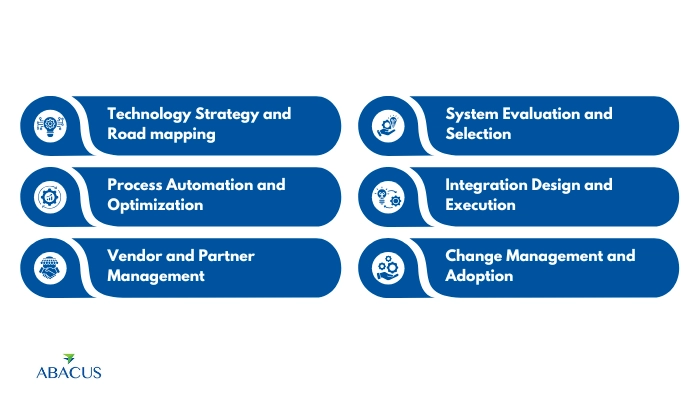
- Technology Strategy and Road mapping: TSPs work with leadership to identify desired technology objectives in relation to the business strategy. They plan roadmaps that build priorities, understand dependencies, and are realistic on timing.
- System Evaluation and Selection: With so many tools available for ERP systems, CRM platforms, helpdesk solutions, analytics stacks, a TSP evaluates options based on fit, scalability, integration capability, and total cost of ownership.
- Process Automation and Optimization: Task signaling programs (TSPs) remove repetitive work and bottlenecks, automating the tedious so workers can be more precise while doing more with less time.
- Integration Design and Execution: They build integrations for disparate systems to communicate with each other, free of data silos and full of consistency across customer touch points.
- Vendor and Partner Management: Tech solutions also tend to be third-party heavy. A TSP is responsible for the relationship with the vendor, SLAs negotiations, implementation of quality, and accountability.
- Change Management and Adoption: Even the best technology flops if people don’t use it. It is made sure of adoption through a TSP with training, documentation, and feedback loops.
It is through these responsibilities that a TSP ensures technology isn’t just an ante, rather, it’s a strategic advantage.
What Differentiates a TSP From Traditional IT Roles?
Many organizations already staff IT teams. So what sets a Technology Solutions Professional apart?
Legacy IT is the area where we have kept lights on, or data centers running, patched systems, supported desktops and repaired break fixes. These are critical activities, but they tend to be reactive.
A Technology Solutions Professional, on the other hand:
- Operates strategically, not reactively
- Aligns technology with business goals
- Leads don’t follow, but change the direction of cause rather than simply continue it.
- Hand-holds adoption and value, not just the uptime.
- Speaks in business not just tech perspectives.
Where IT ensures stability, a TSP ensures progress.
How a TSP Improves the Bottom Line?
There’s a misconception that strategic technology positions in businesses are “nice to have” or it only make sense for large organizations. And the toll is no less than quantifiable in actual dollars.
According to research by McKinsey & Company, technology transformations when led from the top deliver things like:
- 20–30% improvements in operational efficiency
- 10–15% increase in customer satisfaction
- 15–25% reduction in IT maintenance costs
- 20–40% acceleration in project delivery timelines
These numbers represent the chasm between using technology ad hoc and applying it with purpose in a matched way.
Real-World Example: Scaling Without Chaos
Now imagine a mid-sized US-based e-commerce business entering 3 new geographical markets at the same time. The company has no single technology strategy, so inventory won’t sync up on time, customers aren’t likely to get responses in a timely manner and your report analysis won’t match up across platforms either.
A TSP steps in and:
- Integrates the e-commerce store with stock control/tinyos.
- It offers omnichannel helpdesk solution.
- Automates order fulfillment notices and customer notification.
- Develops real-time dashboards for leadership to see trends.
Within months, support costs decline, delivery complaints decrease and customer satisfaction increases just because technology systems were designed to collaborate instead of operating in isolation.
Key Skills That Set a TSP Apart
The Technology Solutions Professional is a tech-savvy and business\ minded solution-planner. Here are some of the basic techniques:
- Systems architecture and integration
- Data strategy and analytics
- Cloud infrastructure and security
- Vendor evaluation and management
- Process automation (RPA, workflows)
- User experience design
- Project and change management
- Risk and compliance awareness
This diverse skill set enables a TSP to act as a bridge between technical teams, business units, leadership, and external partners.
Comparing Technology Roles in Organizations
Role | Primary Focus | Value Delivered |
IT Support | System maintenance and troubleshooting | System stability |
DevOps | Software deployment and environment management | Efficient delivery pipeline |
Data Analyst | Insights from data | Operational visibility |
Technology Solutions Professional | Align technology with business strategy | Integrated, scalable, value-driven solutions |
CIO/CTO | Overall tech vision and governance | Technology leadership and innovation |
The TSP, which is already set on its course to revolutionizing life cycles methods, has value in each of these positions, but it links the business challenge directly with measurable successful technological solutions.
Emerging Trends That Amplify the Need for TSPs
The pace of technological change has made the demand for strategic technology capabilities more pressing than ever:
Cloud Migration
Businesses are shifting from legacy architecture to cloud based platforms. A TSP ensures a streamlined migration process with no risk to the ongoing business.
AI and Automation
From chatbots to predictive analytics, AI is now a must-have. TSPs implement automated methodologies which reduce human work and error.
Omnichannel Customer Experience
Users engage with brands on web, mobile, chat and social. With this, TSPs develop uniform technology stacks which result to the realization of unified experiences.
Cybersecurity and Compliance
As the number of data breaches continue to grow, compliance and security equal strategic risk. And TSP embeds governance and risk management in every decision about tech.
Data-Driven Decision Making
Information is useful only when it is available, dependable and actionable. TSPs develop analytical platforms and dashboards which support real-time business decisions.
When Your Business Should Hire a Technology Solutions Professional
There are distinct inflection points where adding a TSP becomes a strategic decision:
- You are managing multiple disparate systems that don’t communicate
- Your technology spend is rising but efficiencies aren’t improving
- You’re expanding into new markets or customer segments
- Customer support, operations, or fulfillment systems underperform
- You’re planning a digital transformation initiative
- You lack clear visibility into operational data
If any of these situations are familiar, the cost of a Technology Solutions Professional is not an expense; it’s a competition investment.
Critical Roles of a TSP
- Evaluate business requirements and translate them into technical solutions
- Design integrations that eliminate data silos and synchronize systems
- Lead technology implementations with change management
- Monitor performance and optimize systems continuously
- Bridge communication between technical and business units
This highlights the core areas where TSPs deliver strategic value.
The Human Element: Change Management and Adoption
Adopting technology isn’t just about adopting tools; it’s about adopting people. A TSP is instrumental in helping teams adopt new systems and workflows. They build documentation, training patterns and feedback loops that make it easier for other internal teams to onboard themselves.
One of the biggest obstacles to digital transformation is resistance to change. Without someone leading both the technical and human elements, even the best solutions can backfire.
How Abacus Outsourcing Supports Strategic Tech Adoption
Many businesses find it difficult to hire a TSP as an in-house resource full-time, but there is another way: partnering with an outsourced provider.
Abacus Outsourcing provides tactical technology backing with operational prowess. From designing omnichannel customer support platforms to implementing automation and analytics, Abacus brings the expertise companies require without the headache of hiring and retention.
Whether you are looking for tactical expertise, complete project leadership or strategic IT planning, Abacus offers dependable, scalable and results-oriented solutions to match your business goals.
Conclusion: A TSP Turns Technology Into a Business Advantage
In today’s competitive and fast-paced digital economy, technology is no longer a cost center; it’s a differentiator. A Technology Solutions Professional helps businesses harness that technology in ways that are purposeful, scalable, and measurable. They provide strategic planning, execution excellence, and operational alignment that turn technical investments into business outcomes.
When your business is ready to transform, improve customer experience, and streamline internal operations, aligning with experts like Abacus Outsourcing ensures that you receive more than systems – you receive solutions. Technology is an asset, not a headache.
Fuel your Momentum with IT that’s on Purpose. Join the partnership with Abacus Outsourcing and make your technology work for the business.