



Proactive vs Reactive BPO Approaches: How They Affect Cost, Quality, and Customer Experience
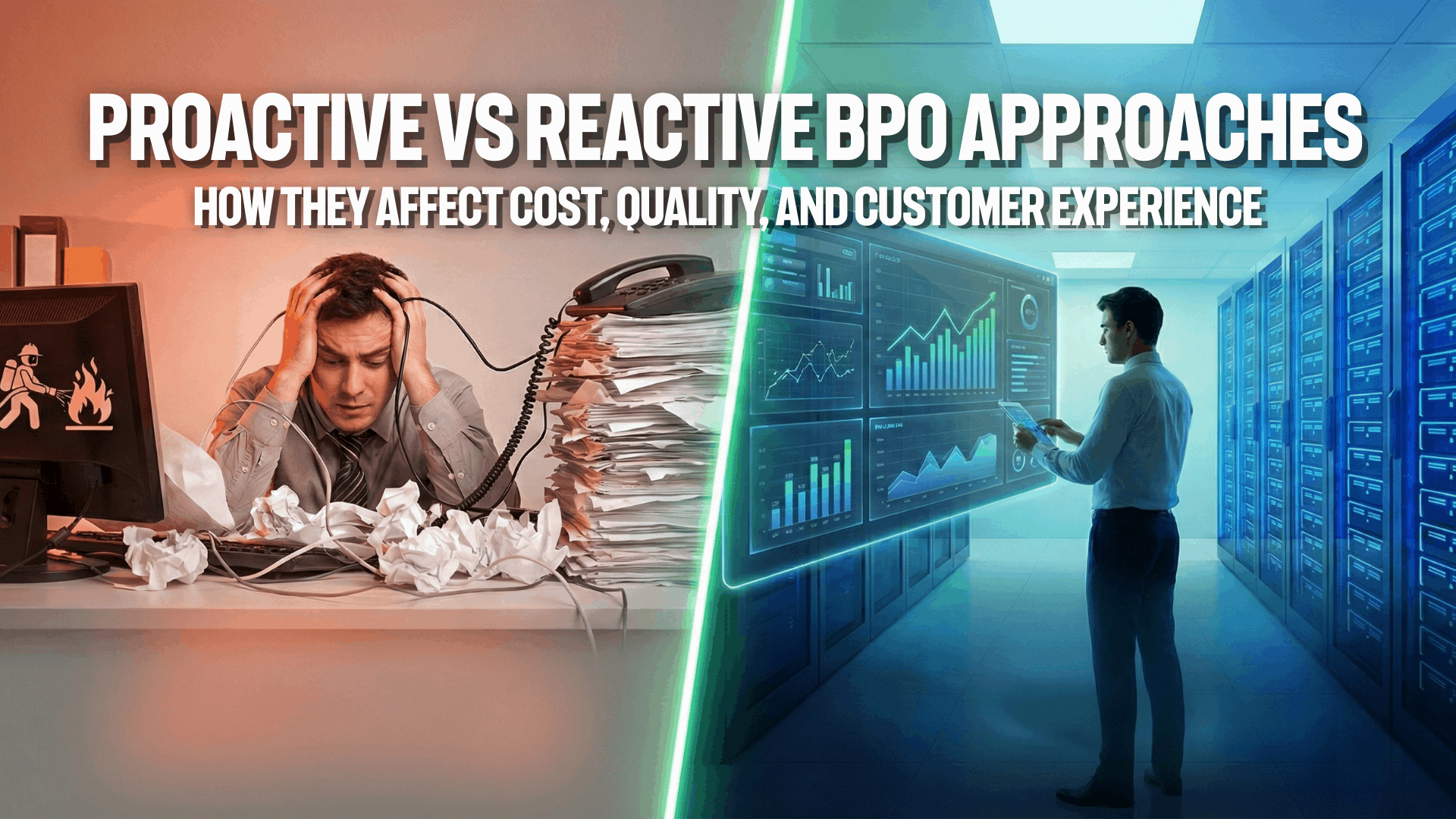
Monday morning in the contact center was going as usual. The phones started ringing, one after another, as they always did. This team, as opposed to the week’s prior, was calm, prepared, and confident. Aside from these much-desired numbers, managers scanned the weekend for trends and prepared agents, via proper briefing, in anticipation of many of the spikes in specific call types. The agent was already aware of this trend through the dashboard and answered immediately when the first caller asked a complicated billing question.
On the other side of town, a different center was feeling overwhelmed and unprepared. Agents were playing whack-a-mole with issues as they came in, scouring dusty playbooks for scraps of intelligence, and managers were battling blazes with no game-time strategy. The middle of the day found customer satisfaction low and overtime expensive.
The only crucial aspect that these two scenarios drive home is the eventual way of working BPO operations can adopt proactive vs reactive. While both serve as a means to an end and focus on achieving a business objective or positive outcome, their strategies yield drastically different results, particularly when it comes to cost, quality of service, and customer experience (CX).
In this in-depth analysis, we will examine the main traits of proactive vs reactive BPO methods, their influence on operational results, case studies, statistics, and the growing importance of moving towards becoming a more proactive manager in the current competitive environment of customer service.
What Does Proactive Mean in BPO?
The BPO foresees customer requirements, proactive identifies potential issues before they happen and reacts to insights rather than reacting. All of these features are powered through a combination of data analytics, performance modeling, ongoing training, and interlinked communication systems. Instead of inadequate responsiveness to tickets, calls or emails as they come in, proactive model predicts trends, automates preventative measures and weaves continuous improvement into the business as usual.
Like how healthcare as a field has become, instead of waiting until a patient comes in with an illness, proactive medicine encourages regular checkups, prevention, and early intervention as needed.
And What about Reactive?
A reactive style deals with problems as they arise. Escalation of customer complaints before any action is performed. When incidents come in, agents then respond and resolve. Once KPIs decrease, managers fix the issue.
It is a common belief that reactive management is easier – why waste time in predicting problems, if just to solve them as they happen? However, this simplicity comes with an invisible price tag: disgruntled customers, inefficient operations, overworked staff, and lost revenue.
We will explore three key dimensions where the performance of the two approaches – in-house and outsourcing, can be evaluated: cost, quality, and customer experience.
Cost Implications: Proactive vs Reactive
Outsource homes primarily due to cost control. In a reactive BPO model, unnecessary efforts escalate costs in the form of unplanned overtime and last-minute resource allocation, while a proactive approach focused on effective staff planning, promotes rework and escalation reduction.
Fewer Outsourcing Companies – Proactive Steps are Beneficial to Cost Savings According to the 2025 Global Outsourcing Survey Deloitte says that such companies benefits from 20−30% lower operations cost. Using predictive analytics, automation, and real-time dashboards, proactive systems allocate resources effectively, significantly reduce cost per contact, and increase overall operational efficiency.
To demonstrate this, consider a simple price comparison:
Aspect | Proactive BPO | Reactive BPO |
Staffing Efficiency | High forecast-based | Low demand-driven |
Overtime Costs | Minimized | Frequent |
Avoidable Contacts | Reduced through prevention | Higher due to repetitive issues |
Management Overhead | Focused on improvement | Focused on firefighting |
Cost avoidance is different: it isn’t just restricting travel; it is reallocation of tech-spend to strategic value instead of impulse patches.
Quality Outcomes: Beyond Speed and Accuracy
Quality is mostly a downstream concern when BPO teams equip themselves to respond only when things go wrong. Agents may know much about certain issues, but they repeatedly run into unsolved patterns without some powerful insight or learning loop. This leads to inconsistent service levels, elevated error rates, and increased variability of customer interactions.
In proactive environments, continuous training, knowledge base augmentations, and trend analysis-related escalation ensure that quality is not just a goal, but a priority. Proactive teams that avoid repeating the same billing question over and over again by updating documentation, sharing best practices, and seeking to avoid duplication of effort wherever possible make for more effective teams.
Think about coaching in the moment. In proactive environments, supervisors are observing interactions and providing immediate feedback that is corrective, addressing behaviors before small issues become large systemic issues. In a reactive setting, quality may be audited only after the fact — and after it is often too late to prevent recurrence.
A SQM Group study showed contact centers with proactive quality assurance strategies achieved first-call resolution (FCR) rates that were 10–15% higher than those with reactive programs. More, average FCR scores are directly related with increased overall service quality and decreased handling time (Source: SQM Group Contact Center Benchmarks 2024).
Institutional quality management leads to an orderly way of working; it improves precision which translates into a win-win situation for customers as well as agents.
Customer Experience: The Ultimate Differentiator
Modern customers demand more than just responses. They are accustomed to ease, time savings, accuracy, and personalization. Reactive BPO provides responses, however a lot of occasions, after the customer journey has been damaged.
Consumers can sense the difference between literal spoon-fed eyes glazed over scripted customer service vs. an agent who has insight into ownership/authority to solve the problem quickly. While a reactive call has an agent addressing an individual interaction, proactive BPO organizations serve customers in anticipation of needs – for instance by contacting customers before they face known issues, supplying relevant information, or delivering self-service tools to handle common queries without human intervention.
In fact, a survey conducted recently by Microsoft found that over half (57 percent) of customers have higher expectations for customer service than they did a year earlier, following their experience with customer relationship through digital platforms which offer better, faster, contextual and proactive interactions. [Image Source] Microsoft 2025 State of Global Customer Service Report
Proactive BPO operations understand context. They analyze the data, the problem types, and do the right thing for the customer before the customer asks for it.
That shift from reactive to proactive is what separates simply satisfying customers from delighting them.
The Role of Technology in Proactive BPO
One of the great enablers of proactive service is advanced technology. Using real-time analytics, AI-enabled forecasting, automated alerts, and intelligent routing empowers BPO players to predict demand, track trends, and optimize resource distribution.
In proactive organizations data is viewed as strategic commodity. Performance dashboards show what is trending, workforce management systems change schedules based on predictive call volume, and AI chatbots help solve basic queries before they reach a live agent. They allow human agents to focus on higher-value interactions, cutting cost and improving experience.
On the other hand, a reactive system usually does not have such tools or implements them reactively — in which case the insights come too late for them to affect the outcome.
The impact is confirmed by statistics: predictive analytics in customer engagement led to 32% higher customer retention rates and 27% lower operational costs for organizations compared to non-users (Source: McKinsey Analytics, State of AI in Business 2024).
Cool technology does not equal success, but with the right mentality, it can act as a driver for performance.
Team Culture: Proactive Thinking vs Reactive Habits
Whether a BPO can maintain a proactive business approach at all depends on culture. Because reactive centers are focused on time, they tend to create habits in which they are always running – fighting fires and responding to escalations with no real plan for the future, plugging one hole after another, addressing the outlier need, etc.
Data-driven decisions, ownership and continuous improvement is encouraged by proactive organizations. Both employees and supervisors can identify trends, provide suggestions for improvements and engage in root cause analysis.
This change in culture results in benefits that go beyond operations:
- Employees are more engaged as they are not just putting out fires.
- Teams cultivate problem-solving skills and become less reliant on supervision.
- Daily work turns into an act of constant learning.
Not surprisingly, a Gallup study found that companies that have engaged employees also a trait of proactive cultures had 21% higher profitability and 17% higher productivity (Source: Gallup State of the Global Workplace Report 2023).
In many instances culture is the unseen engine that drives proactively and success.
Where Reactive BPO Still Has Value
Recognizing that being reactive isn’t necessarily “bad.” As in the case of emergency rescue systems, reactive response becomes vital, as events are unpredictable, and calling for an immediate reaction.
For BPO, reactive frameworks work quite well for dealing with unanticipated surges or new problems that cannot be foreseen. They are simpler to implement and can help lay the groundwork for a more proactive model.
But, reactive on its own, isn’t enough to create competitive advantage in an era where customers, and the businesses who serve them, expect anticipation, personalization, and foresight in every interaction.
Practical Steps to Transition to a Proactive BPO Model
This transition from reactive engagement to proactive engagement cannot happen overnight, but there are many steps organizations can take:
- Implement Predictive Analysis: Leverage real-time dashboards and predictive forecasting to create an expectation of what a call volume will look like and what queries will be coming through.
- Invest in Workforce Management: Use demand forecasts to schedule agents, not solely historical averages.
- Improve KM: Keep documentation, scripts, and training up to date with recent trends.
- Enable your frontline staff to resolve problems without heavy escalations.
- Automate Whenever Applicable: For repetitive questions, consider using AI chatbots or setting up automated notifications.
These changes drive cost optimization, quality and customer experience improvement the three pillars of competitive advantage in customer engagement today.
Proactive vs Reactive: A Comparative Overview
The following table helps convey those differences visually.
Dimension | Proactive BPO | Reactive BPO |
Cost Structure | Lower operational costs through efficiency | Higher costs from overtime, escalations |
Quality Outcomes | Consistent, predictive, and aligned with goals | Varied, inconsistent |
CX Impact | Anticipatory, personalized, efficient | Responsive, but often after friction |
Technology Use | High — predictive analytics & automation | Low to moderate |
Culture | Continuous improvement, data-driven | Firefighting, urgent prioritization |
Real Business Benefits of a Proactive Approach
Proactive BPO results improve beyond customer service metrics for organizations. These include:
- Lower churn because of better service quality
- More predictable workloads mean fewer people leaving the company
- Improved Profitability via Cost Avoidance and Optimization
- Stronger strategic alignment across departments
These results reaffirm that proactive strategies are more than just operational improvements; they are a competitive advantage.
Conclusion: The Strategic Imperative of Being Proactive
However, in the current market, the common denominator here is a proactive BPO that tends to be a catalyst for cost, quality, and seamless customer experience.
Abacus Outsourcing is focused on enabling proactive customer engagement strategies, with quantifiable cost efficiency, quality, and CX. Our proactive frameworks utilize advanced analytics, workforce optimization, and continual improvement methodologies to enable organizations to achieve sustainable success in a competitive environment.
If you want to stop firefighting and start thriving, we are your go-to partner both in strategy and execution, starting with Abacus.