




Offshoring vs Outsourcing: How to Choose the Right Model for Your Business
Growth is rarely linear. One quarter you are managing a small, tight-knit team, and the next you are facing rising costs, customer demand across time zones, and internal teams stretched to their limits. At that moment, many business leaders start asking a crucial question: Should we offshore our operations, or should we outsource them?
While these two strategies are often used interchangeably, they are not synonymous. The cost of choosing a wrong model can be inefficient, concealed costs, and the complexity of management. The right one, however, is what will open the door to scalability, cost optimization, and ultimately ensure longevity in operations.
In this guide, we clarify offshoring vs outsourcing in practical terms to help you make an informed decision for your business today that drives your goals going forward.
Understanding the Core Difference Between Offshoring and Outsourcing
And at the core of the contention is one steadfast difference – ownership vs. partnership.
Offshoring refers to establishing branches of business operations in another country but being in full ownership and control of these branches. In other words, you hire employees, manage infrastructure, oversee compliance, and take on the performance risk. In essence, it’s an extension of your company just in geography.
In contrast, outsourcing refers to contracting out certain business processes to a third-party service provider. The provider already has the people, processes, technology and management systems. It allows you to be outcomeial and them execution oriented.
Both models can operate internationally. The real difference is not geography – but responsibility.

Why Businesses Turn to Global Delivery Models
Businesses these days have to run on a very competitive and cost-sensitive environment. Labor costs are increasing in developed markets, and customers want quicker responses, 24/7 availability, and an uninterrupted journey across channels.
Cost reduction still ranks as the top driver for organizations deciding to outsource, but agility and scalability are nearly as important, according to the Global Outsourcing Survey from Deloitte. In fact, the increasing offshoring, which has been especially noticeable in tech and development-heavy industries, has been the result of these same pressures.
The question is not IF you should go global, but HOW.
Offshoring Explained: Control, Commitment, and Complexity
Offshore locations are generally a more long-term strategic decision. Offshore companies usually desire to have the talent, workflows, and intellectual property in their direct control. This usually happens in industries where proprietary knowledge is the key or it needs to be highly integrated with internal teams.
Offshoring allows businesses to take advantage of cheaper labour markets, while still keeping standards and culture in a country where they hire.
But such fine-grained control adds complexity. Establishing offshore operations involves a high amount of initial investments, such as legal registration, office infrastructure, hiring, training, IT systems and local compliance.
According to a McKinsey report, firms without mature offshore governance structures suffer productivity losses up to 30% in the first year caused by coordination challenges and management overhead.
Outsourcing Explained: Speed, Expertise, and Flexibility
Designed For Speed And Flexibility → Outsourcing Rather than constructing teams from the ground up, companies harness an existing service provider with expertise in a specific function such as customer support, contact centers, finance, or back-office services.
This model enables organizations to scale up operations without having to significantly increase headcount or operational risk internally. They have trained staff, proven processes, and performance benchmarks that would take years to build on the inside.
Statista reports that the global outsourcing market rose above the $620B figure in 2024, largely fueled by the need for conserving resources, flexibility, and access to international talent.
Offshoring vs Outsourcing: A Detailed Comparison
Aspect | Offshoring | Outsourcing |
Ownership | Fully owned offshore team | Third-party service partner |
Setup Timeline | 6–12 months | 2–8 weeks |
Management Effort | High | Low |
Upfront Investment | Significant | Minimal |
Scalability | Slow to moderate | Rapid |
Risk Exposure | High | Shared |
Cost Predictability | Variable | Fixed or SLA-based |
This one comparison alone illustrates why many growing companies take the step of outsourcing when they want to grow, and the offshoring is only deemed viable by only those organizations which are more mature, stable and have more robust management at the foreign land.
Cost Considerations: Beyond Salary Savings
Cost is one of the biggest driving factors, but total cost of ownership is where the difference happens.
While there may be savings in terms of payroll costs while offshoring, it adds indirect costs such as HR management, attrition, legal compliance, office rent, IT security, and leadership travel etc. Such expenses are typically under accounted for in the planning stage.
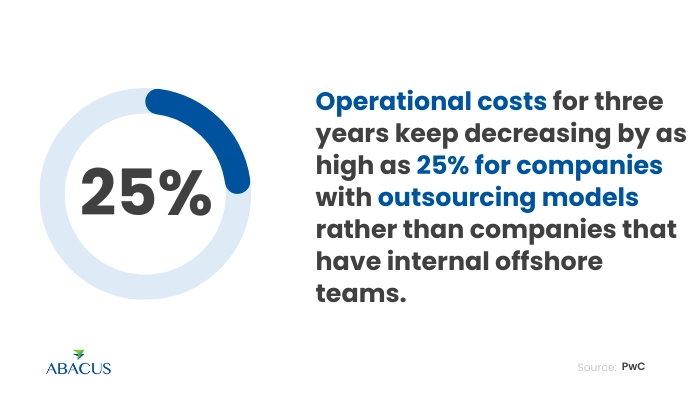
Outsourcing brings together all the costs above into a forecastable service fee. It enables finance teams to budget and anticipate expenditures without the shocks of recruitment, lead times or staff turnover.
Speed to Market: A Critical Advantage of Outsourcing
In the competitive markets we now find ourselves, getting to market quickly may be worth more than cost savings. Extended delays in launch come at the cost of revenue, customer trust, and market dominance.
Businesses can set the teams on site nearly overnight. Providers have trained staff, processes, and infrastructure in place to scale. It becomes even more importante for customer-facing operations where longer response times directly affect brand perception.
By contrast, offshoring takes months to prepare before you even get close to peak productivity.
Risk and Compliance: Who Carries the Burden?
Another differentiating factor is risk management.
Offshoring places the entire burden of regulatory structure, data privacy, employment laws, and security frameworks, in a foreign jurisdiction on the business. The organization pays for any failure.
Outsourcing distributes risk. Legitimate providers spend a lot on compliance, certifications, and security infrastructure. SLAs hold parties accountable, and performance metrics help add to the transparency.
The exposure to operational risk among organizations outsourcing mission-critical operations to established providers is reduced on average by 30–40 % when compared with in-house capabilities, according to ISG Research.
Use Case Scenarios: Which Model Fits Best?
Imagine a brand selling online that is experiencing rapid growth and is ready to expand internationally. But during promotions, customer queries increase and the bar for 24/7 support rises. Outsourcing customer support helps the company to scale up immediately, accommodate seasonality and ensure quality without overburdening the internal resources.
Now think back on a multinational software organization building proprietary platforms. Need for deep integration along with long term knowledge retention and also IP protection So that way offshoring development teams on the direct control will be the solution.
The Most Viable Approach is a Function of Business Maturity, Operational Priorities, and Risk Tolerance
When Outsourcing Is the Smarter Choice
For one, outsourcing is fantastic when a business needs scalability without permanent investment. It is commonly chosen for:
- Support to customers and the operations of the contact center
- Finance and accounting back-office functions
- Data processing and administrative services
These functions require a level of standardization, scalability, and provider expertise that is often best met through external provision.
Why More Businesses Partner with Abacus Outsourcing
Outsourcing does not mean losing control, but gaining a trusty partner. At Abacus Outsourcing we deliver efficient, growth-enabled Outsourcing solutions that accentuate performance and avoid any operational friction.
Abacus Outsourcing has the right infrastructure and experience with skillful teams to allow businesses to focus on strategy while operational excellence is handled by experts in best practices applicable for the industry.
Abacus means trust, reliability and transparency, regardless of the application – customer support, inbound contact centers or back-office operations; with measurable results.
Conclusion: Making the Right Choice for Sustainable Growth
Outsourcing and offshoring are both very useful, but they have different goals. Offshoring gives control but with complexity attached to it. Outsourcing provides rapidity, efficiency, and low risk via partnership.
For businesses with growth aspirations that want to leverage the agility, pre-fixed cost metrices, and stable operations that outsourcing provides, outsourcing to countries like India is most practical and scalable solution.
So, if you are ready to streamline operations, raise service quality standards and scale up with confidence, Abacus Outsourcing is at hand to assist you.
Join forces with Abacus – and create an operational obstacle into a strategic advantage.