On this page
- Upskilling call center agents for AI-era roles requires identifying skill gaps first
- Building training programs that stick: retention strategies for reskilled agents
- Measuring the ROI of agent upskilling investments across your contact center
- Restructuring workflows to match agent capabilities in an AI-enabled environment
- Frequently Asked Questions
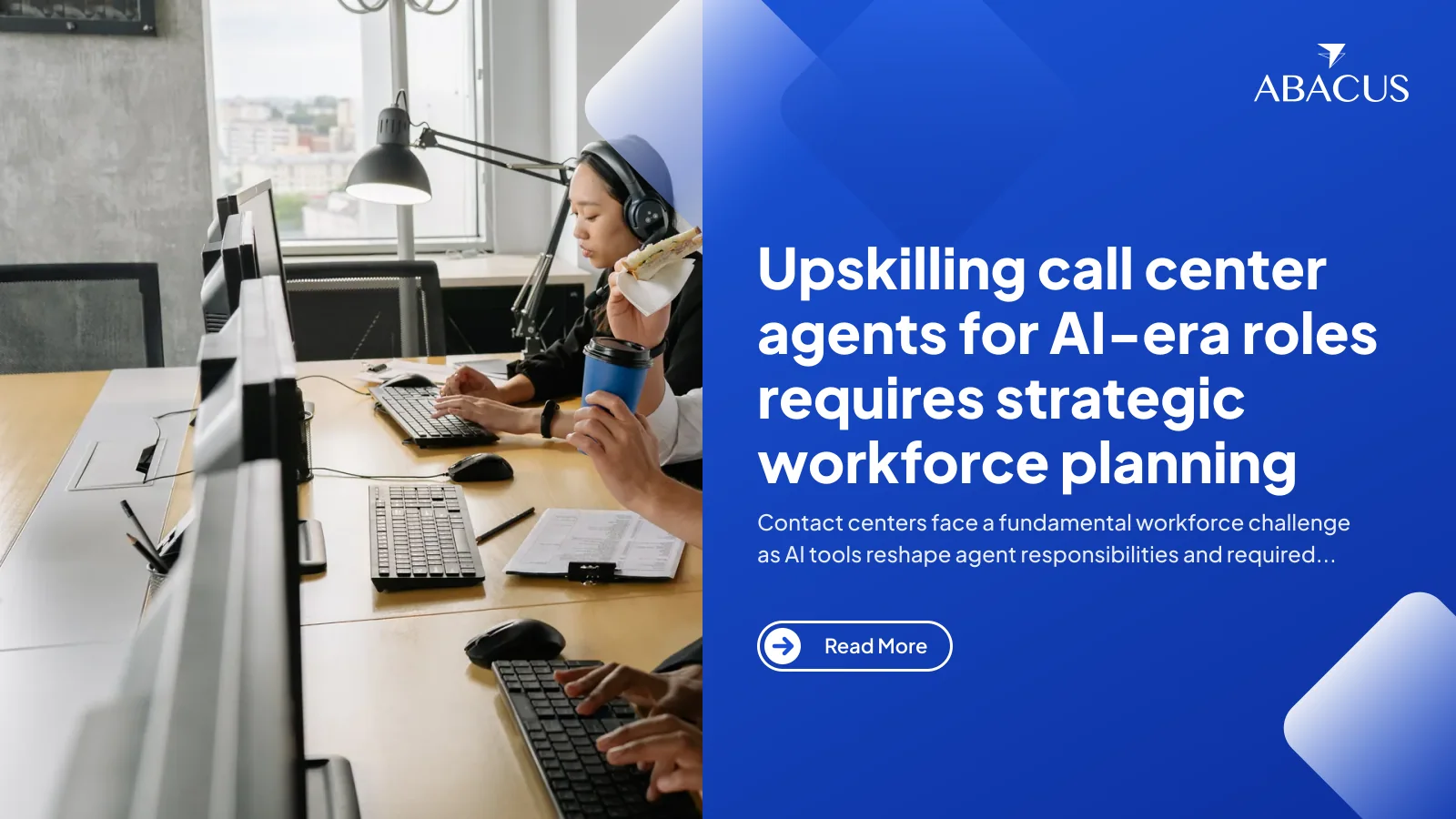
A contact center that deploys AI copilots without reskilling its agents is, in practical terms, handing a pilot a new aircraft and skipping the simulator. The tools change, but the instinct is to keep doing things the old way. The result is neither the efficiency leadership expected nor the customer experience agents are capable of delivering. AI is reshaping agent roles, not eliminating them, and that distinction has real consequences for how workforce planning is structured. Upskilling call center agents for AI-era roles is the operational challenge defining contact center leadership right now, and most programs underestimate its complexity.
Upskilling call center agents for AI-era roles requires identifying skill gaps first
Before any training budget is committed, operations leaders need a clear picture of the gap between what agents currently do and what AI-assisted work actually demands. That gap is almost always wider than initial estimates suggest.
Auditing current capabilities against AI-era requirements
A practical skills audit maps each agent against two distinct capability clusters. The first is technical: Can this agent read an AI-generated summary critically, spot a hallucination, and override a flawed recommendation? Can they navigate dynamic knowledge bases, annotate AI outputs, and flag model errors through the right channel? The second cluster is behavioural: emotional intelligence, critical thinking in ambiguous situations, and comfort working alongside automated systems rather than against them.
According to Execs In The Know, the skill set most in demand spans AI literacy, data fluency, emotional intelligence, and structured collaboration with AI tools, alongside entirely new roles such as conversation designer and AI operations manager. The audit should score agents against each of these dimensions, not just against legacy KPIs like average handle time.
Team leaders are the best first source of raw signal. Calibration sessions, call reviews, and side-by-side observations surface capability gaps that self-assessment surveys miss. The output should be a skills heat map: which agents are ready to move into AI-augmented roles now, which need targeted development, and which will require longer ramp periods or different role assignments.

Building training programs that stick: retention strategies for reskilled agents
The uncomfortable pattern in contact center upskilling is that the agents who complete a reskilling programme successfully become immediately more marketable, and without deliberate retention design, they leave. The training investment transfers to a competitor.
Why newly trained agents walk and what stops them
The causes are usually structural, not attitudinal. An agent who has just completed AI literacy training returns to a job title, a pay band, and a queue structure that still reflects the old role. The cognitive dissonance is significant: they now have skills the organisation is not using or rewarding. Role clarity is the first lever. Agents need a defined new title, a written description of changed responsibilities, and explicit acknowledgement that their role has evolved.
Career pathing is the second. ICMI's 2025 analysis notes that forward-thinking leaders now treat agents as competitive advantages rather than cost factors, which requires visible progression routes into senior agent, quality specialist, knowledge manager, or AI oversight roles. A programme that trains without a visible next step is a programme that produces attrition.
Compensation timing matters too. Delaying a pay review until a formal annual cycle, after an agent has demonstrably taken on more complex work, signals that the organization's commitment to their development is rhetorical. Consider a phased adjustment tied to demonstrated competency milestones rather than calendar anniversaries.
Agents who complete reskilling but return to unchanged queues and unchanged compensation are not retained by the training. They are retained only by inertia, and inertia has a short shelf life in a competitive hiring market.
Operational outcomes associated with AI-era workforce development, by focus area
| Focus Area | Operational Indicator | Source |
|---|---|---|
| AI literacy training | Agents able to critically review AI outputs and escalate errors | Execs In The Know |
| Knowledge management specialisation | 58% of CX leaders plan to move agents into this role as AI depends on governed information | CMSWire / Gartner, 2025 |
| Technology investment alongside talent | Over 50% of service orgs expected to double tech spend by 2028 without equivalent talent cuts | Klaviyo / Gartner, 2026 |
| Role redesign pace | Speed of upskilling and redeployment identified as primary AI-era workforce challenge | BCG, 2026 |
| Human-AI collaboration maturity | Partnerships expected to deepen as AI reaches deployment maturity across service channels | IBM |
Sources: Execs In The Know; CMSWire / Gartner 2025; Klaviyo / Gartner 2026; BCG 2026; IBM.
Measuring the ROI of agent upskilling investments across your contact center
Training completion rates are a process metric, not a performance metric. A centre where 90% of agents finished the AI literacy module but CSAT is flat and escalation rates are unchanged has not demonstrated ROI. It has demonstrated attendance.
Metrics that reveal real upskilling impact
The metrics that matter connect training to operational outcomes. First contact resolution on complex interaction types is the clearest signal: if reskilled agents are handling escalated contacts that previously required a supervisor, FCR on that tier should improve. Equally, track the volume of AI override events where an agent corrects or escalates an AI recommendation. A rising override rate in the first weeks after training is not a failure; it indicates agents are actively applying critical review rather than rubber-stamping AI output.
Quality scores from calibration sessions should be evaluated separately for AI-assisted and unassisted contacts. If quality holds on AI-assisted calls but drops on complex unassisted ones, the training addressed tool use without building the underlying judgement. That is a programme design problem, surfaced early enough to fix. Call center quality assurance frameworks need updating to include AI-collaboration behaviours alongside traditional evaluation criteria.
Attrition rate among upskilled agents, tracked separately from the general agent pool, tells you whether the retention design is working. If newly trained staff leave at a higher rate than untrained peers, the programme is producing talent for the broader market, not for the operation.

Restructuring workflows to match agent capabilities in an AI-enabled environment
Upskilling call center agents for AI-era roles fails operationally if the workflow they return to was designed for a pre-AI role. The training changes the agent. The workflow has to change too, or the capability sits idle.
Redesigning interaction routing and backend processes
A regional telehealth provider outsourced member support to handle prescription authorization queries during its annual benefits renewal window, when call volume spikes well beyond what its clinical staff can absorb. After reskilling, a cohort of roughly 40 agents became capable of reviewing AI-generated authorization summaries, catching missing documentation flagged by the model, and resolving member disputes that previously escalated to a nurse advisor. If the ACD routing logic still sends those contacts to the general queue, the reskilled agents spend their shifts on routine queries the AI could handle autonomously. The redesign work is routing logic, not just training content.
Backend process changes follow the same logic. If an agent is now responsible for annotating AI conversation summaries for quality governance, they need designated time in their schedule, a clear annotation standard, and a place in the QA workflow where that input is actually used. Squeezing it into the existing wrap-up time, without adjusting AHT targets, produces incomplete annotations and frustrated agents.
An internal knowledge base structured for AI-assisted retrievalis a prerequisite for agents in knowledge management roles: without clean, governed content, the AI outputs they are validating are unreliable from the start. Abacus BPO, which has operated contact centre and back-office programmes since 2008 and holds ISO 27001, ISO 27701, and ISO 18295-1 certifications, treats knowledge architecture as a parallel workstream to agent reskilling rather than an afterthought.
Phasing the workflow transition
- Pilot the redesigned routing with a single reskilled cohort before full deployment.
- Set revised AHT and occupancy targets that reflect the new complexity mix, not historical baselines.
- Build a feedback loop where agents report workflow friction weekly during the first quarter.
- Align supervisor coaching cadences with the new role expectations, not legacy scorecards.
Frequently Asked Questions
What skills should call center agents develop for AI-era roles?
Agents need AI literacy, meaning the ability to critically review and correct AI outputs, alongside data fluency, emotional intelligence, and structured critical thinking. Technical skills like navigating dynamic knowledge bases and flagging model errors are equally important. Soft skills remain central because AI handles routine transactions, leaving agents to manage complex, emotionally loaded interactions.
How do contact centers measure the success of upskilling call center agents for AI-era roles?
Completion rates alone are insufficient. Effective measurement tracks first contact resolution on complex interaction types, AI override rates, quality scores on AI-assisted versus unassisted contacts, and attrition among trained agents. These metrics connect training investment to real operational performance rather than just programme participation.
Why do agents leave after completing reskilling programmes?
Agents who finish upskilling become more marketable, and if their job title, pay band, and daily work remain unchanged, they leave for roles that reflect their new capabilities. Retention requires defined new role titles, visible career pathways, and compensation adjustments tied to demonstrated competency milestones rather than annual review cycles.
How should workflows be restructured when agents are upskilled for AI-era roles?
Routing logic, AHT targets, occupancy expectations, and QA frameworks all need revision to match reskilled agents to the interaction types they are now equipped to handle. Without workflow redesign, newly trained agents default to routine work the AI could manage autonomously, which wastes the upskilling investment.
What new roles are emerging in AI-era contact centers?
Knowledge management specialist, conversation designer, AI operations manager, and governance lead are among the roles contact centers are building as AI deployment matures. These positions require agents to move from transaction handling toward oversight, content governance, and human-AI collaboration management.