On this page
- Will AI Replace Call Center Agents?
- The Short Answer: No, But the Job Is Changing
- What AI Can Actually Do in a Call Center Today
- Where Human Agents Still Win
- AI vs. Human Agents: A Side-by-Side Comparison
- The Data: How Fast Is Adoption Actually Moving?
- The Hybrid Model: How Abacus BPO Approaches AI and Human Agents
- What This Means If You're Choosing a BPO Partner
- Main Question: Will AI Replace Call Center Agents?
Will AI Replace Call Center Agents?
Every few months, a new AI voice demo goes viral, and the same question resurfaces in boardrooms and comment sections alike: will AI replace call center agents?
The short answer, backed by 2026 industry data, is no -but the job is changing faster than almost any other role in the BPO industry. AI is already handling a large share of routine, repetitive interactions. Human agents are being pushed toward calls that actually require judgment, empathy, and accountability.
AtAbacus BPO, we sit at the intersection of this shift every day - deploying AI tools inside live contact center operations while still staffing and training human agents for the clients who need them most. This article breaks down what the data actually says, not what a vendor demo wants you to believe.
The Short Answer: No, But the Job Is Changing
Most credible research firms agree on one point: full replacement isn't happening, but partial automation already is. Gartner projects that even by 2027, only around 14% ofcustomer interactions will be handled entirely by AI without any human involvement. At the same time, Gartner also estimates that conversational AI could reduce global contact center labor costs by roughly $80 billion in 2026 -largely by absorbing the high-volume, low-complexity work that used to eat up agent hours.
That combination -low full-automation numbers alongside high cost-savings numbers -tells the real story. AI isn't closing floors of agents. It's closing the simplest tickets before they ever reach one.
What AI Can Actually Do in a Call Center Today
Modern AI voice and chat agents are genuinely good at a specific category of work: high-volume, predictable, low-emotional-stakes interactions. Industry estimates suggest 60–70% ofinbound calls follow structured, repeatable patterns -the kind AI can resolve without a human ever joining the conversation.
Typical AI-handled tasks in 2026 include:
- Password resets and account verification
- Order status checks and delivery updates
- Appointment scheduling and confirmations
- Basic billing questions and balance inquiries
- Call routing and intent detection before handoff
- After-call summaries and CRM data entry
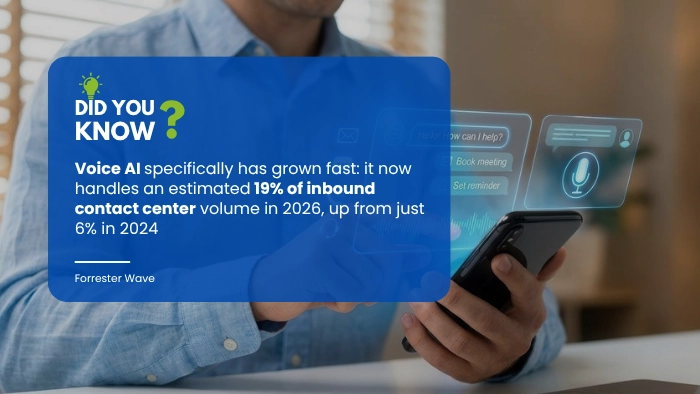
Voice AI specifically has grown fast: it now handles an estimated 19% of inbound contact center volume in 2026, up from just 6% in 2024, according to Forrester Wave research -with banking and telecom adopting it fastest.
Where Human Agents Still Win
AI is confident, but it isn't wise. It struggles with the calls that don't follow a script: a customer who's angry about being billed twice for a service that failed, a healthcare question that needs judgment about tone and timing, a long-time client who wants to feel heard before they'll accept a solution.
This is why, even with heavy AI investment, 79% of Americans still say they strongly prefer speaking with a human over an AI agent for customer service, according to a SurveyMonkey study. The same research found 84% of respondents believe human reps are more accurate for anything outside a simple lookup.
Human agents remain essential for:
- Emotionally charged or high-stakes complaints
- Multi-system troubleshooting that doesn't fit a flowchart
- Retention conversations and relationship-driven accounts
- Regulatory, compliance, or legally sensitive interactions
- Judgment calls -when to bend a policy, escalate, or simply listen
AI vs. Human Agents: A Side-by-Side Comparison
| Factor | AI Agents | Human Agents |
|---|---|---|
| Best suited for | Routine, high-volume, predictable queries | Complex, emotional, or ambiguous issues |
| Availability | 24/7, no staffing gaps | Limited by shift coverage |
| Consistency | Identical quality on every call | Varies with fatigue, mood, experience |
| Empathy & judgment | Limited; can detect tone but not act on nuance | Strong; can adapt in real time |
| Cost per interaction | Low, scales cheaply | Higher, but adds relationship value |
| Handling of edge cases | Weak; escalates or fails silently | Strong; improvises and problem-solves |
| Customer trust (per SurveyMonkey) | 21% prefer AI first | 79% prefer human first |
| Ideal role in 2026 BPO model | First-line triage, deflection, data capture | Escalations, retention, complex resolution |
The Data: How Fast Is Adoption Actually Moving?
It's easy to find hype on both sides of this debate, so here's what multiple independent sources report for 2026:
| Metric | Figure | Source |
|---|---|---|
| Contact centers using some form of AI | 88% | IBM research |
| Contact centers with AI fully integrated into daily operations | 25% | IBM research |
| Global call center AI market size (2026) | ~$4.89 billion | Precedence Research |
| Projected labor cost reduction from conversational AI (2026) | ~$80 billion globally | Gartner |
| Share of interactions AI will fully own without humans (2027 est.) | ~14% | Gartner |
| Agentic AI resolving common issues autonomously (2029 est.) | ~80%, with 30% cost reduction | Gartner |
| Service leaders who say AI improves agent productivity | 70% | Salesforce, 2024 State of Service |
| Voice AI share of inbound call volume (2026 vs. 2024) | 19% vs. 6% | Forrester Wave research |
| Average annual call center agent turnover | 40–45% | Insignia Resources |
| Cost to replace one agent (direct + lost productivity) | $10,000–$46,000 | Insignia Resources |
Two numbers from that table matter most for any business owner reading this: 88% adoption but only 25% full integration. Most companies have already bought AI tools. Very few have actually rebuilt their workflows around them. That gap is where most AI call center projects quietly fail -not because the technology doesn't work, but because it was bolted onto an old process instead of designed into a new one.
The Hybrid Model: How Abacus BPO Approaches AI and Human Agents
Rather than choosing a side in the "AI vs. agents" debate, Abacus BPO builds hybrid operations designed around where each one is actually strongest:
- AI handles first contact -routing, verification, and simple queries -so customers get instant responses without hold times.
- Agent-assist tools support live agents -surfacing account context, suggested responses, and sentiment cues in real time, which Salesforce data links to measurable productivity gains.
- Escalation is seamless, not a dead end -when AI detects frustration, complexity, or a compliance-sensitive topic, the handoff to a trained human agent happens with full context, not a cold transfer.
- Human agents are upskilled, not phased out -turnover already costs the industry tens of thousands of dollars per agent; we use AI to reduce burnout on repetitive work, not to justify headcount cuts.
This mirrors what the data recommends: businesses using a genuine human-in-the-loop model consistently report faster resolution times and stronger customer satisfaction than either AI-only or fully manual setups.
What This Means If You're Choosing a BPO Partner
If a vendor promises a fully autonomous, agent-free call center today, treat that as a red flag rather than a selling point -the research doesn't support it, and your customers likely don't want it either. The more useful question to ask a potential BPO partnerisn't "do you use AI?" It's:
- Which specific call types do you automate, and which do you route to humans?
- How do you measure escalation quality, not just deflection rate?
- What happens to agent training and career paths as AI takes over routine tasks?
- Can you show real CSAT and first-contact-resolution data from your current hybrid deployments?
A partner who can answer those concretely -rather than with a generic AI pitch -is the one actually running a mature operation.
Main Question: Will AI Replace Call Center Agents?
AI will not replace call center agents in any complete sense not in 2026, and not for the foreseeable future. What it will do is absorb the repetitive, low-value work that burns out agents and frustrates customers, freeing human teams to focus on the interactions that actually determine whether a customer stays or churns.
For businesses evaluating outsourcing partners, the real differentiator isn't whether a BPO uses AI. It's whether they've built a genuine hybrid workflow one where AI and human agents each do the part of the job they're actually good at.