On this page
- Remote vs hybrid call center workforce management 2026: Retention outcomes diverge by deployment model
- Scheduling complexity and agent availability when teams span multiple locations
- Onboarding and skill development pathways for remote and hybrid agents
- Infrastructure costs and technology requirements for each deployment strategy
- Frequently Asked Questions
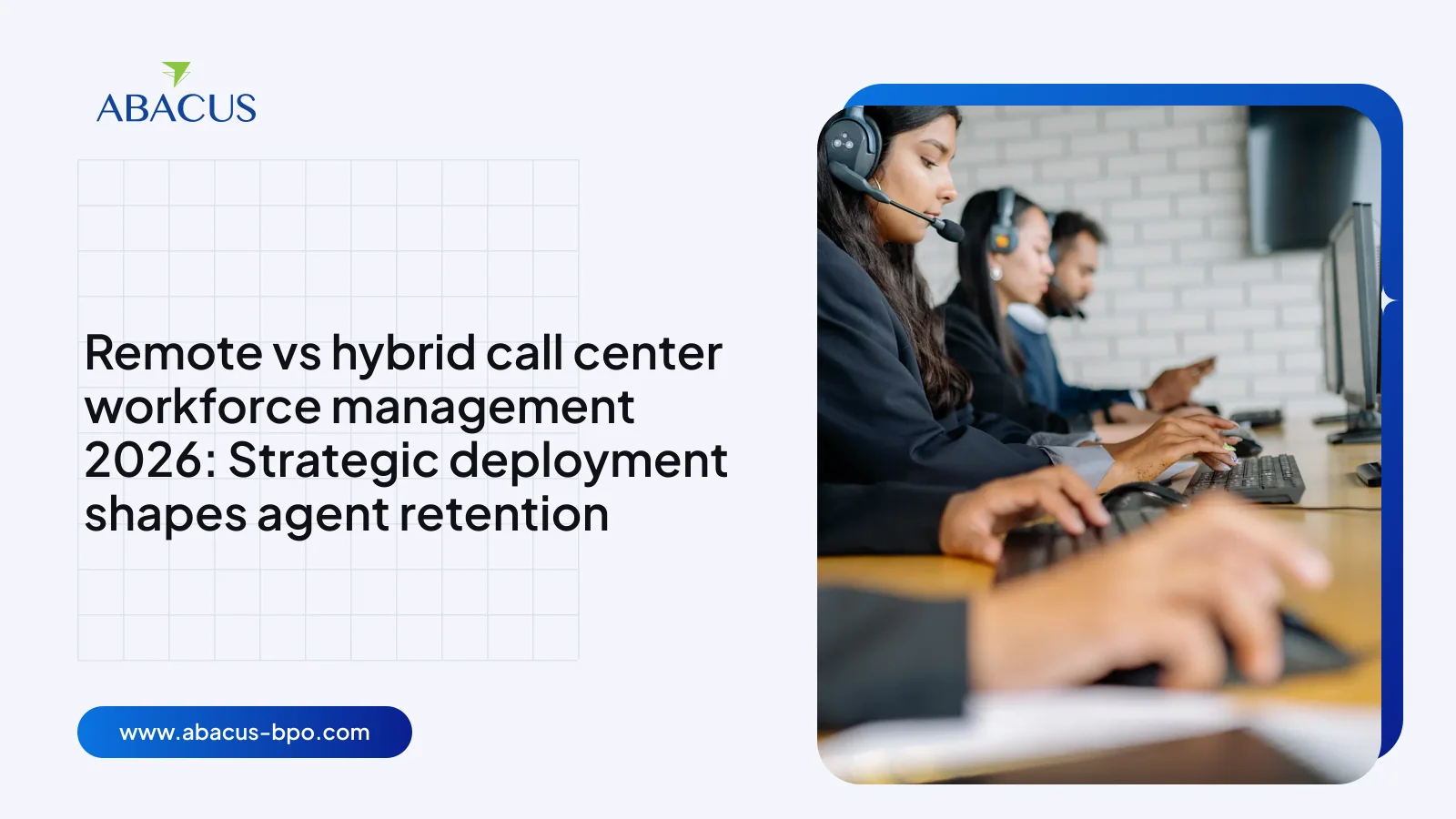
Workforce leaders who expected the remote-versus-hybrid debate to settle down by now are finding it more consequential than ever. Turnover in contact centres has always been a structural problem, but the deployment model, fully remote, hybrid, or on-site, is increasingly the variable that determines whether a programme retains agents past the twelve-month mark. The decisions made in 2025 and early 2026 around remote vs hybrid call center workforce management 2026 are already producing measurable divergence in attrition numbers, schedule adherence rates, and quality outcomes. Getting those decisions right requires an honest look at what each model actually demands operationally, not just what it promises in a job posting.
Remote vs hybrid call center workforce management 2026: Retention outcomes diverge by deployment model
Agent attrition in contact centres has always run higher than in most industries, but the 2026 labour market has introduced a sharper split between models. Gallup's May 2026 data show that 52% of remote-capable employees are working hybrid and 26% are fully remote, with only 22% on-site full time, and the expectations for long-term arrangements mirror those current numbers almost exactly. That stability matters for contact centres: agents who believe their arrangement is durable are less likely to job-hunt.
Why hybrid programmes tend to anchor longer tenure
Hybrid models give agents scheduled social contact without eliminating the flexibility that pulls talent away from on-site roles. Peer relationships built during in-office days create informal accountability that remote-only agents lack, and that informal accountability correlates with lower voluntary attrition. The catch is that poorly structured hybrid schedules, where in-office days feel arbitrary rather than purposeful, produce the same disengagement as fully remote isolation.
Fully remote programmes, by contrast, attract a segment of the workforce that will refuse hybrid arrangements outright. For programmes in geographies with shallow local labour pools, that access to a national candidate base can lower vacancy rates even if it does not reduce per-agent turnover. The trade-off is real: broader reach, but less organic team cohesion to slow exits once an agent starts looking elsewhere.
Retention is not just about flexibility: it is about predictability. An agent who knows exactly which days are in-office and why makes a different long-term commitment than one who waits for a policy change every quarter.

Scheduling complexity and agent availability when teams span multiple locations
Scheduling a 200-seat blended programme where 80 agents are remote across three time zones, and 120 are hybrid across two sites is categorically more complex than scheduling the same headcount in a single building. Real-time attendance tracking, which was once a supervisor walking the floor, now requires integration between the WFM platform, the ACD, and a presence-monitoring layer that flags when a remote agent's status goes dark mid-shift.
Shift coverage gaps specific to distributed models
- Remote agents in Pacific time covering early Eastern queues face fatigue-driven shrinkage that does not show up until a pattern analysis spans six or more weeks.
- Hybrid agents who commute on in-office days have higher late-arrival rates on those days than on their remote days, creating predictable but often unplanned coverage dips in the first interval of the shift.
- Voluntary time-off requests cluster on mandatory in-office days in hybrid schedules, a pattern that erodes the collaboration benefit the model was built to deliver.
- Emergency coverage in a remote model depends entirely on agents with reliable home connectivity accepting overtime, which is a smaller pool than it appears on a roster.
The operational answer is not to over-staff but to build schedule templates that account for model-specific shrinkage drivers separately. A workforce planner treating remote shrinkage and hybrid shrinkage as a single number will consistently mis-forecast intervals. For a deeper look at how modern tools handle this split, the breakdown of call center workforce management software capabilities covers the forecasting and intraday features that matter most.
Operational characteristics of remote, hybrid and on-site deployment models in 2026 contact centres
| Dimension | Fully Remote | Hybrid | On-Site | Source |
|---|---|---|---|---|
| Workforce share (remote-capable employees) | 26% | 52% | 22% | Gallup, 2026 |
| Burnout risk profile | Higher isolation-driven burnout | Lower burnout, social contact maintained | Commute-driven fatigue | YAROOMS, 2026 |
| Talent pool breadth | National or global | Regional commute radius | Local only | YAROOMS, 2026 |
| Schedule adherence monitoring | Requires dedicated digital presence tools | Mixed: floor visibility plus digital tools | Floor-based supervision | HiveDesk, 2026 |
| Facility overhead | Minimal | Reduced but not eliminated | Full | YAROOMS, 2026 |
Source: Gallup 2026, YAROOMS 2026, HiveDesk 2026.
Onboarding and skill development pathways for remote and hybrid agents
Time-to-productivity is the metric that exposes a deployment model's onboarding weaknesses faster than any other. A realistic ramp period for a new inbound customer service agent in a well-run on-site centre runs four to six weeks to independent handling at acceptable quality. Remote onboarding, done well, can match that timeline, but it requires deliberate design, not just a recorded training library and a Slack channel.
The mentorship gap in fully remote cohorts
In a co-located or hybrid environment, a new hire absorbs a significant volume of tacit knowledge by proximity: overhearing how a senior agent de-escalates a caller, watching a team leader pull up a screen to demonstrate a workaround, catching a quick correction before a bad habit sets in. None of that happens automatically in a remote model. Programmes that do not replace it with structured nesting sessions, scheduled side-by-side monitoring via screen-share, and a named buddy who is accountable for the new hire's first thirty days will see quality scores that lag on-site cohorts for months.
Hybrid arrangements occupy a middle ground that most programmes underuse. Scheduling new hires for more in-office days during their first six to eight weeks, then transitioning to a standard hybrid pattern, concentrates the mentorship benefit where it matters most without committing the programme to permanent full on-site density. Remote workforce management frameworks that build this phased transition in from the start consistently produce shorter ramp times than either fully remote or rigid hybrid schedules applied uniformly from day one.

Infrastructure costs and technology requirements for each deployment strategy
The infrastructure comparison between remote and hybrid is not simply facility lease versus home-office stipend. Both models carry ongoing technology obligations that grow with headcount, and the failure modes differ in ways that affect SLA reliability. HiveDesk's 2026 benchmarking data on contact centre operations notes that network monitoring and endpoint security are the two technology layers most frequently underfunded in remote deployments, with outages traced to residential ISP failures and unpatched home devices accounting for a disproportionate share of unplanned agent downtime.
Remote-specific technology requirements
- A minimum-spec home office policy covering headset, monitor, connectivity speed and backup connection, with a stipend or equipment loan programme to enforce it consistently.
- Endpoint detection and response (EDR) software on every agent device, managed centrally, not self-installed.
- A dedicated network monitoring layer that flags residential ISP degradation before the agent's AHT spikes or calls begin dropping.
- Virtual desktop infrastructure (VDI) or a zero-trust access architecture to meet data handling requirements, particularly relevant for programmes under HIPAA or PCI-DSS scope.
Hybrid-specific infrastructure considerations
Hybrid models still carry facility costs: hot-desking infrastructure, shared headset hygiene protocols, locker systems for personal equipment, and conference room capacity for team days. The technology complexity shifts to identity management, because agents authenticate from both corporate and residential networks on different days, and to ensuring that the contact centre platform delivers a consistent experience regardless of access point.
Abacus BPO, which has operated contact centre and back-office programmes since 2008 and holds ISO 27001, ISO 27701 and ISO 18295-1 certifications, has found that the security architecture decision is often made too late in the deployment planning process, after an incident rather than before. Building the security layer into the initial deployment model selection, rather than retrofitting it, reduces both the technical debt and the compliance exposure that accumulates over the first year of a distributed programme. Operations leaders evaluating the full picture should also weigh where call center management is heading as workforce models continue to evolve through 2026 and beyond.
Frequently Asked Questions
What is the main difference between remote and hybrid call center workforce management in 2026?
Remote workforce management covers agents who work entirely from home and requires digital-first scheduling, monitoring and mentorship tools to replace the oversight that floor proximity provides. Hybrid management blends in-office and home-working days, which reduces isolation-driven attrition but adds scheduling complexity around commute patterns and voluntary time-off clustering on in-office days. The operational toolset overlaps significantly, but the failure modes and the people-management intensity differ by model.
Which deployment model has lower agent attrition: remote or hybrid?
Hybrid arrangements generally produce stronger retention among agents who value flexibility but also benefit from structured social contact with peers and team leaders. Fully remote programmes attract a distinct talent segment that will not accept hybrid terms, which can lower vacancy rates in thin local labour markets even if per-agent turnover is comparable. The quality of the model's execution matters more than the label: a poorly structured hybrid schedule can produce the same disengagement as a neglected remote programme.
How does remote vs hybrid call center workforce management 2026 affect onboarding time?
Remote onboarding can match on-site ramp times when nesting sessions, structured buddy programmes and scheduled screen-share coaching replace the tacit knowledge transfer that happens naturally on a contact centre floor. Without those deliberate substitutes, remote cohorts typically show quality scores lagging on-site peers for the first two to three months. Hybrid programmes that schedule new hires for heavier in-office days during the first six to eight weeks often achieve the shortest ramp times of any model.
What technology is essential for managing a remote call center workforce in 2026?
The minimum stack includes endpoint detection and response software managed centrally, a network monitoring layer that flags residential ISP degradation in real time, and either virtual desktop infrastructure or a zero-trust access architecture for data security compliance. Home office minimum-spec policies covering headset, connectivity speed and backup access are also operational requirements, not optional perks. Programmes under HIPAA or PCI-DSS scope need these in place before the first agent goes live, not as a retrofit.
Can a contact centre run a mixed model with some fully remote and some hybrid agents on the same programme?
Yes, and many larger programmes do, but it requires the WFM platform to track shrinkage drivers separately for each cohort rather than blending them into a single shrinkage figure. Mixed models also require equitable scheduling policies that prevent remote agents from absorbing a disproportionate share of undesirable shifts because they lack the visibility that in-office agents have with team leaders. Clear, written policies on how hybrid in-office days are assigned and how overtime is offered across both cohorts are the practical starting point.