



How to Choose the Right Employee Experience Platform for Your Business
Imagine walking into an office where employees feel heard, supported, and equipped with the tools they need to succeed. In an era of fierce competition, companies are becoming cognizant of the fact that employee happiness is directly linked to productivity, retention, and customer satisfaction. Discovering this directed the quick reception of the employee experience platform.
This is why modern day businesses are investing in digital employee experience platforms which unify communication, engagement and provide employees with a seamless access to workplace tools. But, nowadays, as there are too many employee experience platforms in the market, it becomes tricky to find the right solution.
This guide delves into how organizations can define employee experience and identify the right employee experience management platform that can aid in driving long-term growth and productivity.
What Is Employee Experience?
Before choosing the right technology, it is important to understand what employee experience is.
Employee experience is the entire journey and experience an employee has with an organization starting from hiring-right from recruitment, onboarding, working, development, and the culture of the entire workplace.
Employees need to feel engaged and motivated to work their best, and it requires a strong employee experience program. This experience is getting mediated more and more by the use of technology, employee experience software, and digital employee experience solutions.
What Is an Employee Experience Platform?
An employee experience platform is a digital solution – one that enhances the way employees interact with systems, resources, and communication channels.
These platforms combine various tools of HR services, communication portals, feedback systems, productivity tools, etc. and give them as a single employee platform that simplifies the workspace.
Today, modern digital employee experience platforms typically contain the following capabilities:
- Employee engagement surveys
- Internal communication tools
- Performance management systems
- Learning and development modules
- Collaboration and workflow integrations
Overall, employee experience management software harnesses these capabilities to deliver the connected, productive workplace experience that organizations want.
Why Employee Experience Platforms Matter
The changing nature of the workplace itself, particularly with the advent of hybrid and remote work. Managing modern workforce expectations cannot be handled by traditional HR systems present alone anymore.
By utilizing a comprehensive workplace experience platform, organizations will benefit by fostering a more cohesive and productive workplace.
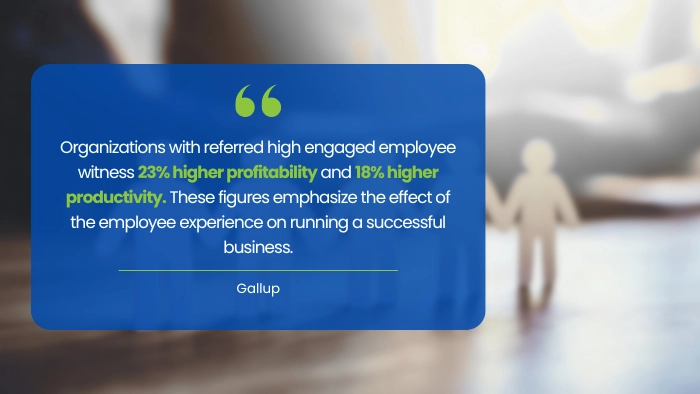
According to the research conducted by Deloitte, the organizations that give importance to their employee experience are 4 times more profitable and 2 times more innovating than organizations that do not focus on employee experience (read more).
In addition, 47% of HR leaders report that employee experience is a number one priority in their organizations, Gartner said.
As this kind of data shows, investing in employee experience solutions has gone from being a luxury to a strategic necessity.
Key Features to Look for in an Employee Experience Platform
The employee experience management platform businesses use needs to be able to be both employee and management-friendly, which means organizations must pay close attention to various features while evaluating different platforms.
1: Integrated Digital Workplace Tools
A good digital employee experience software should overlap several systems into a single platform. One interface of access for employees where they can connect with the HR services, communication channels, and productivity tools.
Such integration helps in working efficiently, and it minimizes switching between different disconnected systems.
2: Employee Feedback and Engagement Tools
However, one thing remains clear: For workplace culture to grow, the employers must get inside the minds of the employees to understand their actual sentiments. Employee experience tools are effective in the form of feedback like surveys, pulse, and sentiment analysis.
With these tools, organizations can track their engagement and nip any challenges in the bud and prevent them from degenerating into bigger challenges.
Qualtrics says that for those companies who measure employee experience, employee retention improves by twenty-five per cent.
3: Strong Analytics and Reporting Capabilities
For managing digital employee experience as a business function, data-driven insights are a must. An employee experience platform should be able to provide advanced analytics and reports on employee engagement, productivity, and satisfaction.
These insights are useful for HR teams to make decisions on workplace policies, training programs, and improvements to the organization.
4: Personalization and Employee Journey Mapping
Each employee has a unique relationship with the workplace. Use of advanced employee experience solutions enables organizations to provide personalized employee journey with tailored content, learning opportunities, and communication channels.
Personalization is also a way to create an engaging and meaningful workplace experience.
5: Scalability and Integration with Existing Systems
And if an organization grows, it should opt for an employee experience management service aimed to grow with the business. The platform should have integration ability with both the existing HR systems as well as CRM platforms and collaboration tools too.
This feature makes sure that as the business grows, the technology will support them.

Comparing Employee Experience Platforms
As a result, organizations must compare several metrics when evaluating the various employee experience platforms and solutions available.
Feature | Basic Employee Platform | Advanced Employee Experience Platform |
Communication Tools | Limited | Integrated communication channels |
Employee Feedback | Basic surveys | Real-time sentiment analysis |
Analytics | Minimal reporting | Advanced workforce analytics |
Integrations | Few integrations | Extensive system integrations |
Employee Journey Tracking | Not available | Full employee lifecycle management |
The approach is so comprehensive that we don’t just compare the employee digital experience platform, we compare workforce engagement platform as well.
Common Challenges When Implementing Employee Experience Platforms
Although employee experience software brings several advantages, organizations frequently struggle with implementation.
Resistance to change is one of the most common challenges. New tools, especially if unfamiliar or too complex, might see reluctance from employees in using them. Companies can combat this by offering training and clarity on what the platform brings to the table.
Integrating tools with existing systems is another great challenge. Organizations need to ensure that experience platform integrates well with HR systems, collaboration tools and internal workflows.
Adoption is the result of proper planning with involvement from stakeholders.
Example: Improving Workplace Experience Through Technology
Suppose you have a company with high employee turnover, low employee engagement, etc. The organization uses digital employee experience platform and integrate communications tools, employee feedback surveys, and performance management systems.
Within months, the company is learning what their employees are concerned about and improves their onboarding programs and internal communication channels.
This, in turn, enhances employee engagement, increases productivity and reduces turnover rates. This is just one of the many examples that showcase the ability of the existing capabilities of digital employee experience solutions to drive workplace culture.
The Future of Employee Digital Experience
HCM tools are becoming increasingly employee-friendly, paving the way for a seamless workplace experience through high-tech solutions — in the workplace of the future. Innovative technologies like AI, automation, and predictive analysis are being used in employee experience platforms.
These technologies allow organizations to predict employee needs, automate redundant tasks, and provide tailored workplace experiences.
The work environment is undergoing rapid transformation, as a result businesses that implement a solid digital employee experience management strategy will find it easier to attract the best and brightest talent while keeping employee productivity high.
Conclusion: Choosing the Right Platform for Long-Term Success
Choosing an employee experience platform may just be the most integral decision in a new era of modern organizations. The ideal platform can be reduce employee interaction, improve communication, and increase productivity throughout the company.
And businesses should assess their requirements with great care list out some of the key considerations, including integration, analytics, employee engagement tools, and scalability, just to name a few. With the right employee experience management software, organizations can create a more engaged and happy workforce.
A properly designed employee experience practice is a win-win{ for employees and business performance.
Enhance Workplace Performance with Abacus Outsourcing
At Abacus Outsourcing we know that without a motivated employee experience there cannot be a good customer experience. Our workforce solutions, next-gen contact center infrastructure, and employee engagement strategies enable an organization to build productive and right-sized teams.
From workforce management solutions to contact center support for both efficiency and efficacy, or even operational efficiencies, Abacus Outsourcing offers the right skills and technology to get the most from every employee.
So, if you want to build such an environment, partner with Abacus outsourcing today and make your workplace where employees and customers both flourishes.