



Why Performance Matters in High-Volume BPO Operations
It was Tuesday morning, and the call center floor was buzzing. Dozens of agents had their headsets on, screens filled with dashboards, and managers scanning reports on real-time performance. But something wasn’t right – average handling time (AHT) was trending upward; service levels were slipping, and customer satisfaction scores were falling. Leadership knew they had to act before these metrics were translated into lost contracts and frustrated clients.
This scenario highlights a critical truth: in high-volume BPO operations, performance isn’t just a metric – it’s the backbone of sustainable success. Consistently strong performance ensures efficiency, quality, customer satisfaction, retention, and profitability. When performance falters, the consequences ripple through every layer of the operation.
In this blog, we’ll explore why performance matters in high-volume BPO environments, how it influences cost and quality, examples of where performance makes a measurable difference, and what strategies help drive performance excellence.
Understanding High-Volume BPO Operations
High‐volume BPO operations are those that handle large quantities of transactions, calls, emails, or interactions daily. These can include customer service centers for telecommunications, banking support lines, e-commerce help desks, or insurance claims processing units. The common thread is sheer scale – tens of thousands of interactions a day or week, often with strict performance expectations.
In such environments, even marginal improvements or declines in performance metrics can have exponential effects on cost, customer satisfaction, and operational stability.
Why Performance Is More Than a Metric
Performance in this context isn’t about checking boxes, it’s about operational effectiveness. It determines how well the BPO meets its service commitments, maintains quality, controls costs, and supports long-term client relationships.
Three core elements illustrate this:
- Efficiency: delivering outcomes with optimal use of time and resources.
- Quality: ensuring accuracy, resolution effectiveness, and professionalism.
- Customer Experience (CX): how customers perceive service right down to emotional impact.
High performance means all three working in harmony.
Performance and Cost: A Direct Relationship
In high-volume BPO operations, performance and cost are tightly linked. Metrics like average handling time (AHT), first contact resolution (FCR), adherence to schedule, and service level directly influence cost per contact and overall operational efficiency.
Let’s take AHT as an example. If a call center handles 10,000 calls per day and AHT increases by just 30 seconds per call, total handling hours rise significantly. Over time, this impacts staffing needs, overtime expenses, and even workforce planning accuracy.
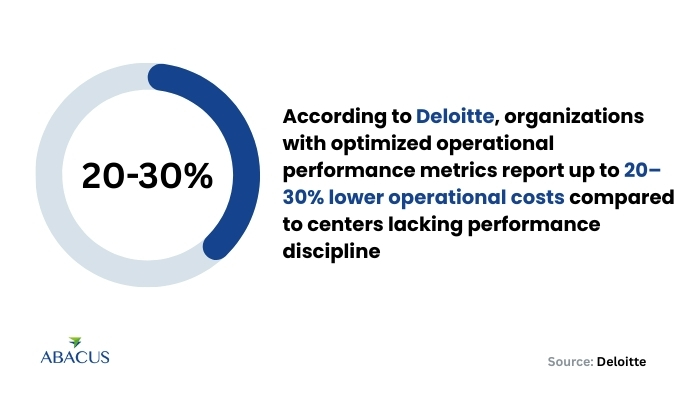
Efficiency here isn’t about speed alone – it’s about doing the right things, which minimizes waste and maximizes resource use.
Quality: A Performance Indicator With Customer Impact
Cost matters, but quality drives reputation.
High performance in quality metrics such as accuracy of information, first contact resolution, and compliance adherence directly influences how customers perceive a brand. Customers notice when agents provide correct answers without repetition, resolve their queries on the first touch, and deliver support with professionalism and empathy.
Research shows a strong correlation between quality performance and customer satisfaction. In fact, SQM Group’s contact center benchmarks indicate that centers with high first contact resolution rates tend to have significantly higher customer satisfaction scores than those without strong resolution performance.
Imagine two customers with the same issue. One experiences a quick resolution on the first call. The other is transferred multiple times, repeats information, and waits longer. Which interaction feels better? The answer isn’t subjective – it’s evidenced by CX data.
Customer Experience: Performance Seen Through the Customer’s Eyes
In high-volume BPO environments, performance doesn’t just impact internal metrics — it influences customer sentiment and brand loyalty.
Studies by Microsoft’s State of Global Customer Service Report reveal that 61% of customers expect companies to understand their needs even before they reach out for support, and 56% say they have higher expectations for customer service than just one year ago.
These expectations mean that BPO operations must deliver not only speed and accuracy, but also contextual responsiveness, personalization, and proactive support.
Performance metrics that track quality and customer outcomes – like net promoter score (NPS), customer satisfaction (CSAT), and customer effort score (CES) – translate internal operations into external perceptions of brand value.
Common Performance Metrics in High-Volume BPO Operations
High-volume BPO environments rely on a structured set of performance KPIs that guide operational decisions and long-term strategy. These typically include:
Performance Metric | What It Measures | Why It Matters |
Average Handling Time (AHT) | Average time spent per interaction | Indicates efficiency and resource use |
First Contact Resolution (FCR) | Percentage of issues resolved in one contact | Reflects quality and customer satisfaction |
Service Level | Percentage of calls answered within target time | Measures responsiveness |
Adherence to Schedule | Agent compliance with planned hours | Impacts staffing costs and service continuity |
Customer Satisfaction (CSAT) | Customer perception of service quality | Ties performance to customer experience |
Each metric provides insights into performance at different levels – from individual agents to the entire operation.
Real-World Example: Small Change, Big Impact
Consider a logistics company’s customer support center that was struggling with high follow-up contact rates due to unclear information provided during first calls. By analyzing the issue, leadership discovered that agents lacked access to standardized script updates and real-time system data.
The solution was twofold: implement a centralized knowledge repository and provide targeted coaching for agents on information retrieval. Within three months, first contact resolution improved by 18%, customer satisfaction increased, and the number of repeat calls dropped significantly.
This case demonstrates that performance improvements don’t always require expensive technology – often; they require clarity, process refinement, and alignment.

Performance Culture: People, Process, and Technology
Performance doesn’t happen by accident. It emerges from a culture that balances three core elements:
- People: Hiring the right talent, continuous training, performance coaching, and recognition systems create an environment where agents are empowered to perform.
- Process: Standardized procedures, clear role expectations, and workflows aligned with customer needs to reduce variability and enhance consistency.
- Technology: Tools such as real-time dashboards, workforce management systems, automation, and AI support agents and supervisors with insights that improve speed and accuracy.
Together, people, processes, and technology form a performance ecosystem – not just a set of disconnected tools.
How Analytics and Automation Amplify Performance
In today’s BPO landscape, data and automation play a growing role in performance excellence.
Analytics platforms provide real-time insights into trends, performance bottlenecks, and predictive indicators of demand. For example, workforce management tools can forecast peak call volumes based on historical data, allowing staffing adjustments that reduce wait times.
Automation – such as automated self-service, chatbots, and intelligent routing – handle routine tasks, reducing volume pressure on agents and allowing them to focus on higher-value interactions.
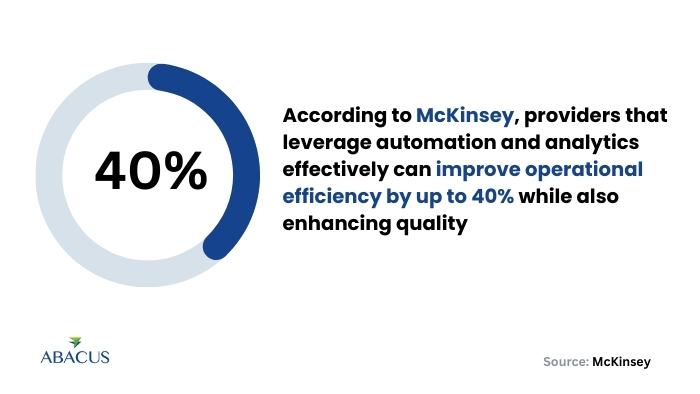
This kind of performance leverage is especially impactful in high-volume environments were even slight improvements scale across hundreds or thousands of interactions.
Challenges to Performance and How to Overcome Them
High-volume BPO operations face specific challenges when it comes to performance:
- Volume spikes: Seasonal demand or promotional events can overwhelm staffing plans.
- Attrition: High turnover impacts continuity and knowledge retention.
- Data silos: Fragmented systems reduce access to critical customer data.
- Training gaps: Insufficient onboarding or refresh training limits agent capability.
Overcoming these requires strategic investments in workforce planning, coaching programs, knowledge management systems, and integrated platforms that unify data and performance tracking.
Conclusion: Performance as a Strategic Imperative
Performance isn’t just a number on a dashboard, it’s the foundation of operational excellence, customer satisfaction, and sustainable growth in high-volume BPO environments. From cost control to quality delivery and superior customer experience, performance influences every strategic outcome.
At Abacus Outsourcing, we understand that high performance isn’t optional; it’s a competitive advantage. Our solutions integrate people, processes, and technology to enhance operational KPIs, improve service quality, and deliver measurable results in complex, high-volume settings.
If your business is ready to elevate performance, optimize contact center operations, and achieve consistent customer satisfaction, Abacus Outsourcing is your trusted partner.