




Nearshore vs Offshore: Which Outsourcing Model Is Right for Your Business?
One of the most vital strategic choices for businesses searching for efficient growth is choosing between nearshore vs offshore outsourcing. As global competition heats up and customer expectations ratchet higher, leaders must ask an all-important question: Where can we build our support operations to maximize efficiency, save costs, and produce the highest quality?
Consider an e-commerce business that is experiencing growth but is facing escalating labor expenses, uncertainty in the quality of service, and restricted hours of operation. Outsourcing can help the team solve these problems, but they have no clue whether to go for a nearshore call center located just out-of-border or an offshore outsourcing model which is located thousands of miles. With global delivery models evolving so rapidly, making this decision more complicated but also with far-reaching implications, this confusion is now quite pervasive.
In this article, we dissect both alternatives and provide transparency, soberness, and data analysis to make you able to choose which model works with your own long-term business goals.
Understanding the Outsourcing Models
The debate between nearshore and offshore outsourcing starts with fairly simple geographical definition. Nearshore outsourcing is a both a validisation and hiring a service providers located in neighbouring or close nations. For many U.S. companies, this normally means Mexico, Costa Rica, or Colombia. Geographic proximity offers advantages, including shared time zones, ease of travel, cultural affinity and more straightforward communication.
On the flip side, offshore outsourcing is a partnership with providers based on significantly distant regions like the Philippines, India, Pakistan, or Eastern Europe. Historically, the offshore model has primarily attracted clients based on financial considerations and access to an extremely large number of professionals. Which is why offshore vs onshore services remains on the list of many companies as they asses expansion plans to other parts of the world.

The Rising Shift Toward Global Delivery Models
Factors Like Globalization Out of these traditional variables, the ‘Seasonality’ and the ‘Health of the Market’ are beyond our control. Hence, outsourcing is no longer only relevant to the cost issue. It is about creating a system of robust operations that is capable of scaling. In fact, 70% of enterprises now leverage outsourcing as a strategic tool for innovation and operational excellence rather than primarily as a cost reduction mechanism (Deloitte’s 2024 Global Outsourcing Survey).
This, in turn, sparked greater interest in international BPO strategies that capitalize on the best of both nearshore and offshore worlds. Most companies opt for hybrid outsourcing prioritizing one model over the other for different functional areas in the same or different geographic locations based on talent supply, cost structure, and operational complexity of the processes.
Nearshore Outsourcing: Advantages and Considerations
Nearshore outsourcing is a popular choice for many companies due to its unique mix of low operational barrier to entry and cultural fit. Working within similar time zones is generally a recipe for swifter problem-solving, seamless teamwork, and heightened client satisfaction. Teams can join meetings instantly, carry out routine training and keep a degree of operational flexibility that feels nearly comparable to onshore support.
The specific industries that benefit the most from nearshore business process services are tech startups, fintech companies, or logistics firms that require high-touch communication or real-time coordination. Therefore, nearshore is a more practical choice for customer-facing processes like live chat, bilingual customer support and account management.
Yet, nearshore is not always the most cost-effective option compared to offshore markets. Because salaries, infrastructure, and compliance costs can be marginally higher, the model better suits companies which are inclined to invest in quality as opposed to simply low-cost labor.
Offshore Outsourcing: Why It Still Dominates Global BPO
The offshore outsourcing industry is alive and well, due in large part to the high scalability and affordability of its services, albeit with the rise of nearshoring. The Philippines, India, and Pakistan continue to be the Caspian of the world because of availability of available manpower stork, mature ecosystems for outsourcing, and specialized skill-sets.
According to Statista (2024), offshore outsourcing accounts for more than $475 billion of the global BPO market, establishing it as a key pillar of functionality for global organizations. The high cost of business process outsourcing is driven mainly by high labor costs and established systems of training in the U.S. and Western Europe. While many offshore services are even cheaper than call center outsourcing.
Offshore partners also provide the opportunity for 24/7 operations, making them appealing to businesses that also need coverage across time zones. Whether its customer service or technical support or back-office processes, offshore providers are at their best when it comes to consistent and large scale operations.
However, with all benefits come certain challenges that offshore outsourcing creates the most critical of them being the time-zone gap which can disrupt communication, real time collaboration or escalation of issues. Cultural differences also require extra training and processes of implementation.
Nearshore vs Offshore: Key Differences at a Glance
This article is mostly about narrative structure, but appropriate distinctions must also be made. Here is a simple comparison for a glance:
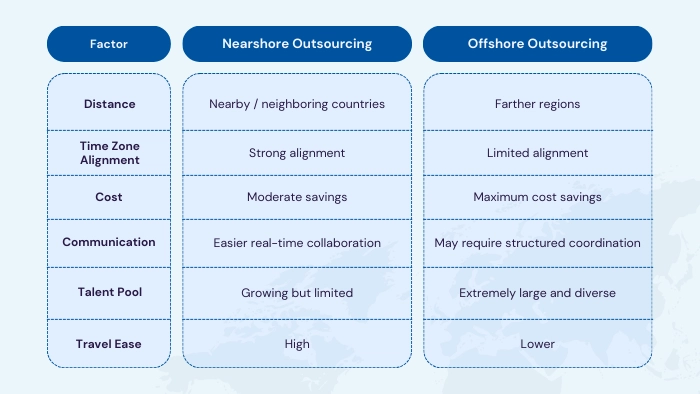
The comparison below illustrates how the two models overlay to reflect different categories of business operations and performance.
Which Outsourcing Model Is Right for Your Business?
There are several factors in deciding nearshore vs offshore call centers your business needs, including customer service and financial dynamics, scalability, and operating hours all play a role in making sure you choose the best option for you.
Nearshore providers attract companies with needs for in-person collaborative work, cultural cohesion, and bilingual, concurrent customer experiences. Offshore outsourcing is what businesses opt for when a large chunk of support, substantial cost reduction, and round-the-clock business is essential.
Startups and various mid-sized companies lean towards offshore teams for lower costs starting off while the enterprises would go for a hybrid model in balancing the speed with quality and cost. In the end, this decision is in sync with your overall global delivery model and expansion plans.
Why Abacus Outsourcing Helps You Choose the Right Model
And irrespective of whether you are leaning towards nearshore or offshore support, the most critical factor is to collaborate with a service partner who understands your operational imperatives and industry challenges. To strike the right balance between cost, efficiency, and customer experience, businesses need to adopt the strategy that works for them, and Abacus outsourcing has both in their offering.
Having deep experience in international BPO delivery and an unwavering approach to ensuring seamless operations, Abacus makes sure that your business is given the suitable support at the suitable location be it nearshore, offshore, or a balanced model that synergizes the benefits of both. Take the leap with Abacus Outsourcing, and prepare to scale more intelligently, bring your service level quality to the next level, and build your global presence.