



Why More Companies Are Switching to Virtual Call Centers
Not that many years ago, most companies thought customer service had to be delivered within a physical call center – with agents lined up in rows, supervisors on site, and systems on-premises. Then came digital transformation and suddenly customer expectations were at an all-time high and remote work was fully validated. The most dynamic companies today are opting for outsourcing their virtual call center and are moving their organizations away from rigid physical call center setups, and toward more flexible, scalable and digitally reinforced customer experience models.
Let’s say there is an e-commerce brand, and it is handling seasonal spikes. They were still searching for a fix to staff shortages, extended wait times, and even higher abandonment rates before transitioning to a cloud-based call center service. Once they moved to a remote contact center company, their average handling time decreased by 25%, and they were able to expand their team in a matter of hours during Black Friday without any extra physical resources. These are the types of stories that hint at why virtual call centers are quickly becoming the global standard.
Understanding the Shift Toward Virtual Call Centers
When we realized the pandemic is here to stay, virtual customer service models were no longer merely an option – it had evolved into the choice organizations chose which provide efficiency, adaptability, and the ability to scale quickly. Rise of distributed workforce solutions, increased connectivity and improved access to cloud technologies have made it relatively feasible for organizations to run an entire contact center and have them operate as a fully functional unit without the need for employees to be within the same physical footprint.
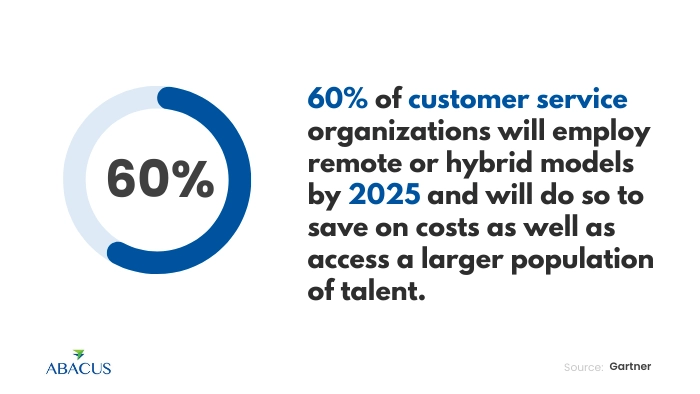
This move serves the companies with extreme peaks or valleys in call volume – think telecom, e-commerce, healthcare, and travel – that need flexibility in hiring and training people on-site without the confusion.
The Power of Cloud-Based Call Center Services
Cloud technology is the one at the center of the transformation. Hotline sales: This model allows companies to access everything they need from a virtual phone system, through CRM integrations, ACD / IVR routing, call recording, analytics, and omnichannel tools to run a virtual call center, all without physical servers or hardware installations.
The advantages go beyond convenience. Cloud support:
- Reduces operational costs
- Enables instant scalability
- Improves uptime and reliability
- Supports remote-first teams across regions
- Enables secure remote access to systems
For example, a report from IDC concluded that organizations adopting cloud contact center platforms received benefits with 57% faster deployments and 32% operational cost reductions, versus traditional on-premises systems.
Source: IDC Cloud Contact Center Market Analysis
Remote agents log into cloud systems from anywhere, serving customers as efficiently as (or more than) an on-site agent.
Remote Work Isn’t a Trend – It’s the Future of Contact Centers
The pandemic served businesses lessons, and if there’s one thing it learnt, that is remote workplace not only works but actually perform better and is a lot more efficient as well. With a work from home call center model, businesses can access a wider range of talent, recruiting high-quality agents across various geographies instead of relying on agents within a specific office location.
Remote agents are known to provide more help because:
- Greater work-life balance
- Expansion of specialized talent across the boundaries of city county lines
- Reduced commuting stress
- More availability due to flexible shifts
For instance, a study conducted by Stanford University found that remote workers are 13% more productive than on-site workers, mostly because they are focused and have fewer distractions at work.
Source: Stanford Study of Work from Home Productivity
The resulting productivity gain has twofold rewards for firm’s dependent on remote BPO operations, enabling them to provide quicker and better support at scale.
How AI-Enabled Contact Centers Are Transforming the Experience
AI is not taking over from agents; it is giving them power. Over the last decade, modern companies have been relying on AI-enabled contact centers to optimize customer experience by leveraging intelligent automation, predictive routing, chatbots, sentiment analysis and assisted agent workflows.
These AI enhancements help in:
- Reducing average handling time
- Predicting customer intent
- Providing real-time agent assistance
- Automating routine conversations through chatbots
Flagging high-priority or high-value interactions
According to McKinsey, AI-based contact centers achieve a 30% reduction in costs and a 20% improvement in customer satisfaction owing to automation of repetitive tasks and predictive insights.
Omnichannel Virtual Support Is Becoming the New Normal
Today’s customers demand a seamless cross-channel communication experience. Be it an email that is followed by a chat or social media that turns into a voice call; the move needs to appear seamless.
By leveraging omnichannel virtual support, businesses will be able to consolidate interactions from:
- Voice
- Live chat
- Social media
- WhatsApp and messaging apps
- SMS
- In-app support
With virtual platforms, agents can get a comprehensive overview of a customer history irrespective of the channel without any hassle as it works on a single interface.
According to a Zendesk report, 73% of consumers expect companies to know how they’ve interacted across channels – this demonstrates just how essential omnichannel integration has become.
Digital Customer Service Outsourcing Drives Faster Response Times
Speed is a customer satisfaction key leader (and, potentially, deal breaker). Digital customer service outsourcing comes with 24/7 teams who can respond in real-time to chat, email, and social media. This guarantees quicker replies at peak times or when customers urgently need assistance.
While in-house call centers are physical entities costing a fortune to cross-operate across multiple time zones, virtual call center operations significantly broaden coverage, so a brand can be available round-the-clock without raising local headcount costs.
Real-time digital support has become an indispensable need in industries such as Fintech, travel, & online retail to prevent customer churn & losing hard earned loyalty.
Global Call Center Companies Provide Immediate Scalability
One of the biggest advantages of shifting to virtual operations is the ability to scale quickly. Global call center companies often maintain networks of remote agents across countries, enabling businesses to add or reduce staffing within hours – not weeks.
This flexibility is especially crucial for organizations facing unpredictable call patterns. Whether it’s a sudden product launch, a viral marketing campaign, or an emergency outage, virtual teams can expand capacity instantly.
Traditional brick-and-mortar call centers simply cannot scale with that level of agility.
Comparing Traditional vs. Virtual Call Centers
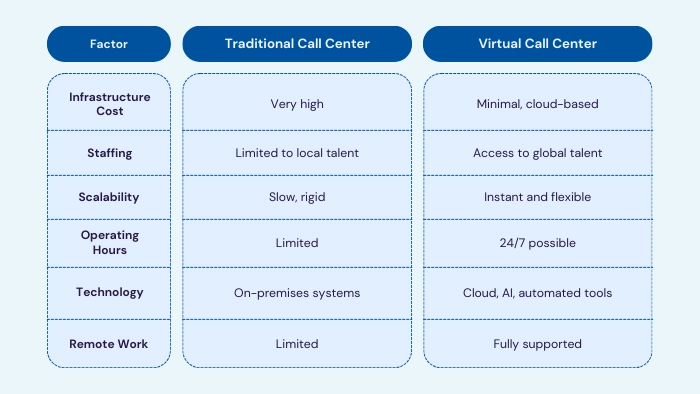
It’s clear why virtual models outperform traditional setups in cost, agility, and customer experience.
Why Companies Are Making the Switch Now
The simultaneous increase in popularity of virtual call centers is associated with the following business drivers:
- Cost Efficiency: Merge pricing, lower room, and eliminate infrastructure to make your funds go further
- Access to Talent: hire agents remotely and choose only employees that suit you best, regardless of their location.
- Speedier Rollout: Virtual formats come to yield quickly with less moving parts.
- Operational Resilience: Remote teams mean there is no downtime during weather incidents, emergencies, or local outages.
Improve Customer Experience – Faster and more tailored service by leveraging AI, omnichannel tools, and trained remote teams.
All the above benefits highlight that neither is a compromise on operations while working with a virtual call center service provider; in fact, this is a strategic investment.
Conclusion: The Future of Customer Support Is Virtual
Benefits of Transitioning to Virtual Call Centers the sudden transformation to virtual contact centers is not simply prompted by the happenings across the globe but by the insight that customer service can be remote-first, cloud-enabled, and more flexible, scalable, and cost-effective than any customary model. As a result, businesses from various domains rely on remote BPO operations and distributed workforce solutions to deliver quality assurance and cater to every customer at the right time.
Abacus Outsourcing provides all the technology, talent, and omnichannel capabilities needed to develop a future-ready virtual call center and gives organizations looking to evolve a strong partnership. Tomorrow’s leaders in customer satisfaction, global reach, and operational efficiency will be the businesses that adopt this model today.