
On this page
- Cost Savings
- Why US Companies Are Outsourcing More Than Ever in 2026
- Ability to Access: Specialized Skills and Expertise
- Concentrate on the Business: Going to the essential
- What Business Functions Do US Companies Outsource Most
- Innovation and Competitive Advantage
- Enhanced Service Quality Leading to Higher Customer Satisfaction
- Ready to Outsource? Here Is Why US Businesses Choose Abacus BPO
- Frequently Asked Questions
No business strategy has gained more prevalence than outsourcing among businesses regardless of size, whether it be a startup or a giant corporation. However, outsourcing still raises the question – why do companies choose to outsource work? And more broadly, why do companies outsource in the first place?
Outsourcing, at its most fundamental component, is to be able to hire outside vendors or outsource companies to handle and manage specific tasks, processes, or functions, usually performed in another area of region or country. There are several rationales why companies go this route, including reduction of costs and access to specialized expertise. Now, let us try to go through the top four reasons for outsourcing and how some of the companies that outsource gain a highly competitive edge.
Cost Savings
Cost Saving, this is one of the top reasons for outsourcing. This allows businesses to actually save a lot on operational costs as they are outsourcing work to low labor cost areas. Certain elements of business such as customer experience, IT, and factory can usually be dispatched to low cost of living countries thus resulting in lower cost-of-living wages and cost of living overhead.
Moreover, companies that outsource save costs on hiring, training, and retaining full-time in-house teams. So, if a company does not require an entire team or department for that specific service, outsourcing enables companies to pay for the services without having to hire them.
Why US Companies Are Outsourcing More Than Ever in 2026
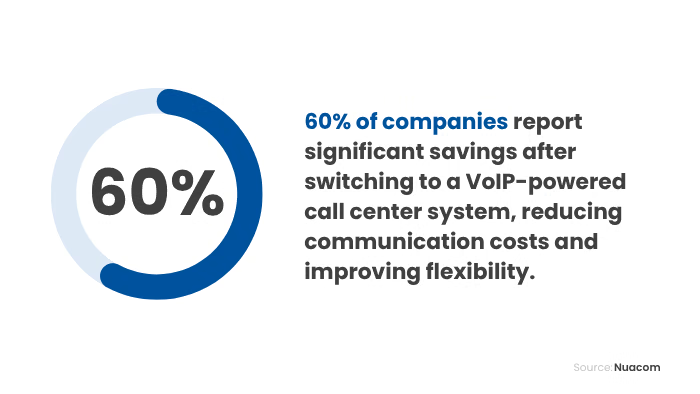
The numbers confirm what US business leaders already know:
- 70% of US companies outsource primarily to cut costs — but 40% also cite flexibility and 20% cite speed to market (Deloitte Global Outsourcing Survey)
- US businesses save 30–60% on operational costs by outsourcing vs hiring in-house (IBM Research)
- 59% of US organizations outsource customer service specifically to improve quality — not just reduce cost (Deloitte)
- The global outsourcing market exceeded $620 billion in 2024, led by US businesses (Statista)
- Companies that outsource non-core functions grow 2x faster than those that manage everything in-house (McKinsey)
- BPO companies can save operational costs as much as 60% compared to in-house operations (IBM Global Research)
Ability to Access: Specialized Skills and Expertise

It helps at times to Outsource which means provide the specific skills are required or relevant for the specific task. Outsource companies have diverse talent pools who can do the heavy lifting of complex tasks more effectively whether their expertise in advanced technologies, niche industry knowledge or creative services.
For example, when a business is looking for app development at an advanced level, it can transfer IT to a team of proficient app developers. As with every other benefit, it is critical to master the process of the way to outsource IT to make the best of it with maximum team earn the trumps and top-notch results.
Concentrate on the Business: Going to the essential

Like most companies, probably all corporations will find a service provider with robotics processing to do noncore functions (payroll, HR, customer support, etc.) outside of the primary business goals. With this strategy, teams can focus only on their core strengths (like product development or strategic planning) and not get distracted with the everyday chores.
This holds true especially for firms wondering why do some companies outsource marketing-research activities? That brings us to the answer: get actionable insights through specialized market research firms but keep strategizing in-house.
Scalability and Flexibility
Businesses can also quickly respond to changing demands through outsourcing. During periods of rapid growth or seasonal fluctuations, companies that outsource can scale operations without the long-term commitment of new hires.
For startups and companies that are scaling, mastering the art of outsourcing IT or customer support can make a big difference to their ability to experiment with new ideas and grow without strain internally.
Risk Mitigation
Risk management is another reason why outsource strategies work well. For example, some functions, like compliance or even manufacturing, are often outsourced so that risk is more evenly spread. For the above reason the vendors have a full understanding of their domain and are oftentimes better at managing regulatory or operational risks.
Faster Time to Market
In the age of business now, speed is everything. companies that outsource can get products and services to market faster than those who do everything in-house.
This is one of the principal motivations behind innovation outsourcing — shorter cycles, greater efficiency, and greater market alignment momentum.
Global Expansion
Companies that outsource often do so to facilitate global expansion. While you may not want the hassle of opening local offices, outsourcing customer service, logistics, or local marketing may make entering new markets easy.
This transition can be smoothed and success ascertained in unfamiliar regions through company outsider familiar with regional laws and cultural differences.
What Business Functions Do US Companies Outsource Most
|
Function |
% of US Companies Outsourcing |
Primary Reason |
|
Customer support & call center |
68% |
Cost + 24/7 coverage |
|
IT support & helpdesk |
60% |
Specialized expertise |
|
Accounting & finance |
53% |
Cost + accuracy |
|
Human resources |
47% |
Compliance + efficiency |
|
Data entry & back-office |
44% |
Cost + volume handling |
|
Marketing research |
38% |
Specialized expertise |
|
Supply chain & logistics |
35% |
Flexibility + cost |
Innovation and Competitive Advantage

Another reason why companies adopt outsourcing in the name of innovation. Outside teams come equipped with technologies, methodologies and ideas that are simply not achievable to the internal team. It assists businesses in staying on top and helps in creating an edge over the competition.
This, again, ties into the question: Why does a company outsource certain marketing-research functions? This kind of research helps in discovering opportunities and consumer trends which lead to the edge for any business.
Enhanced Service Quality Leading to Higher Customer Satisfaction
Customer service quality becomes much higher through outsourcing. Quick, quality responses from vendors with specialized experience and 24/7 availability leads to higher customer satisfaction and customer loyalty.
Knowing how to outsource IT, or customer service or logistics properly allows the companies to provide services that are constant while the business focuses on growth.
Ready to Outsource? Here Is Why US Businesses Choose Abacus BPO
Abacus BPO helps US businesses outsource the right functions at the right cost — with measurable results from day one:
- Customer support, back-office, and contact center outsourcing — all in one partner
- 17+ years serving US clients across ecommerce, banking, healthcare, and telecom
- 30–60% cost savings vs in-house operations — guaranteed transparent pricing
- Deployment in 7–21 days — no lengthy onboarding cycles
- ISO 18295-certified quality management — performance you can measure
- Flexible model — start small and scale as you grow
Get a Free Outsourcing Consultation →
Frequently Asked Questions
Why do companies choose to outsource work?
Companies outsource to reduce operational costs, access specialized expertise, improve scalability, manage risk, and focus internal resources on core business activities. For US businesses, cost savings of 30–60% compared to in-house operations is the most cited driver.
What are the top reasons US businesses outsource?
The top reasons are cost reduction (70%), access to specialized skills (52%), improved flexibility and scalability (40%), faster time to market (20%), and risk management — particularly around compliance (Deloitte Global Outsourcing Survey).
Is outsourcing good for small US businesses?
Yes. Small US businesses benefit most from outsourcing because they get immediate access to trained staff, enterprise-grade technology, and 24/7 coverage — without the overhead of full-time employees, office space, or software licensing.
What are the risks of outsourcing for US companies?
Common risks include loss of direct control, communication challenges, and data security concerns. These are manageable by choosing certified BPO providers with ISO certification, GDPR compliance, clear SLAs, and transparent performance reporting.
How do I know if my company should outsource?
If your team is spending more than 20% of its time on non-core tasks, if you are struggling to scale customer support during peak periods, or if operational costs are growing faster than revenue — outsourcing is worth evaluating. Most US businesses recover the cost of outsourcing within 3–6 months.