On this page
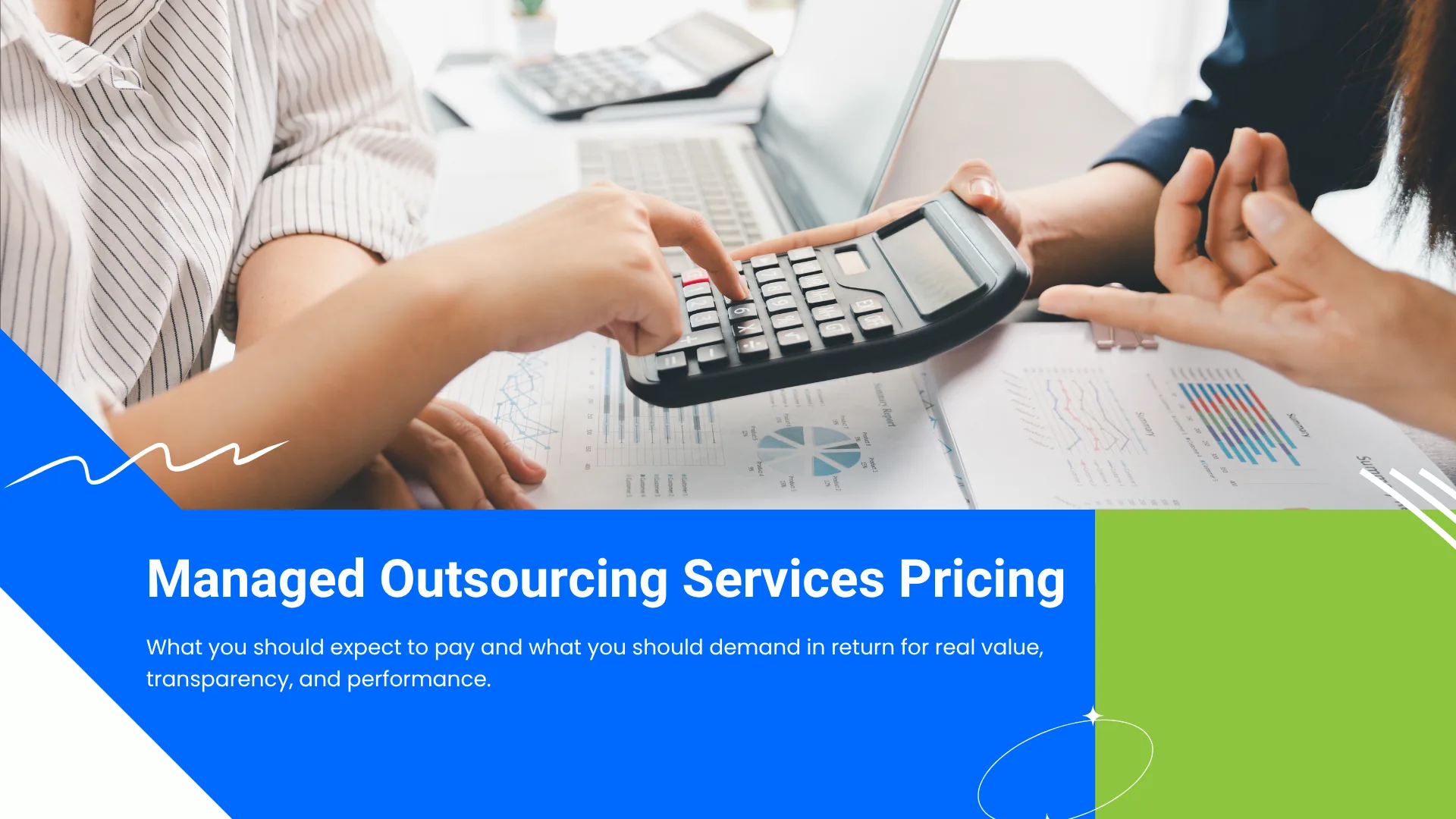
- Managed Outsourcing Services Pricing: What You Should Expect to Pay and What You Should Demand in Return
- The Pricing Conversation Most BPO Providers Avoid
- Why Managed Outsourcing Pricing Varies So Widely
- The Four Pricing Models You'll Encounter
- Managed Outsourcing Services Pricing: What Each Model Delivers
- What Your Managed Outsourcing Investment Must Include
- The False Economy of Choosing on Price Alone
- Why Abacus BPO Pricing Is Built Around Your Business
- Conclusion: Price Is the Starting Point, Not the Finish Line
Managed Outsourcing Services Pricing: What You Should Expect to Pay and What You Should Demand in Return
The Pricing Conversation Most BPO Providers Avoid
Ask ten BPO providers what their managed outsourcing services cost, and nine of them will tell you to "get in touch for a custom quote." What that typically means is: we'd rather control the conversation than let you come in informed.
At Abacus BPO, we take a different position. Businesses making a serious outsourcing decision deserve transparency — not a sales funnel disguised as a pricing process. This article breaks down how managed outsourcing services are genuinely priced, what the key cost drivers are, what pricing structures exist and which suits your business, and critically what you should be demanding in return for every pound you invest.
Because the right question isn't just "what does it cost?" It's "what does this level of investment actually buy me?"
Why Managed Outsourcing Pricing Varies So Widely

If you've started researching managed outsourcing services, you've already noticed that pricing varies enormously between providers. That variation isn't arbitrary — it reflects genuine differences in service depth, delivery model, technology, and the level of accountability a provider is willing to accept.
Understanding the drivers behind pricing gives you the ability to evaluate proposals on their actual merit, rather than simply comparing headline numbers that aren't structured in the same way.
The primary factors that determine managed outsourcing pricing are scope and complexity of the processes being outsourced, required coverage hours including whether 24/7 delivery is needed, the seniority and specialization of staff involved, technology infrastructure and integration requirements, volume of transactions or interactions being managed, and the level of governance, reporting, and account management included.
A provider offering a low headline rate with thin governance and generic staffing is not the same product as a provider offering a higher rate with dedicated teams, SLA accountability, and real-time reporting. Comparing them on price alone is like comparing a budget airline seat to business class and concluding the only difference is cost.
The Four Pricing Models You'll Encounter
Per-Agent or Per-FTE Pricing
The most common model for customer support, data processing, and back-office outsourcing. You pay a fixed monthly rate per full-time equivalent agent dedicated to your account. This model is straightforward and predictable - you know exactly what you're paying for and exactly what resources you have.
It works well for businesses with relatively stable volumes and defined process requirements. The key question to ask is what is actually included in that per-agent rate: training, management, technology, quality assurance, and absence of cover should all be bundled in not charged separately.
Per-Transaction or Per-Interaction Pricing
Common in customer support and data management, this model charges based on the volume of interactions or transactions processed. It offers genuine cost flexibility — you pay more during peak periods and less when volumes are lower.
The risk is that per-transaction pricing can create incentives for speed over quality if not properly governed by SLA standards. Ensure your agreement specifies quality benchmarks alongside volume-based pricing, not instead of them.
Outcome-Based Pricing
A more sophisticated model where pricing is tied to the achievement of defined outcomes — customer satisfaction scores, resolution rates, processing accuracy, or revenue generated. This model aligns the provider's financial interest directly with your business results.
Outcome-based pricing requires more sophisticated contract design and measurement infrastructure, but it's the model that most directly answers the question: are you paying for activity, or for results?
Fixed Monthly Retainer
A single agreed monthly fee covering a defined scope of managed services. This model offers maximum budget predictability and is particularly well-suited to businesses outsourcing multiple functions under a single engagement. It simplifies financial planning and eliminates the variable cost anxiety that comes with per-transaction models during unexpectedly high-volume periods.
Managed Outsourcing Services Pricing: What Each Model Delivers
| Pricing Model | Best Suited For | Budget Predictability | Flexibility | Risk Level |
| Per-Agent / Per-FTE | Stable volume, defined processes | High | Moderate | Low |
| Per-Transaction | Variable volume, seasonal businesses | Moderate | High | Moderate |
| Outcome-Based | Performance-driven engagements | Moderate | Moderate | Low aligned incentives |
| Fixed Monthly Retainer | Multi-function, long-term partnerships | Very High | Low-Moderate | Very Low |
| Hybrid (FTE + Outcome) | Scaling businesses with growth targets | High | High | Low |
At Abacus BPO, we work with clients to identify which model — or which combination of models — best reflects their operational reality and commercial objectives. There is no one-size-fits-all answer, and any provider who tells you otherwise is prioritising their administrative convenience over your business needs.
What Your Managed Outsourcing Investment Must Include
Price is only meaningful in the context of what it delivers. Before accepting any proposal, verify that the following are explicitly included — not implied, not optional extras, but contractually committed components of the engagement.
- Dedicated team ownership. Your processes should be managed by a named, dedicated team — not a shared pool of agents rotating between multiple clients. Dedicated teams develop deeper product knowledge, maintain higher quality standards, and represent your brand with consistency that generic pooled resource cannot.
- Structured onboarding and knowledge transfer. The transition from your current operation to your BPO partner should be managed with a documented process, clear timelines, and parallel running to validate quality before full handover. Any provider who treats onboarding as informal is signalling how they'll treat the ongoing relationship.
- Contractually governed SLAs. Service Level Agreements should specify measurable performance benchmarks — accuracy rates, response times, resolution rates — with defined consequences for underperformance. SLAs without consequences are not SLAs. They are intentions.
- Real-time reporting and performance visibility. You should never have to chase your BPO partner for performance data. Dashboards, weekly reports, and monthly reviews should be standard components of the engagement — proactively provided, not reactively delivered when you ask.
- Named account management with decision-making authority. Your account manager should be a senior point of contact who knows your business, understands your objectives, and has the authority to act when issues arise — not a liaison who escalates everything internally before responding.
- Technology and infrastructure included. All tools required to deliver your processes — CRM access, telephony, help desk software, reporting platforms — should be included in your pricing. Providers who charge separately for technology are adding hidden costs to a headline rate that looked attractive.

The False Economy of Choosing on Price Alone
This is the most important point in this entire article, and it's one that businesses only fully appreciate after making the mistake once.
Managed outsourcing services that appear significantly cheaper than market rate are cheaper for a reason. That reason is usually one or more of the following: shared rather than dedicated resource, weaker governance and accountability, less experienced staff, inadequate technology infrastructure, or contract terms that lock you in while leaving the provider's obligations deliberately vague.
The cost of a failed outsourcing engagement — in management time spent firefighting, in customer experience damage, in the disruption of transitioning to a new provider — consistently exceeds any saving made on a lower monthly rate. The businesses that calculate total cost of ownership, rather than just monthly line-item cost, consistently arrive at the same conclusion: quality-governed managed outsourcing is not a cost. It's a return on investment.
Why Abacus BPO Pricing Is Built Around Your Business
At Abacus BPO, our pricing is designed around one principle: you should always know exactly what you're paying, exactly what you're getting, and exactly how performance will be measured.
We offer flexible engagement models across per-FTE, per-transaction, outcome-based, and fixed retainer structures selected and configured based on your specific operational requirements and growth trajectory. Every engagement includes dedicated team ownership, SLA-governed performance standards, structured onboarding, real-time reporting, and senior account management as standard components not premium add-ons.
We believe the right price for managed outsourcing services is the one that delivers a clear, demonstrable return on your investment and we're prepared to show you exactly how that return is calculated before you commit.
Conclusion: Price Is the Starting Point, Not the Finish Line
When evaluating managed outsourcing services pricing, the businesses that make the best decisions are those that look beyond the monthly figure and ask the harder questions: what governance does this price include, what performance is it contractually committed to delivering, and what happens when that performance isn't met?
Those are the questions Abacus BPO is built to answer with specifics, not assurances.
Contact Abacus BPO today for a transparent pricing consultation. We'll map your requirements, recommend the right engagement model, and give you a clear, itemized proposal so you can make this decision with complete confidence.