On this page
- How supply chain back-office outsourcing services eliminate procurement bottlenecks
- Restructuring inventory management when third parties handle transaction processing
- Compliance and audit trails in outsourced procurement environments
- Measuring procurement performance beyond cost per transaction
- Frequently Asked Questions
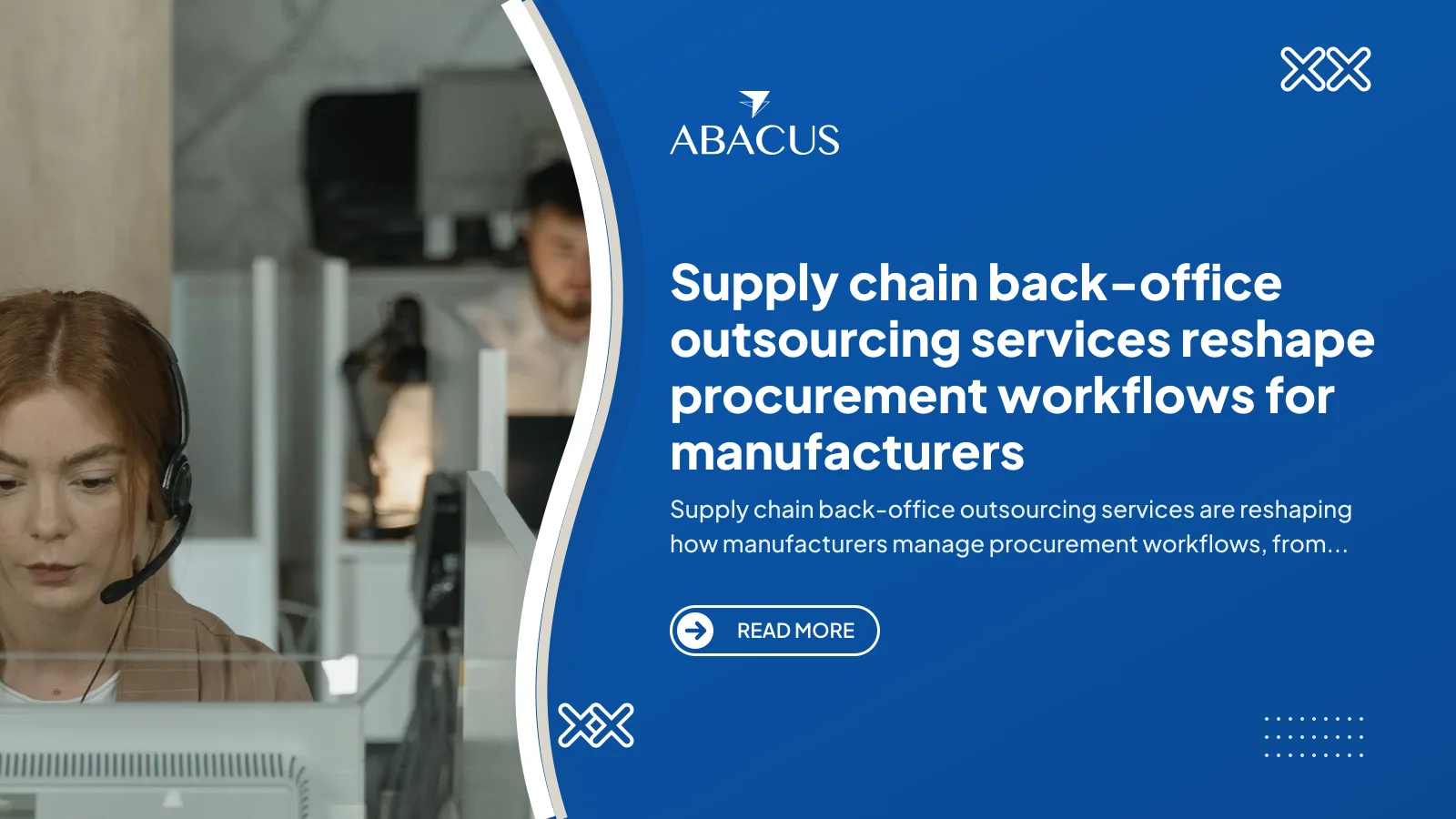
Manufacturers running lean operations often discover that procurement is where efficiency quietly erodes. A purchase order sits in a shared inbox for two days waiting for a GL code. An invoice exception stalls payment while a supplier calls accounts payable for the third time. These delays rarely appear on a balance sheet, but they accumulate in supplier relationship scores, stock-out events, and audit findings. Supply chain back-office outsourcing services exist precisely to absorb that operational friction, and the manufacturers getting the most from them are the ones who understand the mechanics before signing a contract.
How supply chain back-office outsourcing services eliminate procurement bottlenecks
The core promise of supply chain back-office outsourcing services is straightforward: remove the manual handoffs that slow purchase order cycles. In a typical in-house environment, a requisition passes through four to seven human touch points before a PO is issued, each step a potential queue. An outsourced provider consolidates those handoffs into a structured workflow, often supported by robotic process automation for data entry and rule-based approval routing.
Where cycle time actually improves
The gains show up at two specific points: PO issuance and three-way match at invoice receipt. Three-way matching, comparing the PO, the goods receipt note, and the supplier invoice, is labour-intensive when done manually. Outsourced teams running dedicated matching queues can process exceptions in defined SLA windows rather than allowing them to age in a general inbox. The result is a measurable reduction in days payable outstanding without sacrificing accuracy.
- Automated PO generation from approved requisitions, reducing keying errors
- Structured exception queues with defined escalation paths
- Supplier acknowledgement tracking built into the workflow, not bolted on afterward
- Reconciliation completed against agreed tolerance thresholds before payment release
According to Horatio's back-office outsourcing guide, companies that produce physical goods often rely on complex supply chains, and outsourcing procurement and supply chain management allows them to streamline operations that would otherwise require significant internal headcount to sustain.

Restructuring inventory management when third parties handle transaction processing
Handing order entry and reconciliation to an external provider does not automatically preserve inventory accuracy. That outcome depends on how data flows between the outsourced team and the manufacturer's ERP. When a provider enters a goods receipt in a siloed system and batch-syncs it nightly, the in-house demand planner is working with stale stock data for up to eighteen hours, long enough to trigger a duplicate order during a peak run.
Maintaining demand signal integrity
The manufacturers who avoid this problem establish a real-time or near-real-time integration between the outsourced provider's processing environment and the internal planning system. They also define which party owns inventory record corrections: a disagreement about ownership is the most common root cause of reconciliation backlogs found in post-implementation reviews.
Inventory accuracy depends less on who processes transactions than on the latency between transaction completion and ERP update: that interval is the variable manufacturers must contractually control.
Demand forecasting is a separate concern. Outsourced providers handling order entry have visibility into order velocity that most in-house teams underuse. Structuring a weekly data share, covering order frequency, supplier lead time actuals, and exception volumes, gives the internal planning team a richer demand signal than purchase history alone provides. The benefits of procurement outsourcing extend well beyond transaction speed when this data exchange is designed deliberately.
Operational considerations when outsourcing procurement back-office functions
| Function | Key risk if not addressed | Mitigation approach | Source |
|---|---|---|---|
| Purchase order entry | Keying errors creating supplier disputes | Automated PO generation with ERP integration | VSynergize |
| Invoice three-way match | Payment delays and supplier relationship damage | SLA-bound exception queues with defined escalation | ARDEM |
| Inventory reconciliation | Stale stock data distorting demand forecasts | Real-time ERP sync, agreed ownership of corrections | VSynergize |
| GL coding | Audit findings from miscoded transactions | Coded rule sets reviewed quarterly with finance | Axendi |
| Supplier coordination | Lead time surprises disrupting production schedules | Weekly data share covering order velocity and actuals | Conectys |
Sources: VSynergize; ARDEM; Axendi; Conectys.

Compliance and audit trails in outsourced procurement environments
When a manufacturer delegates invoice verification and GL coding to an external provider, the regulatory responsibility does not transfer with the task. The manufacturer remains accountable to its auditors, its lenders, and any applicable trade or industry regulations. What changes is where the evidence of compliance is generated and who controls access to it.
Documentation that must survive the relationship
Audit trails in outsourced environments are only as reliable as the access controls and retention policies written into the service agreement. A provider processing invoices in a cloud platform that the manufacturer cannot independently query is an audit risk, regardless of how cleanly the transactions are coded. The contract must specify read-only access for the manufacturer's finance team, a defined retention period that meets statutory requirements, and a data return protocol if the relationship ends.
- GL coding rule sets held and versioned by the manufacturer, not solely the provider
- Timestamped approval records for every PO and payment release
- Segregation of duties enforced across the outsourced and in-house teams jointly
- Quarterly compliance reviews with the provider's operations lead, not just account management
Abacus BPO, which has operated back-office programmes since 2008 and holds ISO 27001, ISO 27701, and ISO 18295-1 certifications, structures its outsourced procurement engagements around client-controlled audit trails precisely because post-engagement data access is a recurring gap in less formally governed arrangements. Manufacturers evaluating providers should ask for evidence of certification rather than accepting general assurances about data security.
Explore how expert back-office outsourcing services handle compliance documentation as a structural feature, not an afterthought.
Measuring procurement performance beyond cost per transaction
Cost per transaction is the metric most frequently cited in outsourcing proposals and the least useful for evaluating ongoing performance. It measures activity volume, not quality, and it says nothing about whether the procurement function is actually serving the manufacturing operation.
KPIs that reflect operational reality
Procurement cycle time, the elapsed hours from requisition approval to PO issuance, is a more direct measure of whether the outsourced workflow is removing friction or just relocating it. Supplier on-time delivery rate matters because it reflects the accuracy of PO data and the quality of supplier communication, both influenced by how well the outsourced team manages order acknowledgements. First-pass invoice match rate shows whether the three-way match process is catching discrepancies before payment or after.
- Procurement cycle time: target measured in hours, not business days
- First-pass invoice match rate: exceptions as a proportion of total invoices processed
- Supplier acknowledgement turnaround: time from PO issuance to supplier confirmation
- Requisition-to-PO accuracy rate: POs requiring amendment after issuance
- Exception resolution time: hours from exception flagged to payment cleared
Supplier relationship quality is harder to quantify but worth tracking through a simple periodic survey covering responsiveness, PO clarity, and dispute frequency. A provider that processes transactions accurately but generates friction with suppliers is solving half the problem. The finance and accounting outsourcing services that integrate cleanest with procurement back-office functions share a common data model, which reduces the reconciliation effort that otherwise consumes analyst time at month-end.
According toARDEM's back-office outsourcing overview, AI-enabled process automation combined with structured back-office support eliminates operational bottlenecks and improves the accuracy of downstream reporting, a finding consistent with what manufacturers observe when exception volumes drop and planning teams gain cleaner data to work from.
Frequently Asked Questions
What processes are typically included in supply chain back-office outsourcing services?
Supply chain back-office outsourcing services typically cover purchase order creation and management, invoice processing and three-way matching, GL coding, inventory reconciliation, and vendor coordination. The exact scope depends on the provider's capabilities and the manufacturer's ERP environment. Some engagements also include demand data reporting and supplier acknowledgement tracking.
How do manufacturers maintain inventory accuracy when an outsourced provider handles order entry?
Accuracy depends on the latency between transaction completion and ERP update: the shorter the sync interval, the more reliable the stock data available to planning teams. Manufacturers should contractually define which party owns inventory record corrections and establish a real-time or near-real-time integration between the provider's processing environment and the internal ERP. A nightly batch sync is generally insufficient during high-volume periods.
Who is responsible for compliance when invoice verification is outsourced?
The manufacturer retains regulatory accountability even when invoice verification and GL coding are delegated to an external provider. The service agreement must specify manufacturer read-only access to audit trail data, a statutory-compliant retention period, and a data return protocol if the relationship ends. Providers holding ISO 27001 and related certifications offer a more structured baseline for compliance governance.
What KPIs best measure the success of supply chain back-office outsourcing services?
The most operationally meaningful KPIs include procurement cycle time from requisition to PO issuance, first-pass invoice match rate, supplier acknowledgement turnaround, and exception resolution time. Cost per transaction is useful for volume benchmarking but does not capture quality or the downstream impact on supplier relationships. A quarterly supplier perception survey adds a qualitative layer that transaction metrics alone miss.
How should manufacturers evaluate providers of supply chain back-office outsourcing services?
Manufacturers should ask for evidence of formal certification, such as ISO 27001 for information security, rather than accepting general data security assurances. The provider's integration approach with common ERP platforms, its segregation of duties model, and its escalation procedures for exception handling are all more predictive of performance than headcount or geographic footprint. Reference checks focused specifically on procurement back-office engagements, not general BPO work, give the most reliable signal.