On this page
- How US Companies Cut Operational Costs 40% with BPO Outsourcing
- The Real Cost of Keeping Everything In-House
- What the Data Actually Shows About BPO Cost Savings
- Where the 40% Actually Comes From: A Cost Breakdown
- The Functions US Companies Are Outsourcing Most
- What US Companies Get Beyond the Cost Saving
- Which Business Functions Should US Companies Outsource First?
- The Bottom Line
- Ready to Cut Operational Costs Without Cutting Corners?
How US Companies Cut Operational Costs 40% with BPO Outsourcing
Every year, thousands of US companies make the same expensive mistake. They keep hiring in-house for functions that do not need to be in-house - customer support, back-office operations, data entry, finance processing - and quietly watch their operational costs climb while their core business gets less attention, not more.
BPO outsourcing fixes that. Not as a cost-cutting shortcut, but as a structural decision that frees capital, eliminates overhead, and gives businesses access to trained teams and enterprise-grade technology they could never justify building internally.
Here is exactly how it works - and why the numbers are difficult to argue with.
The Real Cost of Keeping Everything In-House
Before understanding what BPO saves, you need to understand what in-house operations actually cost — because most businesses severely underestimate it.
A US-based customer service representative carries a significant cost burden beyond just salary. Once you factor in benefits, payroll taxes, training, management overhead, office space, and equipment, the true fully-loaded cost per agent is 40–60% higher than the base salary figure most businesses budget for.
That same role, handled by a dedicated BPO team, can be delivered at 60–80% lower total cost depending on the function, service scope, and delivery model. The labor cost differential alone explains why 66% of US companies now outsource at least one core business process.
The hidden costs go deeper than salaries. Recruiting takes time. Turnover is expensive. Training cycles delay productivity. And every hour your leadership team spends managing non-core operations is an hour not spent on growth.
What the Data Actually Shows About BPO Cost Savings
This is not anecdotal. The savings from BPO outsourcing are documented at scale across multiple independent research bodies:
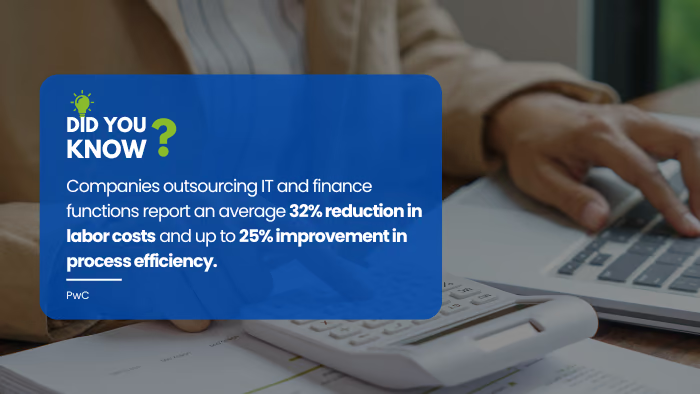
According to Deloitte's Global Outsourcing Survey, 57% of companies cite cost reduction as their primary reason for outsourcing. Statista reports companies save between 20% and 70% on operational costs when outsourcing to third-party vendors, depending on industry and service type. A PwC study found companies outsourcing IT and finance functions report an average 32% reduction in labor costs and up to 25% improvement in process efficiency.
More specifically, ISG's Market Lens BPO Study - which surveyed 368 executives globally - found BPO programs deliver an average of 15% savings over in-house operations, with 68% of respondents listing cost reduction as their top motivator for outsourcing.
The 40% figure is not an outlier. US tech companies outsourcing software development and engineering support regularly reduce costs by 40% or more, according to 2025 outsourcing market analysis. For customer support and back-office functions, the savings range is wider but consistently significant.
Where the 40% Actually Comes From: A Cost Breakdown
The savings do not come from one place - they compound across multiple cost categories simultaneously:
| Cost Category | In-House Cost Driver | BPO Saving |
| Labor | US salary + benefits + taxes | 40–70% reduction via global talent |
| Infrastructure | Office space, equipment, IT systems | Eliminated for outsourced functions |
| Management Overhead | Supervisors, HR, performance management | Reduced - handled by BPO provider |
| Technology | CRM, ticketing, workforce tools | Included in BPO service cost |
| Scalability Cost | Hiring lag during peak demand | Instant capacity flex - no hiring cycle |
| Compliance Risk | Internal legal and regulatory exposure | Managed by experienced BPO teams |
Source: Deloitte Global Outsourcing Survey | ISG Market Lens BPO Study | Statista Outsourcing Cost Data
When all seven cost categories are reduced simultaneously - which is what happens when a business moves a function to a BPO provider - the cumulative saving reaches and frequently exceeds 40%.
The Functions US Companies Are Outsourcing Most
Not every function is equally suited for outsourcing. The highest ROI consistently comes from processes that are repeatable, volume-driven, and do not require deep institutional knowledge to execute well.
The most outsourced BPO functions among US companies in 2025:
- Customer support and contact center operations - handling inbound queries, complaints, and multichannel support across voice, email, chat, and social media. About 60% of mid-to-large US companies now outsource customer support operations entirely.
- Back-office processing - data entry, order processing, billing, claims management, and document handling. These functions consume significant staff time internally but add no strategic value when done in-house.
- Finance and accounting - approximately 40% of US businesses outsource bookkeeping, payroll, tax processing, and financial reporting. Automation tools embedded in BPO platforms accelerate this further.
- Technical help desk and IT support - 77% of US businesses outsource IT functions, spending an average of 8.1% of their IT budget on outsourced support.
Each of these falls squarely within the scope of what professional BPO services are designed to handle - not as a temporary fix, but as a permanent operational model.
What US Companies Get Beyond the Cost Saving
Cost reduction gets the headline, but experienced BPO buyers will tell you the secondary benefits are equally compelling - and often more transformative over time.
Access to specialized talent immediately. Building an internal team with CX expertise, multilingual capability, and process knowledge takes 6–12 months minimum. A BPO provider deploys trained, experienced agents from day one.
Technology without capital investment. Enterprise-grade CRM systems, omnichannel ticketing platforms, workforce management tools, and analytics dashboards - all included in the service cost, not billed separately.
Scalability without risk. A BPO model allows businesses to double their support capacity during peak seasons and scale back during slow periods without the HR burden of hiring and redundancy cycles.
Focus on core competency. This is the benefit that compounds most over time. Every hour your leadership team stops managing call volume reports or payroll queries is an hour redirected toward product, sales, or strategy.

Which Business Functions Should US Companies Outsource First?
BPO works best when the function being outsourced is clearly defined, measurable, and repeatable. If your customer support team handles 200+ tickets per week, if your back-office processes the same data tasks daily, if your finance team runs the same reconciliation cycle every month - these are strong candidates for outsourcing.
Where BPO works less well is in functions requiring deep, real-time institutional judgment - senior strategy, product decisions, and client relationships that depend on context only your internal team holds.
The practical approach most US companies take: outsource the operational layer, keep the strategic layer in-house. That separation is exactly what allows the cost savings to land without sacrificing quality or control.
If you are evaluating what your business could save, the starting point is an honest audit of which functions consume the most time and cost the least strategic value. From there, the case for BPO outsourcing services typically builds itself.
The Bottom Line
The 40% cost reduction figure is not a marketing claim - it is a documented outcome across hundreds of businesses and multiple independent research studies. The mechanism is straightforward: labor arbitrage, eliminated overhead, absorbed technology costs, and operational efficiency that in-house teams rarely match at scale.
The US BPO market is projected to reach $525 billion by 2030, growing at nearly 10% annually. The businesses driving that growth are not cutting corners - they are making a structural decision to operate leaner, scale faster, and compete harder.
The question is not whether BPO outsourcing saves money. The question is how much your business is currently spending to avoid finding out.
Ready to Cut Operational Costs Without Cutting Corners?
Abacus BPO has helped businesses across the US reduce operational costs by outsourcing customer support, back-office processing, and contact center operations — without sacrificing service quality or brand standards.
If your team is spending time and budget on functions that could be handled better, faster, and at lower cost by a dedicated BPO partner, the conversation is worth having.