On this page
- Call center outsourcing in Egypt for European companies reduces operational risk through redundancy
- Infrastructure stability in Egyptian call centers outpaces labor cost savings for European operations
- Compliance frameworks protect European companies from regulatory exposure in Egyptian outsourcing
- Measuring Egyptian call center performance beyond first-call resolution metrics
- Frequently Asked Questions
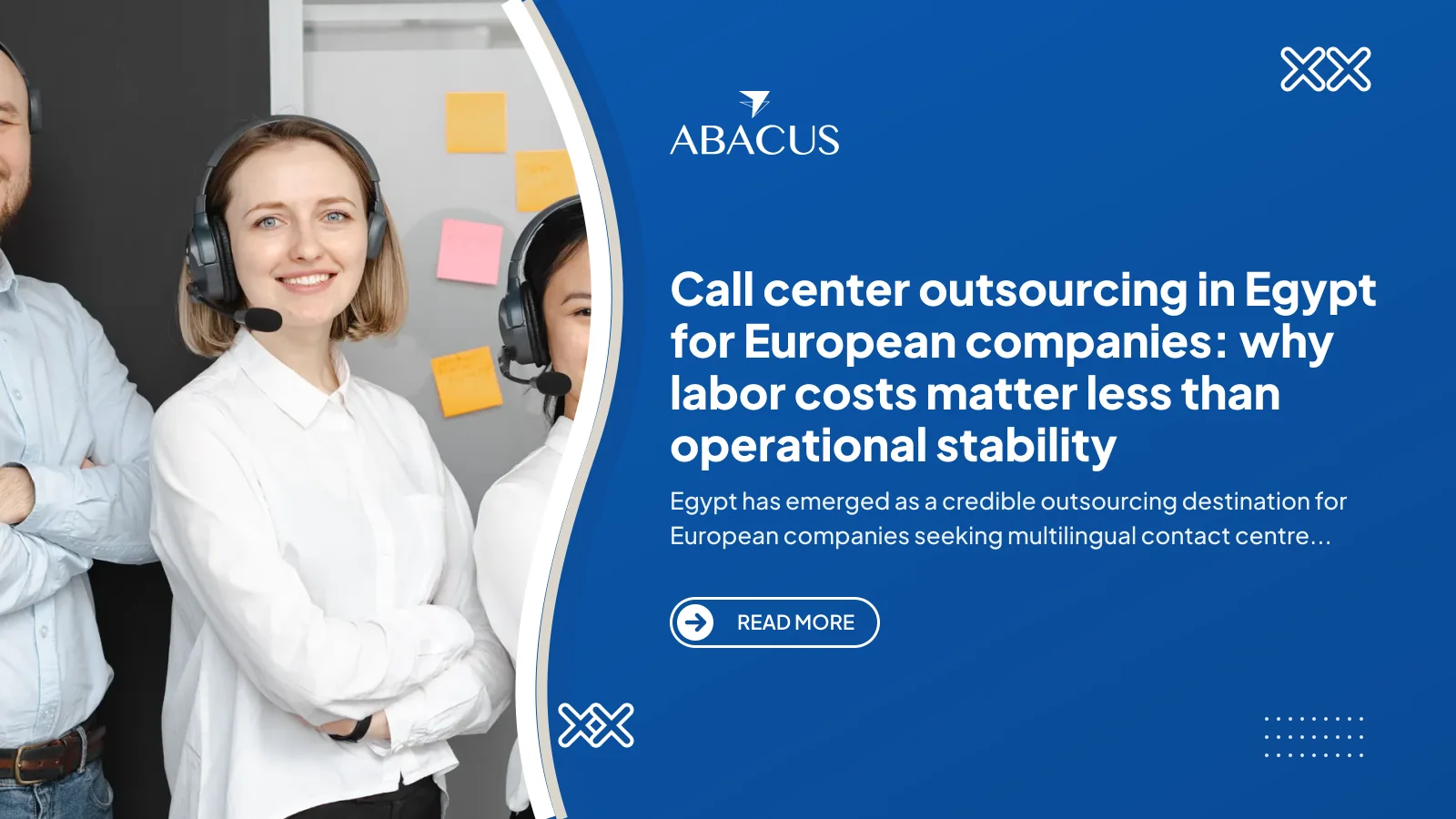
Labor cost is usually the opening argument for any nearshore or offshore outsourcing pitch, and Egypt is no exception. The country's contact centre industry has built a strong multilingual roster, covering English, French, German, Arabic, Italian and Spanish, which makes it genuinely attractive for European brands that need broad language coverage without running separate delivery hubs. But the decision-makers who have actually moved production volume to Egyptian partners tend to tell a different story once the program is live: the wage differential matters far less than whether the lights stay on, the data stays compliant, and the failover actually works. Understanding that shift in priority is the real starting point for any serious evaluation of call center outsourcing in Egypt for European companies.
Call center outsourcing in Egypt for European companies reduces operational risk through redundancy
Geographic separation is one of the most underrated risk controls in a multi-region service model. When a European company routes a portion of its inbound or back-office volume through an Egyptian partner, it places that capacity outside the regulatory, meteorological and infrastructure perimeter of the EU. A localized outage in Germany or France, whether caused by a data center incident, a national grid disruption or a regulatory action, does not cascade into the Egyptian site.
How separation prevents single-region failure
Well-structured outsourcing arrangements designate Egyptian capacity as a warm standby or a blended live-traffic partner rather than a pure overflow queue. The practical difference is significant: a warm standby that has been handling five to ten percent of daily volume has trained agents, calibrated quality processes and live system access already in place. Activating it fully during a European disruption takes minutes rather than days.
Regulatory separation adds another layer. Egypt operates under its own data protection law, Law No. 151 of 2020, which governs personal data handling domestically, but reputable Egyptian providers serving EU clients contractually align their processing to GDPR requirements as a condition of the engagement. This dual-framework approach means the Egyptian site is not simply exempt from EU rules because it sits outside the bloc; it is governed by contract to meet them, while also being insulated from EU-specific enforcement actions that might freeze a purely European operation mid-incident.
Infrastructure stability in Egyptian call centers outpaces labor cost savings for European operations
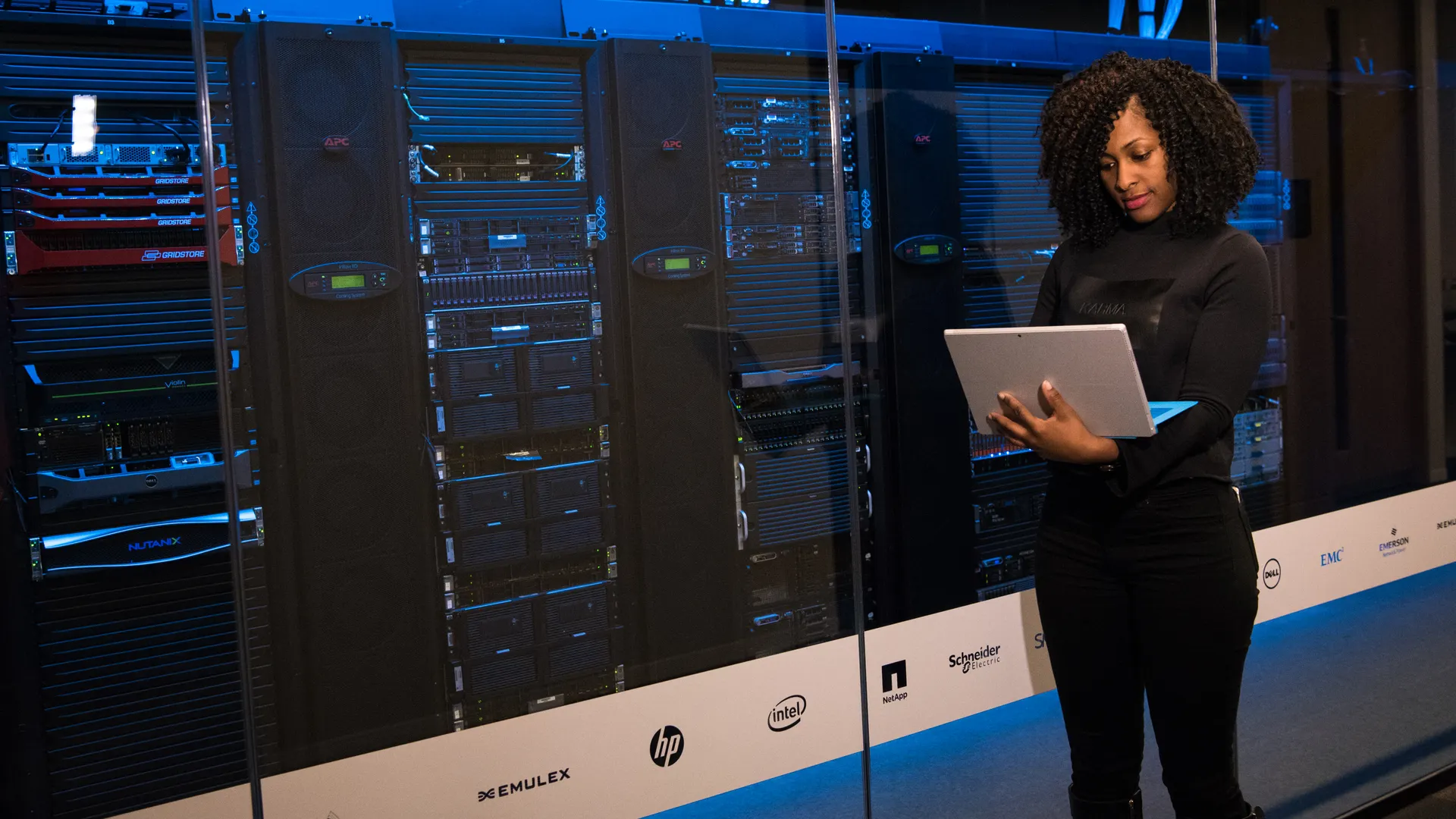
Infrastructure is the category where Egyptian providers have invested most heavily over the past decade, and it is the category that operations leaders most frequently underestimate during vendor selection. Tier-1 facilities in Cairo and Alexandria now run dual-feed power with diesel generator backup, uninterruptible power supply bridging and, in some cases, on-site solar arrays. The practical target is 99.95 percent uptime at the facility level, which translates to fewer than five hours of unplanned downtime annually.
Internet backbone and connectivity
Egypt sits at a strategic junction for submarine cable systems connecting Europe, the Middle East and Asia. That geography gives Egyptian data centers access to multiple independent cable routes, reducing the risk of a single-cable cut degrading voice quality or session capacity for European callers. Providers that have invested in SD-WAN architecture can dynamically reroute traffic across carriers within seconds, keeping average handle time stable even when one upstream link degrades.
A contact centre that saves on hourly wages but runs on a single internet uplink and a shared UPS is trading a visible cost for an invisible liability that surfaces at the worst possible moment.
According to Outsource Consultants, Egypt's strategic location and diverse language capabilities have positioned it as a regional powerhouse for EMEA customer experience delivery. That positioning rests on connectivity infrastructure as much as on workforce depth. Operations leaders evaluating Egyptian partners should request documented carrier diversity certificates and redundancy test logs, not just sales-deck claims about uptime.
Operational stability factors in Egyptian call center outsourcing versus headline labor cost advantages
| Factor | What to measure | Why it matters for European programs | Source |
|---|---|---|---|
| Facility power redundancy | Generator capacity, UPS bridge time | Prevents service outages during grid events | TDS Global Solutions |
| Internet carrier diversity | Number of independent uplinks, SD-WAN deployment | Protects voice quality during cable or carrier failures | Outsource Consultants |
| Multilingual agent depth | Headcount by language, ramp capacity | Supports European language SLAs without thin coverage | CustomerServ |
| GDPR contractual alignment | DPA clauses, SCCs, audit rights | Limits regulatory exposure for EU data controllers | Outsource Accelerator |
| Failover activation time | Minutes to full traffic switchover | Determines actual recovery speed during incidents | TDS Global Solutions |
Source: TDS Global Solutions, Outsource Consultants, CustomerServ, Outsource Accelerator.

Compliance frameworks protect European companies from regulatory exposure in Egyptian outsourcing
GDPR reaches beyond EU borders. Any Egyptian provider that processes personal data on behalf of an EU-established controller is bound by Chapter V of the GDPR, which governs international data transfers. The practical mechanism is a Data Processing Agreement that incorporates Standard Contractual Clauses approved by the European Commission, giving the EU client a contractual basis for the transfer and audit rights over the Egyptian processor.
What compliant Egyptian providers demonstrate
- Signed SCCs or equivalent transfer mechanism documented before data flows begin
- Data residency controls specifying where recordings, transcripts and CRM records are stored
- Agent-level access controls preventing data beyond role scope
- Annual or biannual third-party audits covering physical and logical security
- Documented breach notification procedures aligned to GDPR's 72-hour window
Egypt's domestic Law No. 151 of 2020 and its executive regulations require data controllers to implement technical and organizational security measures, appoint a data protection officer in certain cases and register with the Personal Data Protection Center. While the domestic law does not replicate GDPR in full, its existence means Egyptian providers already operate in a regulated environment rather than a legal vacuum, which shortens the gap that contractual provisions need to bridge.
For European companies weighing the ethical considerations in outsourcing a call center, labor law compliance is equally relevant. Egyptian labor law requires formal employment contracts, sets maximum working hours and mandates social insurance contributions, all of which reduce the reputational risk of a supplier being exposed for precarious employment practices that could reflect on the European brand.
Measuring Egyptian call center performance beyond first-call resolution metrics
First-call resolution and CSAT scores are useful quality indicators, but they are lagging measures. By the time a poor FCR trend surfaces in weekly reporting, a stability problem has already affected customers. The KPIs that actually predict service continuity for a European program running out of Egypt sit at the infrastructure and capacity layer, not the interaction layer.
Stability KPIs that belong in every SLA
- Site uptime percentage: measured at the facility level, not the platform level, targeting 99.9 percent or better on a rolling monthly basis
- Failover activation time: the elapsed minutes from incident declaration to full traffic handling at the backup site or redundant floor
- Concurrent session capacity: the maximum simultaneous voice, chat and email sessions the facility can sustain without degrading average handle time
- Network latency to EU routing hubs: measured in milliseconds, with contractual thresholds for voice-quality degradation
- Shrinkage rate by cause: separating planned absence from unplanned absence reveals staffing fragility before it hits occupancy and queue times
Abacus BPO, which has operated contact centre and back-office programmes since 2008 and holds ISO 27001, ISO 27701 and ISO 18295-1 certifications, applies a similar layered measurement model: infrastructure metrics gate into quality metrics rather than running as parallel, disconnected scorecards. The logic is straightforward. An agent cannot deliver a good interaction from a site that has lost power or dropped its internet uplink. Stability is the floor on which quality stands.
For companies already evaluating multiple delivery locations, reviewing how call center outsourcing companies compare across infrastructure and compliance dimensions provides a useful analytical baseline before contract negotiations begin.
Frequently Asked Questions
Is call center outsourcing in Egypt for European companies legally compliant with GDPR?
It can be, provided the Egyptian provider signs a Data Processing Agreement that incorporates Standard Contractual Clauses approved by the European Commission. The DPA must include data residency controls, audit rights and a breach notification procedure aligned to GDPR's 72-hour window. Without those contractual foundations, the EU data controller remains exposed regardless of where processing occurs.
What languages do Egyptian call centers typically support for European clients?
Egyptian contact centres commonly support English, French, Arabic, German, Spanish and Italian, making them viable for multi-country European programs from a single delivery hub. Language depth varies by provider, so headcount by language and ramp capacity should be validated during due diligence rather than taken at face value from a capabilities deck.
How does infrastructure redundancy in Egyptian call centers work in practice?
Tier-1 facilities in Cairo and Alexandria typically run dual-feed power, diesel generators and UPS bridging, targeting 99.95 percent uptime at the facility level. Internet redundancy is achieved through multiple carrier uplinks and, in mature providers, SD-WAN routing that switches traffic between carriers within seconds. Prospective clients should request documented redundancy test logs, not just uptime claims.
Which operational KPIs should European companies track when outsourcing to Egypt?
Site uptime percentage, failover activation time, concurrent session capacity and network latency to EU routing hubs are the infrastructure-layer KPIs that predict service continuity. Shrinkage rate broken down by cause is equally important because it surfaces staffing fragility before it degrades occupancy and queue performance. FCR and CSAT remain useful but function as lagging rather than leading indicators.
What makes call center outsourcing in Egypt for European companies different from other EMEA outsourcing locations?
Egypt's geographic position at the junction of submarine cable routes connecting Europe, the Middle East and Asia gives it connectivity advantages over landlocked alternatives. Its domestic data protection law, Law No. 151 of 2020, means providers already operate in a regulated environment, shortening the compliance gap that contractual provisions need to cover. Combined with broad multilingual capacity, that combination is difficult to replicate in most other EMEA nearshore markets.