On this page
Customers often form their opinion of a brand based on their initial interactions with their call center agents. It's essentially a customer's first point of contact with your business. To provide consistently effective customer service, you must prioritize Call Center Training.
Take companies like Amazon who know the importance of first-contact resolutions (FCR). Amazon invests in call center training – aiming to address customer problems in the initial interactions. It has maintained a high FCR rate – cutting the volume of repeat calls and boosting customer trust. This led to a 90% satisfaction rating from customers.
Customer experience (CX) and agent experience go hand in hand. Employee satisfaction is important when it comes to providing an optimal customer experience and that's why you need an effective call center training program.
Why Is Call Center Training Important?
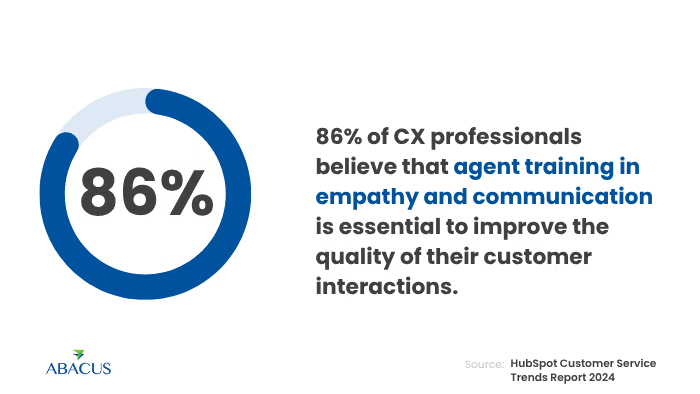
86% of CX professionals believe that agent training in empathy and communication is essential to improve the quality of their customer interactions.
Call center customer service training equips agents with knowledge and skills to do their job optimally. A good agent training program can essentially be the difference between a good and bad customer experience.
- More Skilled Agents – A comprehensive training program equips agents not only with technical product knowledge but also soft call center skills like active listening and empathy. Agents with updated information are better able to cater to customer needs.
- Better Agent Productivity – Contact center coaching equips agents with the skills necessary for effective customer interactions. Top brands like Zappos and Amazon, known for their exceptional call center training program, see quicker response times and optimal satisfaction. Well- trained employees are better able to embody your brand values.
- Decreased Attrition Rates – Investing energy and time in call center courses keeps employees motivated. Satisfied employees are likely to stay longer with a company, resulting in a lower churn rate and reduces the need to recruit new agents. Also, it fosters a sense of engagement and loyalty, leading to long-term retention.
What Are the Practices in Call Center Training?
When it comes to agent training, there are many strategies and techniques, each with varying levels of impact. When creating a training program, it's important to know what to prioritize. Let's look at these best practices for an optimized training program.
1- Provide a Thorough Business Knowledge

A high-performing call agent must have an in-depth knowledge of your business, including the products/services as well as your call center operations. With a training program you can enlighten them with your internal objectives, product specifications, and latest trends. Also, make sure your agents are thoroughly educated on company culture, core values, and mission so they can better represent your brand.
2- Use AI for Enhanced Call Quality Control
For effective customer service quality assurance, it's important to identify improvement areas and provide targeted coaching. It's imperative when it comes to call center training. AI-powered tools can help you review all your customer-agent interactions.
AI provides valuable insights like after-call summaries, transcripts, and recordings, enabling managers to gather actionable feedback. Also, these tools can help detect areas where further development or training is needed, ensuring consistent improvement in your call center operations.
3- Teach Soft Skills to Understand Call Center Etiquette
Treating customers with respect and candor is just as important as enlightening them with product technicalities or company software.
- Etiquette – While being kind and patient is a given, being communicative is just as important. For instance, agents should clearly communicate potential wait times with call center clients. Long queues and frustrated customers can lead to call abandonment.
- Tone – Call center agent must be trained how to handle tricky customers, coming from an angry/negative state of mind. It's never good practice to answer back with the same tone. Instead, agents should maintain a positive tone throughout and deal with patience.
- Active Listening – It's important for agents to listen to customer concerns and queries consciously to show understanding and compassion. Your call center clients should feel heard and that they are dealt with care.
Training in call center etiquette will best prepare your call center agents to make customers feel safe, respected, and valued.
4- Provide Technical Onboarding

An essential purpose of call center training is to make your agents adept and confident at using your call center software and tools. Technical proficiency is important to ensure quick issue resolution, minimizing hold times. Empower your team with training certifications, webinars, and courses.
Develop their customer service skills by providing training on:
- Handling calls
- Redirecting calls
- Using AI to create call transcripts and post-call summaries
- Managing call muting and unmuting functions
- Accessing client profiles during live calls
Also, it's more convenient to pick software that is easy to navigate through and intuitively created to ensure minimal training timelines.
Make Job Shadowing a Part of Your Training
Peer learning or job shadowing is one of the most highly effective call center methodologies for onboarding new call center agents. Shadowing is when a new hire is paired with an expert employee to guide them through their job experience until they get a decent grip of the call center operations. Learning by observation is also incredibly important. It teaches call center agents how to handle calls, gives them exposure to varying scenarios, and boosts their overall confidence.
Call center agent training plays an essential role in optimizing your call center operations. It is always a good practice to invest in an effective contact center training program and leverage training services like the one provided byAbacus BPO.
Get the best trainers, ensuring that your agents are skilled and equipped with tools and knowledge essential to master their domain of call center operations.
FAQ's
What does effective call center agent training cover?
Core training includes product knowledge, soft skills, objection handling, CRM usage, compliance (TCPA, HIPAA where applicable), and call scoring benchmarks.
How long does it take to train a call center agent?
Initial training typically takes 1–4 weeks depending on industry complexity. Ongoing coaching and QA reviews are essential for sustained performance.
What is a call center QA program?
Quality assurance (QA) programs involve regularly reviewing recorded calls against a scorecard tracking metrics like script adherence, resolution rate, tone, and compliance.
Should I outsource call center training or build in-house?
Outsourcing to a BPO provider transfers training responsibility entirely, your vendor hires, trains, and manages agents to your specs, saving significant operational overhead.
What KPIs are used to measure call center training effectiveness?
Key metrics include average handle time (AHT), first call resolution (FCR), CSAT, quality scores per agent, and ramp-to-performance speed.
What are some challenges in implementing call center training programs?
Challenges include maintaining consistent quality in training delivery, ensuring agents retain and apply what they've learned, and keeping training programs aligned with evolving company needs.