On this page
- How voicebot systems handle repeat inquiries that typically require supervisor escalation
- Integration requirements for deploying agent augmentation across existing BPO infrastructure
- Measuring first-contact resolution lift and labor cost impact in BPO environments
- Vendor selection criteria for BPO centers evaluating augmentation platforms
- Frequently Asked Questions
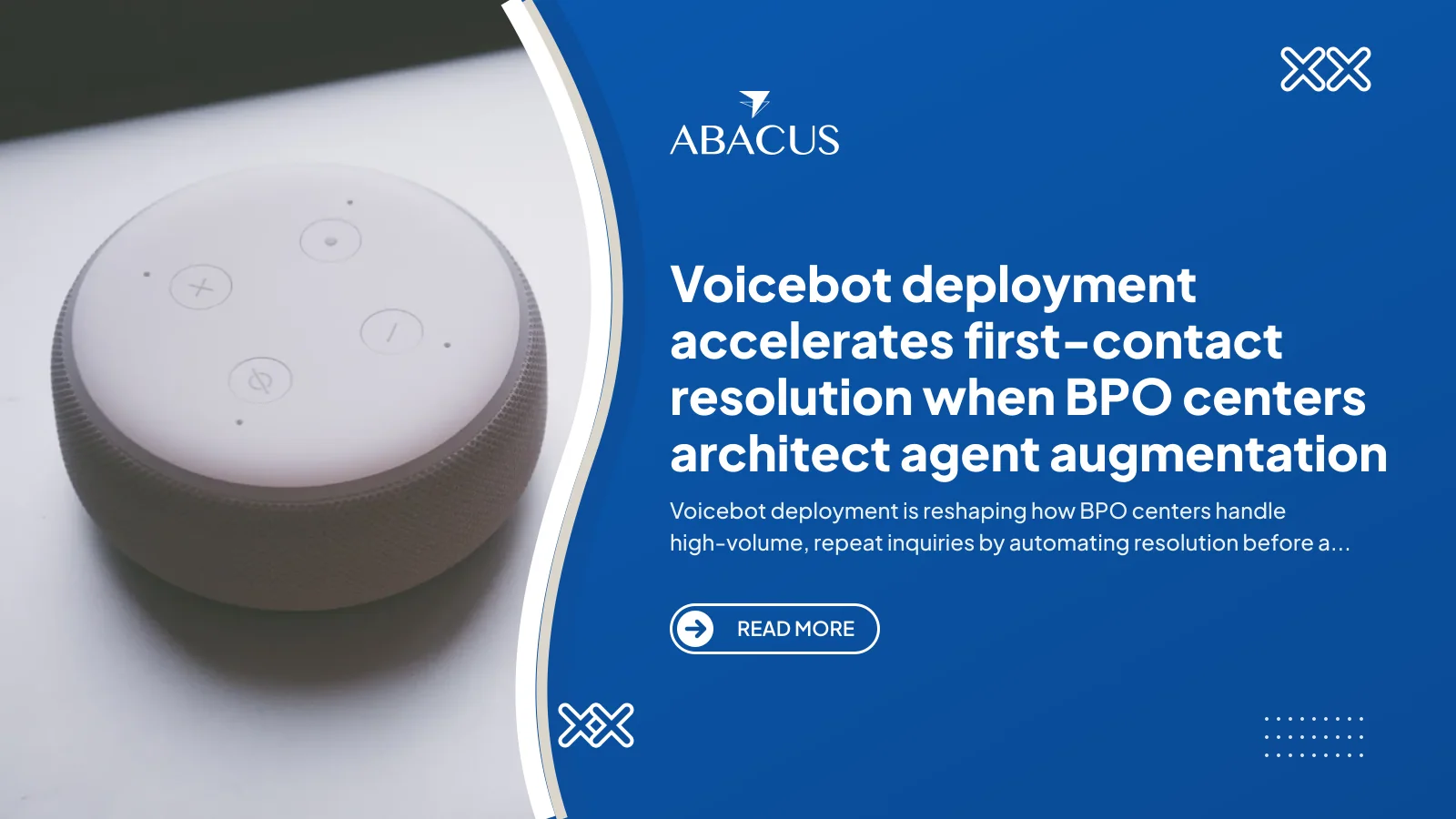
Property insurers processing first notice of loss calls know the problem intimately: a policyholder calls at 11 p.m. on a Sunday after a pipe bursts, and the question is almost always the same set of eight or nine items, claim number, coverage confirmation, next steps, adjuster timeline. That interaction is predictable, emotionally charged and completely unsuited to a 45-minute queue. It is also exactly the kind of call that voicebot for customer service was built to absorb. The question for BPO operations leaders is not whether the technology works in a lab environment. It is whether the architecture decisions, integration constraints and measurement frameworks are in place to make it work on a live floor.
How voicebot systems handle repeat inquiries that typically require supervisor escalation
A voicebot, as defined precisely by Genesys, is an AI-powered virtual assistant that interacts with users through speech, using natural language processing and speech recognition to understand spoken requests, automate responses and complete tasks without human intervention. That definition matters operationally because it draws a hard line between a voicebot and a legacy IVR: a voicebot interprets intent in natural language, not touchtone selections.
First-contact resolution, FCR, is the metric most directly affected. The call patterns that inflate supervisor escalation rates tend to cluster around a small number of inquiry types: account status checks, payment confirmations, claim or order status updates, appointment scheduling and straightforward policy or product questions. These are high-frequency, low-complexity interactions where the resolution path is deterministic once identity is confirmed.
Where voicebots resolve without transfer
- Balance or status inquiries requiring a database lookup and read-back
- Appointment confirmation or rescheduling against a live calendar API
- Standard FAQ responses tied to a knowledge base with version control
- Payment due date or confirmation number retrieval after identity verification
- First notice of loss intake for property claims when a structured data form is the output
The escalation triggers that push these calls to supervisors in human-only queues are rarely complexity. They are authentication failures, long hold times that frustrate the caller into demanding a manager, or agents who lack real-time access to the same system the caller is referencing. A voicebot with direct API access to the system of record removes the middle step entirely.
Integration requirements for deploying agent augmentation across existing BPO infrastructure
Technical architecture is where most voicebot deployments slow down. The voicebot sits at the telephony layer, upstream of the ACD, so it must negotiate SIP trunking or a carrier API handoff before it touches any CRM or policy system. BPO centers running legacy on-premise ACDs face a specific constraint: the voicebot vendor's cloud infrastructure must connect through a session border controller rather than a direct cloud-to-cloud path, adding latency that must be budgeted into the conversation design.
Core integration dependencies
- Telephony layer: SIP trunking or cloud carrier API, with failover routing defined before go-live
- Authentication: identity verification handshake between the voicebot and the CRM or IDP, ideally tokenised rather than credential-passed
- Data retrieval: REST API connections to the system of record with rate limits and timeout thresholds documented
- ACD hand-off: a warm transfer protocol that passes confirmed intent and collected data as a screen-pop to the receiving agent
- WFM impact: voicebot containment changes arrival patterns in the human queue, and shrinkage models must be recalibrated
Workflow modification is as important as the technical wiring. When a voicebot handles 30 to 40 percent of inbound volume on a program, the agent queue changes shape. Average handle time for the remaining human interactions rises because the easy calls have been filtered out. Team leaders who benchmark AHT without adjusting for containment will misread performance, flagging agents as slower when the queue composition has simply shifted.
Voicebot containment does not reduce agent workload uniformly: it concentrates the residual human queue around higher-complexity, higher-emotion interactions, which typically require more coaching investment and tighter quality calibration, not less.
Operational considerations by integration model for voicebot deployment in BPO environments
| Integration model | Latency profile | Legacy ACD compatibility | Data security posture | Deployment timeline | Source |
|---|---|---|---|---|---|
| Cloud-based (SaaS) | Low, dependent on carrier path | Requires SBC for on-premise ACDs | Shared-tenancy; SOC 2 required | Faster initial deployment | Market Research Future, 2024 |
| On-premise | Lowest, local routing | Native compatibility | Data stays within perimeter | Longer; hardware provisioning required | Market Research Future, 2024 |
| Hybrid | Medium; split processing | Moderate; custom connectors often needed | Sensitive data on-prem; model in cloud | Moderate; phased rollout suits BPO | Market Research Future, 2024 |
| Embedded IVR upgrade | Variable; depends on existing platform | High; built on existing telephony | Inherits existing controls | Fastest if ACD vendor supports it | Dialpad, 2024 |
| API-first agent augmentation | Low to medium | High; platform-agnostic | Token-based; auditable call logs | Moderate; integration testing intensive | Voiceflow, 2024 |
Source: Market Research Future, 2024; Dialpad, 2024; Voiceflow, 2024.

Measuring first-contact resolution lift and labor cost impact in BPO environments
A 300-agent operation running a property insurer's first notice of loss line across three time zones illustrates what measurement looks like in practice. Before deploying a voicebot, the program logged roughly 2,200 inbound calls on a typical weekday. Claims intake agents spent an average of 11 minutes per call, most of it reading policy details back from a system the caller could not access directly. Repeat-call rate sat at 28 percent, driven by callers who hung up during peak-hour queues and called back within 24 hours.
Three weeks after a voicebot was placed at the IVR layer with direct API access to the claims platform, containment on status-check and coverage-confirmation intents reached 34 percent of total volume. The repeat-call rate on contained interactions dropped sharply, because the caller received a confirmed answer rather than an estimated one relayed by an agent reading from the same screen. The team leaders' Monday morning calibration sessions shifted focus: instead of reviewing basic intake errors, they were coaching on empathy handling for total-loss conversations, a material upgrade in where supervision time was going.
Metrics to track from day one
- Containment rate: percentage of calls fully resolved by the voicebot without transfer
- FCR delta: change in first-contact resolution rate across contained versus transferred calls
- Repeat-call rate by intent category: segmented, not aggregate
- Post-containment CSAT: surveyed separately from human-handled calls to avoid blending
- AHT migration: track human-queue AHT separately after go-live to account for complexity shift
Baseline assessment requires at minimum 60 days of pre-deployment call data, tagged by intent. Without intent tagging, containment rate cannot be measured accurately because there is no denominator. BPO programs that skip this step typically undercount voicebot performance because untagged escalations are attributed to agent handling rather than voicebot fallout.
Vendor selection criteria for BPO centers evaluating augmentation platforms
Evaluating voicebot vendors for a BPO environment requires a framework built around program-specific constraints, not generic feature comparisons. The first filter is speech recognition accuracy on the actual audio profile of the program: accented speech, background noise from home-based callers, medical or legal terminology in regulated verticals. A vendor demo recorded in a studio environment says nothing useful about performance on a live insurance line.
Evaluation framework
- Intent accuracy benchmark: tested on a sample of 500 real calls from the target program, not vendor-supplied test sets
- Multilingual and accent support: documented language models with accuracy metrics per locale, critical for programs serving Spanish-dominant caller populations
- Compliance certifications: SOC 2 Type II, HIPAA readiness for healthcare adjacencies, PCI DSS for payment-handling intents
- Fallback and escalation design: how gracefully the voicebot transfers when confidence scores fall below threshold, with intent and collected data passed to the agent
- Reporting granularity: intent-level containment data exportable to the BPO's existing WFM and QA platforms
Regulated industry programs add a compliance layer that eliminates several otherwise capable vendors. TCPA exposure, state-level recording disclosure requirements and data residency rules for healthcare adjacencies all affect which deployment models are viable. According to Floatbot's 2024 voicebot guide, modern voicebots use LLM-based reasoning to handle intent variation, but the compliance wrapper around that reasoning must be explicitly scoped during vendor contracting, not assumed from a standard SaaS agreement.
Abacus BPO, which has operated contact centre and back-office programmes since 2008 and holds ISO 27001, ISO 27701 and ISO 18295-1 certifications, evaluates augmentation platforms against both the technical integration requirements above and the compliance profile of each client program before recommending a deployment path. The voicebot for customer service considerations differ meaningfully by vertical, and no single vendor passes every filter for every program type.
Frequently Asked Questions
What is a voicebot and how does it differ from a traditional IVR?
A voicebot is an AI-powered system that understands spoken natural language and responds conversationally, without requiring callers to press touchtone options. Traditional IVR systems route calls based on keypad input or simple keyword detection, while a voicebot interprets full spoken intent using NLP and can complete transactions directly. The practical difference is that a voicebot can resolve an inquiry in a single interaction rather than routing the caller through a menu tree to reach an agent.
How does voicebot deployment affect first-contact resolution rates in a BPO?
Voicebot deployment improves FCR by resolving high-frequency, deterministic inquiries at the IVR layer before they enter the human queue. When the voicebot has direct API access to the system of record, it can confirm account status, claim details or payment information with the same accuracy an agent would use, eliminating the callback loop that inflates repeat-call rates. FCR lift is measured separately for contained calls versus transferred calls to isolate the effect.
What integration work is required before a voicebot goes live on a BPO program?
The minimum integration requirements are a SIP or carrier API connection at the telephony layer, an authenticated API path to the relevant CRM or database, and a warm-transfer protocol that passes collected intent data to the receiving agent as a screen-pop. Legacy on-premise ACDs typically need a session border controller to connect to a cloud-based voicebot platform. Workforce management models also need adjustment because voicebot containment changes the volume and complexity profile of the human queue.
Which compliance certifications should a voicebot vendor hold for regulated industry BPO programs?
For programs handling payment data, PCI DSS certification is required at the voicebot platform level, not just the agent desktop. Healthcare-adjacent programs need documented HIPAA readiness and data residency controls. SOC 2 Type II is a baseline expectation for any cloud-deployed voicebot vendor, and programs operating in states with two-party recording consent laws need explicit disclosure language built into the conversation design before the first spoken word.
How long does it take to see measurable FCR improvement after voicebot deployment?
Meaningful FCR data typically emerges within three to four weeks of go-live, once containment volumes are large enough to produce statistically stable intent-level metrics. However, the baseline assessment period before deployment, ideally 60 days of intent-tagged call data, is what makes that early measurement credible. Without a tagged pre-deployment baseline, it is not possible to calculate FCR delta or identify which intent categories the voicebot is resolving versus escalating.