On this page
- Agentic vs generative AI requires rearchitecting BPO contracts and liability terms
- The staffing math that makes agent autonomy cheaper than hybrid models
- Measuring agent performance when decisions happen in milliseconds without human observation
- Why most contact centers will need a staged deployment rather than full autonomy from day one
- Frequently Asked Questions
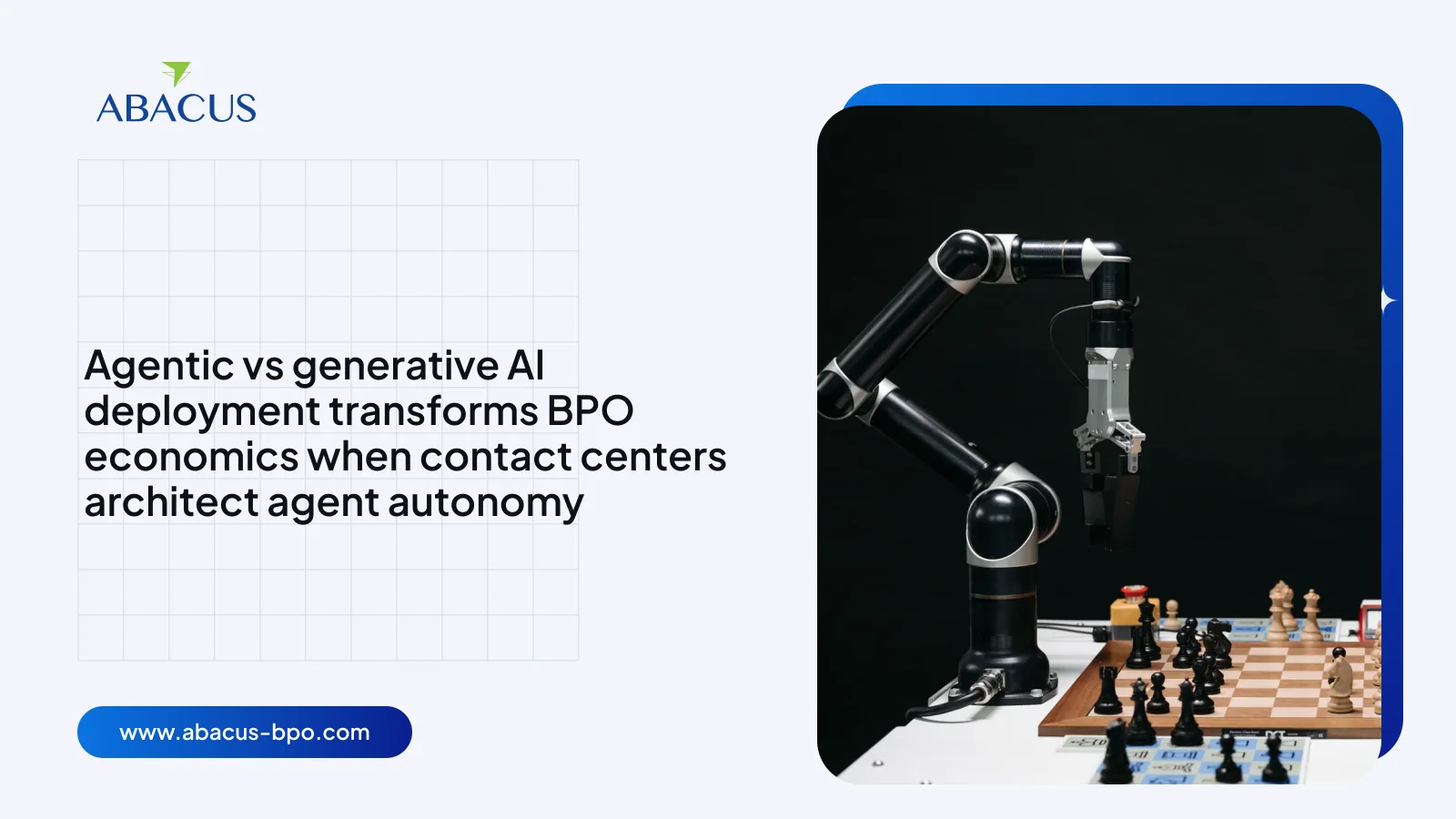
Most contact center technology debates center on what a system can produce. Agentic AI shifts that debate entirely: the question is no longer what the system generates but what actions it takes, on whose authority, and with what accountability trail. For operations and CX leaders evaluating agentic AI in the contact center, the gap between a generative tool that drafts a response and an autonomous agent that processes a return, issues a refund, and closes a ticket without human review is not a feature difference. It is a governance difference, a liability difference, and a staffing model difference all at once.
Agentic vs generative AI requires rearchitecting BPO contracts and liability terms
Generative AI produces an output that a human reviews before it reaches the customer. Agentic AI, as Thomson Reuters explains, operates from an initial set of instructions and autonomously manages multistep processes to achieve a larger objective with less human intervention. That autonomy creates a new actor in the service chain, one that is not covered by traditional BPO master service agreements written around human-staffed processes.
Where standard SLA language breaks down
Conventional contact center SLAs define service levels in terms of human agent behavior: handle time, first contact resolution, adherence to scripts, escalation thresholds. When an autonomous agent makes a binding decision, such as approving a chargeback or modifying a subscription, the question of which party is liable for an error becomes genuinely ambiguous under those legacy terms.
Indemnification clauses written for human error do not map cleanly onto system-generated decisions. Clients typically want the BPO to bear liability for agent actions; BPO operators, in turn, need indemnity from the AI platform vendor when a model decision causes harm. Contracts going forward need explicit tiers: decisions the agent makes unilaterally, decisions it recommends for human ratification, and decisions explicitly outside its authority boundary.
Practical contract additions for autonomous deployments
- Define the agent’s authority ceiling by transaction type and dollar threshold, not by channel
- Require immutable decision logs that satisfy both client audit rights and applicable consumer protection regulations
- Separate uptime SLAs for the AI runtime from quality SLAs for decision accuracy
- Build in a reversibility clause specifying how disputed autonomous decisions are unwound

The staffing math that makes agent autonomy cheaper than hybrid models
Hybrid models, where generative AI drafts and a human approves, reduce handle time but preserve most of the supervision and quality assurance infrastructure. Agentic deployment targets that infrastructure directly. When an autonomous agent resolves a tier-one contact without review, the QA analyst checking that interaction disappears from the cost model, as does one layer of team leader oversight.
FTE displacement follows the QA layer, not the agent layer
The first FTE reductions in a well-scoped agentic deployment typically come from quality assurance, not from frontline agents. A programme running a 10-to-1 agent-to-QA ratio can move toward a 25-to-1 or higher ratio for interactions the autonomous system handles, because machine-generated decisions produce a complete decision record by default. That record replaces the sampling-based QA process for in-scope interactions.
Supervisor span of control also widens. Where a team leader managing blended human-agent queues typically oversees eight to twelve agents, an autonomous agent queue requires supervision that is event-driven rather than scheduled: the team leader responds to exception flags rather than monitoring live calls.
Ramp timelines for agentic deployments run longer than for generative tools because the system must accumulate sufficient decision history to calibrate confidence thresholds before QA coverage can safely thin out.
An e-commerce programme with 110 agents that faced a returns surge across a six-week peak period provides a clear illustration. The operation had been running a generative-assist model: agents used AI-drafted responses and a QA team of nine reviewed 8% of contacts daily. When the team piloted autonomous return approvals for orders under a defined value threshold, the QA team’s review burden on that contact type dropped to exception-only within four weeks. The trade-off was a three-week calibration period during which the agent operated in shadow mode alongside human agents, adding temporary overlap cost before the QA reduction materialized. The operation also discovered that seasonal volume spikes required adjusting confidence thresholds monthly rather than quarterly, a task that required a dedicated AI operations role that had not been budgeted.

Measuring agent performance when decisions happen in milliseconds without human observation
Traditional quality monitoring assumes a human made a decision that can be evaluated against a rubric. Autonomous agent decisions happen inside inference loops that complete before any supervisor can observe them. According to Databricks, agentic AI operates through repeated inference loops where each workflow step triggers one or more model calls, compounding compute and decision complexity across workflow depth. Standard CSAT scoring and post-call surveys capture customer reaction but cannot isolate whether a specific autonomous decision caused a negative experience.
Instrumentation requirements for autonomous decision auditing
- Decision trace logging: every step in the agent’s reasoning chain captured with timestamps, inputs, and the policy rule invoked
- Confidence scoring at the decision point, not just the output, so low-confidence decisions can be flagged for retrospective review
- Outcome-linked attribution: connecting the autonomous decision to downstream metrics such as repeat contact rate, escalation rate, and complaint volume
- Drift detection: monitoring whether the agent’s decision distribution shifts over time, which signals model degradation before it appears in CSAT scores
Compliance audits need a new evidence standard
Regulated industries face a specific challenge: compliance teams are accustomed to reviewing call recordings and agent notes. For autonomous decisions, the equivalent evidence is the decision trace and the policy version the agent was running at the time of the interaction. BPO operators need to retain both, versioned, for the same retention periods their client contracts specify for call recordings.
Operational readiness comparison: generative AI assist vs. agentic AI autonomy in contact centre deployments
| Dimension | Generative AI (assist model) | Agentic AI (autonomous model) | Key implication |
|---|---|---|---|
| Human review requirement | Every output reviewed before delivery | Decisions execute without review | Liability framework must shift; source: Thomson Reuters |
| Infrastructure readiness | 89% of organizations have supporting technology | Only 51% have cloud infrastructure ready | Agentic deployments face a larger readiness gap; source: Adobe Digital Trends 2026 |
| Workflow type | Content generation, response drafting | Multistep process execution | Requires policy-bounded authority definitions; source: AWS Smart Business |
| QA model | Sampling-based human review | Automated decision trace auditing | QA staffing ratios can widen but require new tooling |
| SLA structure | Standard agent performance SLAs apply | Separate runtime and decision-accuracy SLAs needed | Contract renegotiation required before go-live |
| Compliance evidence | Call recordings and agent notes | Decision traces and versioned policy logs | Retention and audit procedures must be updated |
Sources: Thomson Reuters; Adobe Digital Trends 2026; AWS Smart Business.
Why most contact centers will need a staged deployment rather than full autonomy from day one
The appeal of full autonomous deployment is real, but the operational constraints that make it impractical for most programmes on day one are equally real. Adobe’s 2026 Digital Trends report found that only 51% of organizations have the cloud-based technology infrastructure to support agentic AI, compared with 89% for generative AI tools. That gap is not a software gap; it reflects the difference between a tool that generates text and a system that must securely connect to CRM, order management, billing, and compliance systems simultaneously.
Contact type and industry shape the autonomy ceiling
Not all contact types are equal candidates for early autonomy. Order status enquiries, standard return authorizations, and password resets carry low consequence and high predictability, making them appropriate for first-wave autonomous handling. Billing disputes, complaints involving regulatory obligations, and contacts from vulnerable customers carry higher consequence and require human review to remain in place even in mature deployments.
Industry adds another layer. A BPO serving a healthcare client faces different autonomy ceilings than one serving a retail client, because the downstream consequence of an erroneous autonomous decision in a healthcare context can implicate regulatory obligations that no calibration period eliminates.
A practical staged framework
- Stage one: shadow mode, where the autonomous agent produces decisions in parallel with human agents but takes no live action, building the decision history needed for calibration
- Stage two: bounded autonomy on low-consequence contact types, with full decision logging and elevated human review of flagged cases
- Stage three: expanding authority as confidence thresholds are validated, with QA coverage shifting from sampling to exception-driven
- Stage four: full autonomy for in-scope contact types, with periodic policy audits and customer trust monitoring via escalation and repeat contact rates
Abacus BPO, which has operated contact center and back-office programmes since 2008 and holds ISO 27001, ISO 27701, and ISO 18295-1 certifications, structures staged deployments around the compliance and data security requirements of each client’s industry before expanding agent authority. Readers looking for broader context on howgenerative AI enterprise use casesfeed into agentic workflows will find that the transition between the two is less a technology upgrade than a governance redesign. Team readiness is as constraining as system integration: supervisors accustomed to managing agent behavior need retraining to manage agent policy, exception queues, and drift alerts instead.
Frequently Asked Questions
What is the core difference between agentic vs generative AI in a contact center context?
Generative AI produces content that a human reviews before it reaches the customer, while agentic AI executes multistep decisions autonomously without waiting for human approval. In a contact center, that distinction determines who is accountable for the outcome of each interaction and how QA and compliance processes must be redesigned.
How do BPO contracts need to change when agentic AI makes autonomous decisions?
Standard SLA language written for human agents does not assign liability clearly when an autonomous system makes a binding decision such as issuing a refund or modifying an account. Contracts need tiered authority definitions, immutable decision logs, separate uptime and decision-accuracy SLAs, and reversibility clauses for disputed outcomes.
What staffing changes should contact centers expect when deploying autonomous agents?
The first reductions typically come from QA analyst headcount rather than frontline agents, because autonomous decisions produce a complete decision record that replaces sampling-based review for in-scope contacts. Supervisor span of control also widens as oversight shifts from monitoring live interactions to managing exception flags.
Why do traditional quality monitoring methods fail for agentic AI deployments?
Traditional QA assumes a human made a reviewable decision, but autonomous agent decisions execute inside inference loops faster than any supervisor can observe. BPO operators need decision trace logging, confidence scoring at the decision point, outcome-linked attribution, and drift detection to maintain quality and compliance visibility.
Is agentic vs generative AI a binary choice for most contact centers?
No. Most programmes benefit from using both, with generative AI handling content creation and agent assist while agentic AI is scoped to contact types that are low-consequence and highly predictable. A staged deployment approach expands autonomous authority incrementally as confidence thresholds are validated and infrastructure readiness is confirmed.