On this page
- How self service portal metrics reveal true deflection versus false resolution rates
- Agent efficiency gains when deflection reduces routine inquiry volume
- Contact center staffing models shift when deflection reaches 40 percent threshold
- Adoption barriers that slow portal usage despite strong ROI projections
- Frequently Asked Questions
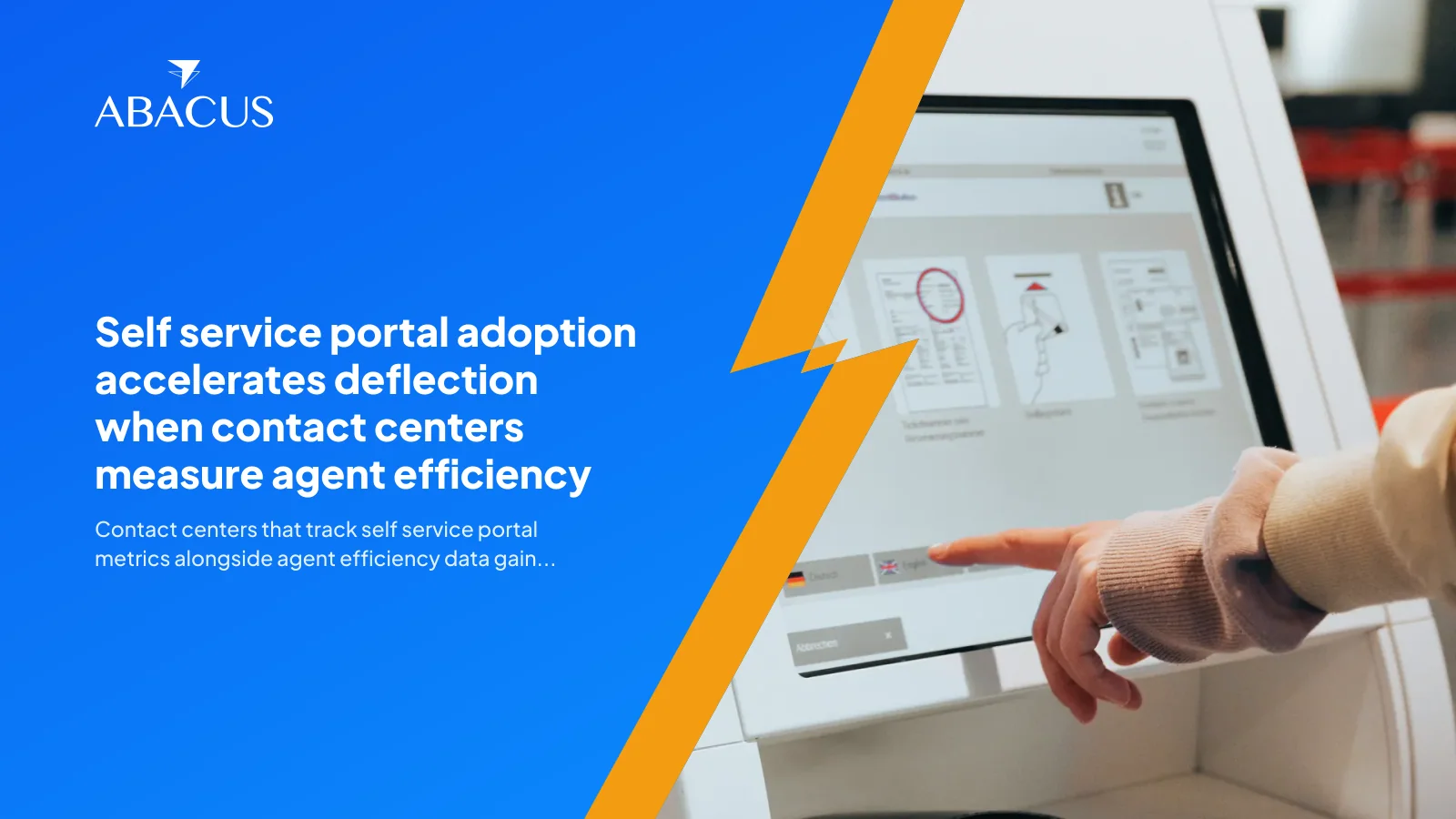
Deflection numbers look great until a team leader opens the escalation queue on a Monday morning. A self service portal can show tens of thousands of completed sessions, yet the inbound call volume barely moves. The gap between reported deflection and actual resolution is one of the most persistent measurement problems in contact centre operations, and it tends to surface at the worst time: during a business review when staffing decisions have already been made. Getting the metrics right is the first discipline; everything else follows from it.
How self service portal metrics reveal true deflection versus false resolution rates
True deflection means a customer resolved their need without any agent involvement, present or future. False deflection means the portal session ended without a submitted case, but the customer called in anyway, opened a chat, or submitted a new ticket the next day. Most reporting systems count the first scenario and miss the second entirely.
Contact ratio as the baseline metric
Gartner identifies contact ratio, the ratio of web sessions to cases submitted online, as the foundational measurement for a self service portal, because it surfaces whether enough content exists to close a customer’s need in one visit. A high session count with a climbing contact ratio signals that visitors are starting journeys but not finishing them. That gap is where false deflection lives.
Operational teams that want cleaner data add a 72-hour lookback: for every portal session marked as resolved, they check whether the same customer identifier generated a voice, chat or email contact within three days. That window captures the most common re-contact patterns without dragging in unrelated future contacts. Any session that triggers a re-contact within that window moves from the deflected column to the failed-resolution column.
Tagging re-contact patterns by failure type
Re-contacts are not all the same. Some customers return because the portal answer was incomplete. Others return because the action the portal prompted, say, a document upload or a status check, did not update the underlying system in time. Separating content failures from integration failures changes the fix: the first is a knowledge base problem, the second is an API latency or sync problem. Running them together in the same metric masks both.
A portal session that ends on a confirmation screen is not a resolution. It is a resolution only if the customer’s need stays closed.

Agent efficiency gains when deflection reduces routine inquiry volume
When a self service portal handles password resets, status inquiries and standard update requests, agents stop spending the first forty minutes of every hour on tasks that require no judgment. The shift is real, but it does not appear in AHT or occupancy figures automatically. It has to be isolated.
How the efficiency signal shows up in the data
The clearest signal is a change in the mix of contact types reaching agents. As self-service adoption rises, the proportion of complex, multi-step or emotionally charged contacts increases as a share of total volume. Average handle time often goes up in this period, not because agents are slower, but because the contacts left in the queue are genuinely harder. Operations leaders who see rising AHT during a portal rollout and interpret it as a performance problem misread the data.
According to Document360’s 2025 self-service statistics report, self-service portals rank as the most preferred support channel among customers today, which means agent queues increasingly hold the contacts customers could not or would not resolve themselves. Those are disproportionately the high-effort, high-stakes interactions where agent skill determines CSAT.
Quality scores and calibration sessions
In a calibration session, team leaders reviewing complex-contact recordings after a portal rollout typically find two things: first-call resolution rates on transferred or escalated tickets improve because agents have more context from the portal interaction history; second, quality scores on routine contacts, which are now rarer, become less statistically meaningful as a sample. Recalibrating quality frameworks to reflect the new contact mix is a step many operations skip, and it distorts performance management for months.
For a practical look at how self-service contact center solutions integrate with agent workflows, the design decisions at the hand-off point matter as much as the deflection rate itself.

Contact center staffing models shift when deflection reaches 40 percent threshold
At low deflection levels, say under 15 percent, the staffing model barely changes. Volume reduction is absorbed by reduced overtime and tighter scheduling. The 40 percent threshold is different. At that point, the contact mix has shifted far enough that skill requirements change, team structures built around volume no longer fit, and ramp plans for new agents need to be rewritten.
A utility operation’s decision point
A 300-agent operation spanning three US time zones handles outage calls for a regional utility. After a major storm system, inbound volume runs at three times normal for five to seven days. The operation had a self service portal for outage status checks, and during the storm it absorbed roughly 42 percent of what would otherwise have been voice contacts. The team faced a choice at day two: backfill with temporary agents trained on the full call type range, or staff only for the complex escalations, billing disputes and medical-baseline customers that the portal could not serve.
The operation chose the narrower staffing model, bringing in a smaller cohort with a four-day ramp focused on outage escalation scripts only. The trade-off was real: when the portal experienced a sync delay on day four and customers could not see accurate restoration times, the under-staffed voice queue hit a 22-minute ASA. A broader temporary cohort would have absorbed that spike more cleanly. The lesson was not that the deflection strategy was wrong, but that staffing contingency plans need a portal-failure scenario built in from the start.
Team composition at the deflection inflection point
Operations that cross 40 percent deflection sustainably tend to shift toward smaller teams with higher tenure requirements, broader agent authority to resolve without escalation, and more time allocated to coaching per agent. Shrinkage calculations also change: when contacts are harder, unplanned absence hits quality harder than it did when volume was the primary pressure.
Adoption barriers that slow portal usage despite strong ROI projections
A well-built self service portal that customers do not use produces none of the efficiency gains described above. Adoption barriers are not primarily technical. They are habitual, structural and sometimes rooted in distrust of digital channels among specific customer segments.
Why resistance persists even when the tool works
The most common barrier is not awareness: it is the first failed experience. A customer who tries the portal once, hits a confusing authentication step or gets a stale knowledge article, and then calls in has a re-contact that hurts the metrics and builds a habit of bypassing the portal. Research published in the Journal of Systems and Software (2025) examining quality aspects of customer self-service in IT service provision found that perceived quality, not feature completeness, drives sustained portal adoption. A portal with fewer features that works reliably outperforms a feature-rich one with inconsistent response accuracy.
Structural barriers on the agent side
Internal adoption faces a different problem. Agents who are measured on call volume sometimes steer customers away from self-service because resolved portal sessions do not appear in their handled-contact count. Incentive structures that reward only voice or chat interactions inadvertently create agents who undermine the deflection strategy. Aligning performance metrics with channel-agnostic resolution, counting assisted deflection where an agent guides a customer to complete a portal transaction, closes that gap.
Strategies that move adoption in practice
- Identify the top five contact reasons driving portal abandonment and fix those journeys before promoting the portal further
- Use post-call IVR prompts to offer portal completion for the same task on the next contact, reinforcing the channel for customers who just called
- Build assisted-deflection into agent scorecards so guiding a customer to portal self-service counts positively
- Set authentication friction as a tracked metric: login failure rate is often the single biggest driver of first-session abandonment
The design of digital self-service platforms that support both customer-facing and agent-assisted flows makes the structural incentive alignment easier to operationalise, because the same interaction record is visible in both channels.
Key self-service portal metrics and what they indicate operationally
| Metric | What it measures | Operational signal | Source |
|---|---|---|---|
| Contact ratio | Web sessions vs. cases submitted | Content coverage and journey completion rate | Gartner |
| 72-hour re-contact rate | Portal sessions followed by agent contact within 3 days | False deflection volume | Operational best practice |
| Portal abandonment by step | Drop-off point in self-service journeys | Specific friction points requiring redesign | Operational best practice |
| Login failure rate | Authentication errors per session | First-session abandonment risk | Operational best practice |
| Assisted deflection rate | Agent-guided portal completions | Incentive alignment and channel adoption health | Journal of Systems and Software, 2025 |
| Customer preference for self-service | Channel preference in surveys | Adoption ceiling by segment | Document360, 2025 |
Source: Gartner; Journal of Systems and Software, 2025; Document360, 2025.
Frequently Asked Questions
What is the most reliable metric for measuring self service portal effectiveness?
Contact ratio, the ratio of web sessions to cases submitted online, is the most direct measure of whether a self service portal is closing customer needs or simply starting journeys that end elsewhere. Pairing it with a 72-hour re-contact check identifies sessions that appeared resolved but generated a follow-up agent contact. Together those two figures give a cleaner deflection rate than session volume alone.
Why does average handle time increase after a self service portal rollout?
When a portal absorbs routine contacts, the cases that reach agents skew toward complex, multi-step or emotionally charged interactions. Those take longer to resolve by nature, so AHT rises even when agent performance is steady or improving. Operations leaders who treat rising AHT during a portal rollout as a productivity problem risk misreading a positive shift in contact mix.
At what deflection level should a contact center reconsider its staffing model?
The 40 percent deflection threshold is where contact mix shifts far enough to change skill requirements and make volume-based staffing models less appropriate. Below that level, reduced volume is typically absorbed through scheduling adjustments. Above it, tenure requirements, agent authority levels and coaching ratios usually need to be restructured.
What stops customers from using a self service portal even when it is well designed?
The most common barrier is a poor first experience, particularly at the authentication step, which builds a habit of calling instead. Research on IT self-service quality published in 2025 found that perceived reliability drives sustained adoption more than feature breadth. A portal that works consistently on a narrow set of tasks builds adoption faster than a comprehensive one with unpredictable accuracy.
How can contact centers get agents to support self service portal adoption rather than undermine it?
Agents measured only on handled voice or chat contacts have no incentive to guide customers toward self-service. Adding assisted deflection to agent scorecards, counting portal completions that an agent facilitated, aligns individual performance goals with the deflection strategy. That structural change is typically more effective than training or policy alone.