On this page
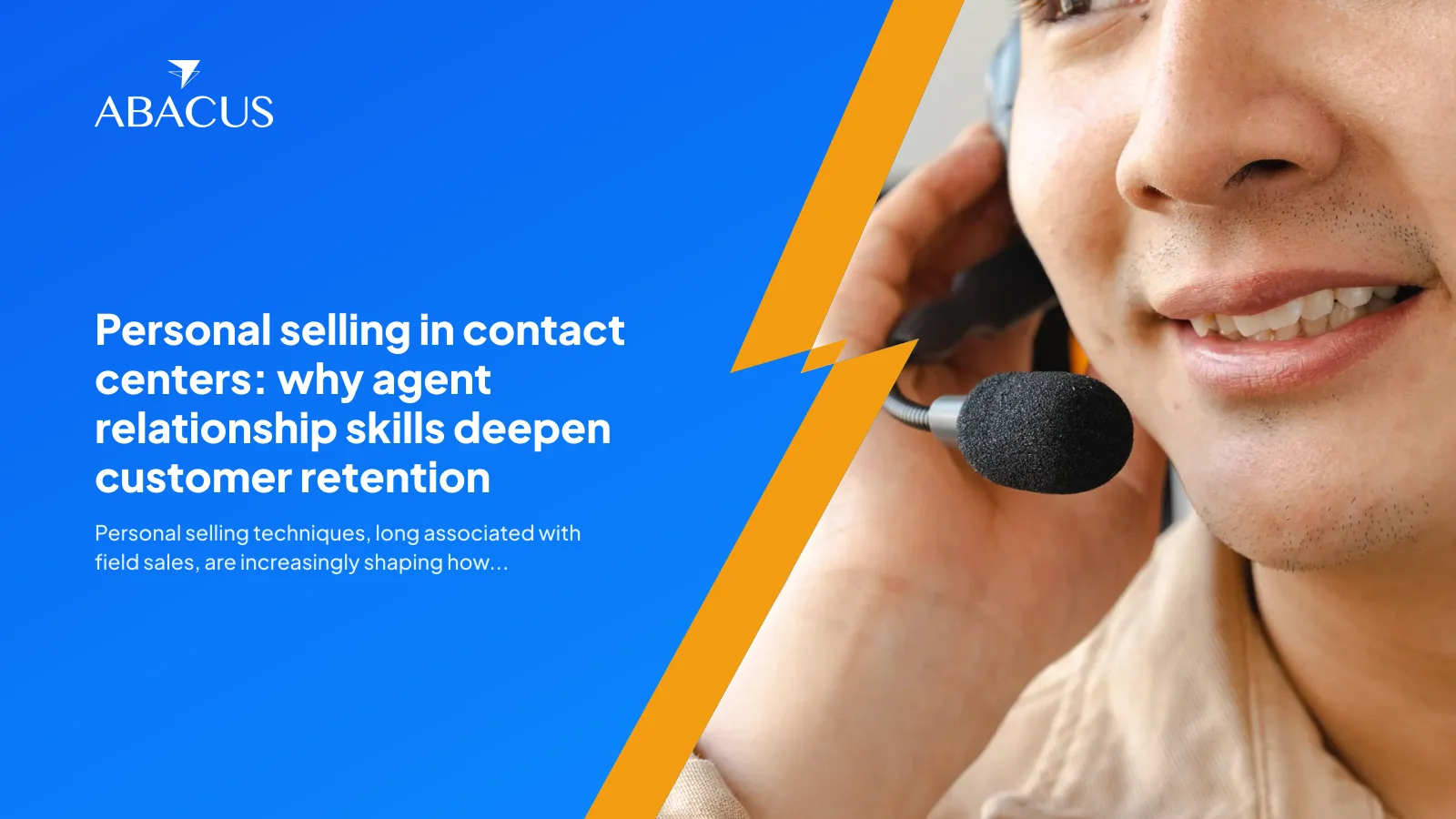
Most contact center leaders think about retention in terms of systems: CRM configuration, routing logic, IVR design. Those things matter, but the research points somewhere more human. When agents move beyond scripted transactions and engage customers with genuine curiosity and tailored responses, churn rates move, repeat contact rates improve, and customers become harder for competitors to pull away. Personal selling, at its core, is the discipline that trains people to do exactly that at scale.
How personal selling creates measurable loyalty metrics for contact centers
Personal selling is the direct, interactive process by which a representative communicates one-on-one with a customer to understand their needs, present a relevant solution, and address concerns, according to Rox's 2026 guide on the personal selling process. In a contact center context, that definition shifts slightly: the goal is not always a first purchase, but often a renewed commitment, an upsell, or simply a retained account that was on the edge of cancellation.
The loyalty mechanics work through three channels. First, customers who feel individually recognized make repeat contacts rather than switching to a competitor's self-service portal. Second, personalized interactions raise first-contact resolution rates because agents probe for root causes rather than closing tickets at face value. Third, a customer who has had a genuinely helpful conversation is significantly more expensive for a competitor to acquire than one who has only ever navigated an IVR.
From transaction to relationship: what the data reveals
A 45-agent retention team at a regional insurance carrier recently reviewed two approaches to policyholder lapse calls. Agents working from objection-handling scripts closed calls faster but rarely surfaced why a customer was actually canceling. Agents trained in personal selling techniques, listening for unstated needs and offering individualized responses, caught issues a script would miss, such as a coverage confusion that a single clarifying sentence could resolve. Churn numbers diverged over a quarter, not dramatically on any single day, but steadily.

Building agent capabilities that drive relationship depth
Structured capability development is where most centers fall short. Generic product training and compliance modules fill the onboarding calendar, while the relational skills that actually move CSAT scores get a single afternoon workshop and are never reinforced. That imbalance is worth correcting deliberately.
According to a 2025 study published in the Journal of Personal Selling and Sales Management, drawing on survey data from 303 salespeople across multiple industries, the interplay between personal motivation and external performance pressure shapes how consistently relationship behaviors are applied. For contact centers, that finding has a practical implication: training alone is insufficient if the coaching cadence and performance framework pull agents back toward speed over depth.
Skills that belong in a relationship-focused training curriculum
- Active listening with explicit acknowledgment of customer context before moving to a solution
- Need discovery through open questions rather than binary qualification prompts
- Adaptive communication that matches tone and vocabulary to the individual customer
- Objection reframing, treating pushback as information rather than resistance
- Follow-through language that sets expectations and signals personal accountability
Calibration sessions work best when team leaders review calls specifically for relational moments: did the agent learn something new about the customer, and did that learning shape the rest of the conversation? That is a different question than whether AHT was under four minutes.
Training for personal selling in contact centers fails when quality scorecards reward speed and compliance but never credit the agent who spent an extra ninety seconds building the rapport that prevented a cancellation.
Competitive advantage when relationship skills set your center apart

In saturated markets, most contact centers compete on the same three variables: handle time, cost per contact, and CSAT score. Centers that develop genuine relationship depth add a fourth variable that is difficult to benchmark and nearly impossible to copy quickly: customer trust built through consistent, individualized engagement.
Mailchimp's analysis of personal selling notes that the technique builds trust and brand awareness in ways that mass-communication channels cannot replicate. For a contact center, that translates directly into brand equity at the agent level: customers who associate a positive experience with a specific interaction style return to that channel rather than migrating to a cheaper self-service alternative.
How relationship depth creates switching costs
Switching costs in B2C and B2B customer relationships are not always contractual. A customer who has received consistent, personalized service faces a soft switching cost: starting over with a new provider means losing the implicit history and context that made the previous relationship comfortable. Contact centers that capture and surface customer context systematically make every interaction feel continuous, and that continuity is a competitive moat.
Personal selling capabilities and their operational retention impact, by approach
| Capability | Transactional approach | Relationship approach | Retention indicator affected | Source |
|---|---|---|---|---|
| Need discovery | Qualification script only | Open-ended probing for unstated needs | FCR, churn rate | Rox, 2026 |
| Adaptive communication | Standard script applied uniformly | Tone and vocabulary matched to customer | CSAT, repeat contact rate | Salesforce |
| Objection handling | Script-driven rebuttal | Reframing resistance as diagnostic data | Save rate, NPS | VCU Marketing Principles |
| Follow-through language | Case closure only | Explicit commitment and next-step setting | Customer effort score | Zendesk |
| Motivation and pressure balance | Speed metrics dominant | Coaching that rewards relational depth | Attrition, quality scores | Journal of Personal Selling, 2025 |
Source: Rox 2026, Salesforce, VCU Marketing Principles, Zendesk, Journal of Personal Selling and Sales Management 2025.
Operational design that sustains personal connections at scale
Relationship-focused service is easy to achieve with a team of ten handling fifty contacts a day. The operational challenge is preserving it across a 300-seat program running at 85 percent occupancy during a peak period. The design choices that make that possible are specific and worth naming.
Agent continuity and intelligent routing
Continuity routing, assigning returning customers to the same agent or agent cohort where queue conditions allow, is the single most direct structural support for personal selling. It is not always feasible at high volume, but even partial continuity, routing a returning customer to an agent who handled their last three contacts, produces measurable context benefits. The agent already knows the account history in a meaningful sense, not just what the CRM record says.
Shrinkage management and staffing philosophy
Relationship-depth interactions run slightly longer than pure-transaction contacts. Operations leaders who insist on the same AHT targets for retention and sales queues as for billing and technical support are effectively designing personal selling out of the program. The fix is a tiered AHT model: different targets for contact types, with retention and complex sales contacts holding a wider tolerance and a different quality rubric. Abacus BPO, which has run contact centre and back-office programmes since 2008 and holds ISO 18295-1 certification for customer contact centres, applies exactly this kind of contact-type differentiation when designing staffing models for relationship-intensive programs.
Scheduling also matters. Agents doing emotionally engaged relationship work need structured break patterns and manageable occupancy rates, not because of sentiment, but because cognitive fatigue is the fastest route to scripted, impersonal responses. Protecting that capacity is an operational choice with a direct quality outcome.
Frequently Asked Questions
What is personal selling in the context of a contact center?
Personal selling in a contact center is the practice of agents engaging customers in direct, individualized conversations designed to understand specific needs and offer tailored solutions, rather than following a fixed script. It draws on the same one-on-one relationship principles used in field sales but applies them to phone, chat, and video interactions. The goal is to build trust and context that make customers more likely to stay and more resistant to competitor offers.
How does personal selling differ from standard customer service?
Standard customer service focuses on resolving a specific issue efficiently, typically measured by handle time and first-contact resolution. Personal selling goes further by treating each interaction as an opportunity to understand the customer's broader situation, surface unmet needs, and reinforce the relationship. The distinction shows up most clearly in retention calls, where a service mindset closes the case while a selling mindset addresses the underlying reason a customer considered leaving.
Can personal selling techniques work in high-volume contact center environments?
Yes, but the operational design has to support them. Continuity routing, tiered AHT targets by contact type, and coaching frameworks that reward relational behaviors alongside speed metrics are the structural requirements. Without those supports, agents default to transactional responses under volume pressure regardless of their training.
What agent skills are most critical for effective personal selling?
Active listening, open-ended need discovery, adaptive communication, and objection reframing are the core skills. Follow-through language, where agents set explicit expectations and signal personal accountability, is often overlooked but strongly affects customer effort scores. All of these can be developed through structured training and reinforced through targeted calibration sessions.
How does personal selling reduce customer churn in practice?
Customers who feel individually recognized and well-served face a soft switching cost when considering a competitor: they would be giving up a relationship that already works. Personal selling builds that implicit context systematically, so churn decisions become less impulsive. In retention queues specifically, agents trained in personal selling techniques surface root causes that scripted objection-handling misses, resolving the real reason for dissatisfaction rather than just the stated one.