On this page
- How AI Personalization Ecommerce Scales Customer Retention When BPO Staff Handle More Volume
- Training Programs That Align Offshore Teams With Brand-Specific Customer Segments
- Why Personalization Fails When Agent Turnover Outpaces Knowledge Transfer
- Measuring Retention Lift From Agent-Driven Personalization Across Multiple Time Zones
- Frequently Asked Questions
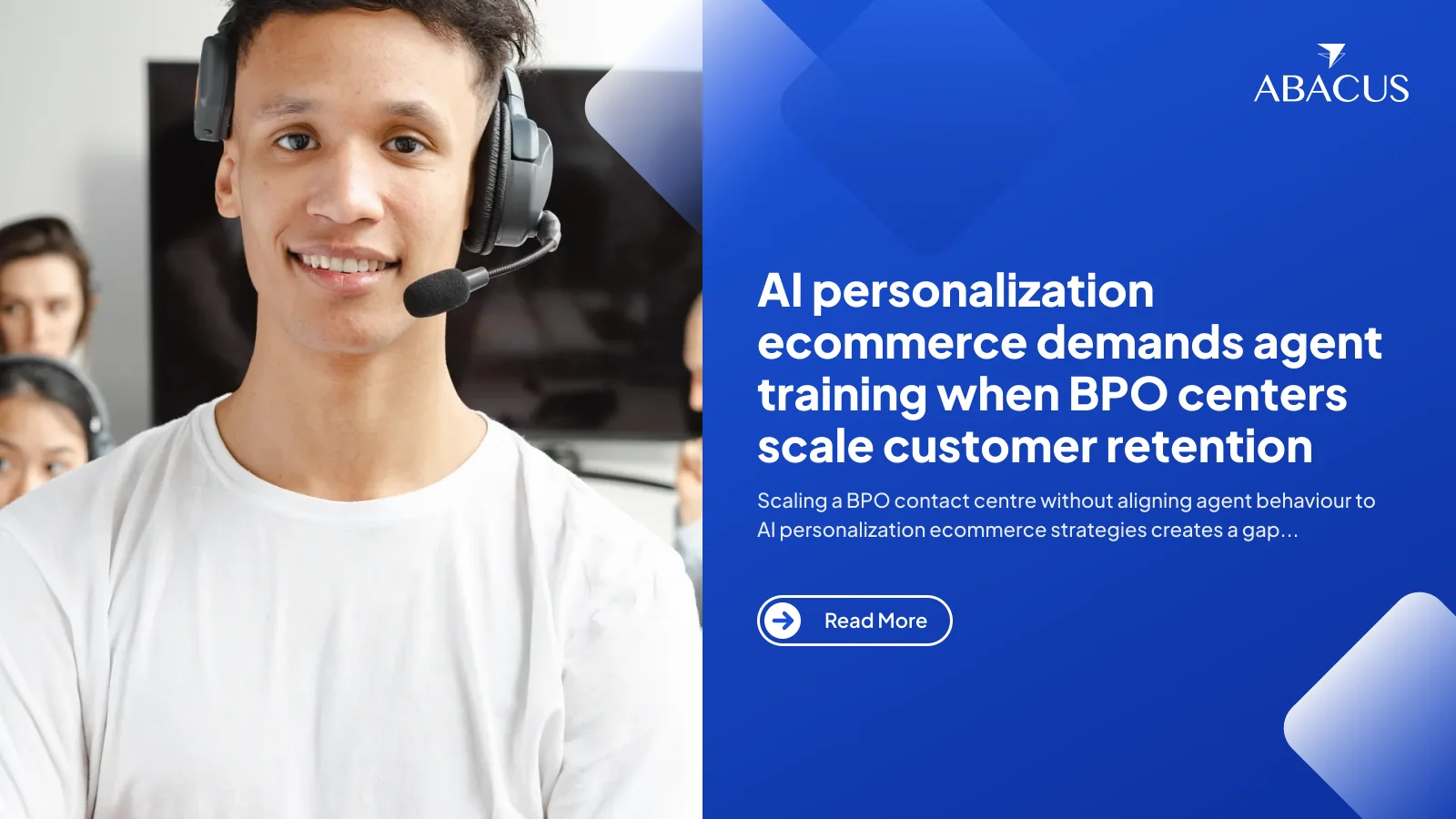
Ecommerce brands invest heavily in AI recommendation engines, dynamic pricing models, and real-time segmentation tools, then route their customers to contact centre agents who have never been briefed on any of it. The result is a friction point that cancels out retention gains the technology was supposed to deliver. Ecommerce BPO outsourcing services that treat agent training as an afterthought to AI personalization ecommerce deployment tend to find their CSAT scores moving in the wrong direction precisely when volume is highest.
How AI Personalization Ecommerce Scales Customer Retention When BPO Staff Handle More Volume
AI personalization in ecommerce works by predicting customer intent and adjusting content, offers, and messaging before a visitor or buyer has to ask for anything. According to Braze's ecommerce personalization guide, machine learning models draw on behaviour across web, app, email, push, and SMS channels to keep every touchpoint contextually relevant. The moment a customer escalates from a digital channel to a live agent, that contextual relevance has to carry through, or the brand experience fractures.
That fracture matters more as volume grows. A BPO centre handling fifty contacts a day can paper over inconsistency. At five hundred contacts a day, inconsistency becomes a pattern that customers remember and act on. Research published in the Advances in Consumer Research journal found that AI-powered personalization improves purchase decision-making primarily through its effect on consumer trust, and that trust is not rebuilt quickly once an agent interaction contradicts what the digital experience promised.
Where Volume Growth Creates Retention Risk
- Agents receive new contact types without updated segment briefings
- Retention offers coded into the CRM are applied generically rather than by segment criteria
- Escalation paths are designed for speed rather than for preserving the personalised experience
- Quality monitoring scores interactions on compliance and handle time, not on segment alignment

Training Programs That Align Offshore Teams With Brand-Specific Customer Segments
Segment-aware agent training starts with one decision: whether agents are assigned to specific customer cohorts or trained to identify cohort signals mid-call. Both models work, but they have different ramp costs and different failure modes. Cohort assignment keeps specialist knowledge deep but creates scheduling constraints. Signal-based training is more flexible but demands a heavier initial investment in call-flow scripting and ongoing coaching.
Building a Segment Briefing Framework
The practical starting point is a segment card: a single-page reference document tied to each AI-defined customer group that tells an agent what that customer's purchase history pattern looks like, what retention offer tier applies, and what tone register the brand expects for that cohort. These cards are not scripts. They are decision criteria, and they should be updated every time the AI model retrains on new behavioural data.
Agents who understand why a retention offer exists for a specific segment apply it with more conviction than agents who apply it because a screen prompt says to. That conviction is audible to customers, and it affects whether the offer is accepted.
Calibration sessions are where segment alignment is tested rather than assumed. A team leader reviewing five calls from the previous shift against the segment card criteria will catch drift within days, not weeks.The operational benefits of outsourcing ecommerce customer service are only realised when the offshore team's quality framework includes segment fidelity as a scored dimension, not just a soft coaching note.
Operational approaches to agent-driven personalization in BPO ecommerce programmes
| Dimension | Cohort Assignment Model | Signal-Based Model | Key Trade-off | Source |
|---|---|---|---|---|
| Ramp time | Shorter per agent | Longer initial training | Cohort model scales headcount faster | Braze Ecommerce Personalization Guide |
| Scheduling flexibility | Low, agents tied to cohort queues | High, any agent handles any contact | Signal model suits unpredictable volume spikes | Wisepops AI Ecommerce Personalization |
| Knowledge depth | Deep segment expertise per agent | Broad but shallower | Cohort model produces stronger retention outcomes per interaction | Advances in Consumer Research |
| Attrition risk | High, specialist knowledge walks out | Lower, knowledge is more distributable | Signal model is more resilient at scale | Firework AI Ecommerce Personalization |
| Quality scoring complexity | Segment-specific rubrics required | Single rubric with signal-detection criteria | Cohort model demands more QA infrastructure | Braze Ecommerce Personalization Guide |
Source: Braze Ecommerce Personalization Guide; Wisepops AI Ecommerce Personalization; Advances in Consumer Research; Firework AI Ecommerce Personalization.

Why Personalization Fails When Agent Turnover Outpaces Knowledge Transfer
A 90-agent operation split across day and overnight shifts illustrates the problem precisely. At the start of the day shift, the team leader opens the workforce management dashboard and immediately sees three things: two overnight agents called in sick, the AI model pushed a new retention offer tier at 02:00, and four of the nine agents scheduled for the first queue block were hired within the past three weeks. The overnight briefing note referencing the new offer tier was read by experienced agents who have since gone home. The new agents have not seen it at all.
That first hour is where institutional knowledge fails. The team leader has to decide between delaying queue opening to run a five-minute briefing or accepting that new agents will apply the previous offer tier to customers who now qualify for the updated one. Neither option is good. The root cause is that the knowledge transfer process was built for stable headcount, not for the attrition rate that rapid scaling produces.
Documenting What Leaves With Departing Agents
The hardest knowledge to retain is not procedural. Procedures live in SOPs. What departs with experienced agents is interpretive: the judgment calls about which segment card applies when a customer's behaviour straddles two cohorts, the tone adjustments that work with high-value at-risk customers, the signals that indicate a retention offer will not land and a supervisor should be looped in. None of that survives in a call-flow diagram.
Research published in Science Direct examining transaction-level data from Amazon found that AI-driven personalization produces measurable behavioural shifts in consumers, but those shifts depend on consistent reinforcement across touchpoints. An agent who misreads a segment cue at a critical retention moment breaks that reinforcement chain at the worst possible time.
Measuring Retention Lift From Agent-Driven Personalization Across Multiple Time Zones
Isolating the contribution of agent personalization to retention outcomes is harder than it looks. Overnight shifts handle a different customer mix than day shifts. Promotional campaigns skew offer acceptance rates. AI model retraining changes the baseline. Any measurement approach that does not account for these variables will attribute retention lift to the wrong cause, which makes it impossible to know what to invest in next.
The Metrics That Actually Isolate Agent Contribution
- Segment-matched offer acceptance rate: whether the agent applied the right offer for the customer's cohort, not just whether the offer was accepted
- Post-contact retention delta: repurchase behaviour in the 30 and 60 days following the interaction, filtered by agent tenure and segment assignment
- First contact retention rate: how often an at-risk customer is retained on a single interaction without requiring a callback or escalation
- Shift-normalised CSAT: satisfaction scores adjusted for the known variance between shift populations so overnight performance is not penalised for a structurally different contact mix
The reporting infrastructure behind these metrics requires the CRM, the workforce management platform, and the AI personalization engine to share a common customer identifier across all shifts. Without that linkage, the overnight team's retention contacts appear in a different data silo from the day team's, and cross-shift analysis becomes a manual exercise that never actually happens. Outsourcing ecommerce customer support to a BPO partner with ISO 27001 and ISO 27701 certifications provides the data governance foundation that cross-system identifier sharing requires. Abacus BPO, which has operated contact centre and back-office programmes since 2008 and holds both certifications alongside ISO 18295-1 for customer contact centres, structures its ecommerce programmes around exactly this kind of multi-shift measurement architecture.
A retention metric that cannot be broken down by shift, agent tenure, and customer segment is not measuring personalisation. It is measuring volume.
Frequently Asked Questions
What is AI personalization ecommerce and why does it affect contact centre agents?
AI personalization ecommerce refers to machine learning systems that tailor product recommendations, offers, and messaging to individual customers based on real-time behavioural data. When those customers contact a BPO centre, agents need to understand the segment context the AI has already established, or the interaction contradicts the digital experience. Agents who operate without that context can undo retention gains the technology was designed to protect.
How should BPO training programmes be structured to support AI personalization ecommerce strategies?
Training should be built around segment cards rather than generic scripts, giving agents the decision criteria for each AI-defined customer cohort rather than a one-size response flow. Calibration sessions should score for segment fidelity as a distinct quality dimension. The choice between cohort assignment and signal-based training depends on scheduling flexibility needs and acceptable ramp time.
Why does agent turnover create a specific risk for AI personalization ecommerce programmes?
Experienced agents carry interpretive knowledge about customer segment signals that does not transfer easily to written SOPs. When turnover is high and headcount is growing rapidly, that knowledge gap means new agents apply outdated offer tiers or misread segment cues at retention-critical moments. The risk compounds when AI models retrain frequently and briefing notes do not reach agents before they take their first contacts.
What metrics best measure the impact of agent personalization on ecommerce customer retention?
Segment-matched offer acceptance rate, post-contact retention delta at 30 and 60 days, first contact retention rate, and shift-normalised CSAT are the most operationally useful measures. Each isolates agent contribution from campaign-level and shift-composition variables that otherwise distort the data. Cross-system customer identifiers linking the CRM, workforce management platform, and AI engine are prerequisites for all of them.
How does operating across multiple time zones complicate AI personalization ecommerce measurement?
Overnight and day shifts typically handle structurally different customer populations, and AI models may retrain between shifts, changing the offer landscape mid-programme. Without shift-normalised metrics and a shared customer identifier across systems, retention data from different shifts lands in separate silos and cross-shift analysis does not happen reliably. Measurement infrastructure needs to be designed for multi-timezone operation from the start, not retrofitted after scaling begins.