On this page
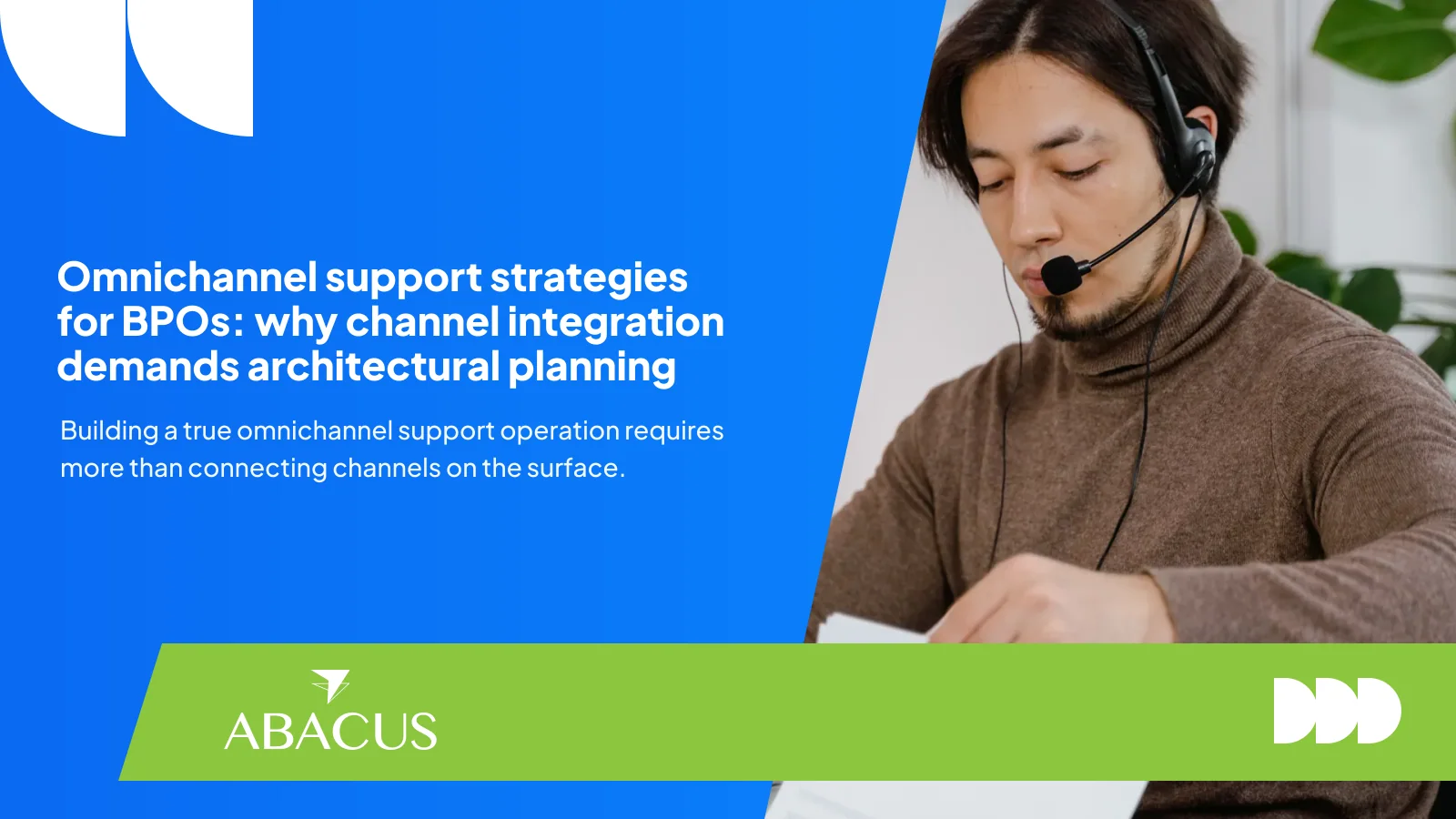
Most contact centre programmes that call themselves omnichannel are, on closer inspection, multichannel with a shared logo. Agents toggle between tabs, customer history lives in three separate systems, and the caller who just sent a chat transcript has to repeat everything. The gap between the promise and the reality is almost always an architectural one, not a channel-count one. Getting to genuine omnichannel capability means making decisions about data infrastructure, workforce design, measurement frameworks and platform selection before a single channel goes live, not after.
Building the omnichannel architecture your BPO actually needs
Genuine omnichannel architecture centres on a single customer record that every channel reads and writes to in real time. That means a CRM or customer data platform sitting upstream of every interaction layer, not downstream of it. When a customer opens a chat, the agent sees the last email thread, the open case from two days ago and the IVR option the customer pressed before being transferred. That context arrives automatically, not because the agent searched for it.
The data plumbing problem
The operational failure mode is integration debt: each new channel gets bolted onto the stack with a point-to-point API connection, and within eighteen months the team is maintaining a web of fragile connectors that break whenever a vendor pushes an update. The cleaner approach is an event-driven architecture where every channel publishes interaction events to a central bus, and downstream systems subscribe to that bus rather than talking directly to each other. It adds upfront engineering effort, but it scales without accumulating technical debt.
- Establish a canonical customer identity key shared by voice, chat, email, SMS and social platforms before any channel is built
- Store interaction history in a single system of record, not in channel-specific databases that sync on a schedule
- Build channel connectors to an API gateway, not directly between platforms, so a vendor change breaks one connection, not many
- Test cross-channel context handoffs in QA before launch, with scenarios that deliberately simulate a customer switching mid-conversation

Staffing decisions when channels demand different skill sets
Channel integration creates a staffing challenge that budget models rarely capture accurately. A voice agent who is average at de-escalation is not automatically a competent chat agent: written communication under time pressure, managing three concurrent chats, and reading sentiment without vocal cues are distinct skills. Blended agent models, where a single agent handles voice and digital simultaneously, sound efficient on paper but produce quality problems unless training addresses each channel's demands separately.
Training investment that is easy to underestimate
Ramp time for a blended agent on an omnichannel programme typically runs longer than for a single-channel role, because agents are internalising multiple interaction modes, multiple queue disciplines and multiple quality rubrics at once. A realistic ramp estimate accounts for competency milestones per channel, not just a single go-live date. A new hire might be fully proficient on voice after six weeks but still be supervised on chat at week ten.
The agents who thrive in blended omnichannel roles tend to have high written fluency and strong task-switching tolerance: traits that standard voice-agent hiring screens do not reliably select for.
Workforce management complexity also increases. Scheduling must account for channel-specific occupancy targets, because a chat queue and a voice queue have different acceptable wait tolerances and different shrinkage patterns. Most legacy WFM tools handle this poorly without configuration work that vendors rarely mention during the sales cycle. The distinction between multichannel and omnichannel staffing models is worth understanding in detail before committing to a headcount plan.

Measuring support quality across channels with unified metrics
Standard contact centre KPIs were designed for single-channel voice operations, and they break in instructive ways when applied to omnichannel. Average handle time means something different on a chat where an agent is handling three concurrent interactions. First contact resolution becomes ambiguous when a customer opens a ticket by email, follows up on chat and gets resolved on a callback. Measuring these events as three separate contacts inflates volume and obscures true resolution performance.
Building a cross-channel measurement framework
The metric that matters most in an omnichannel environment is case-level resolution, tracked against the customer identity key rather than against the individual interaction. A case is open until the customer's issue is resolved, regardless of how many channels touch it. Channel transfer rate, the proportion of cases that require a customer to move from one channel to another to reach resolution, is a reliable indicator of where the architecture or the staffing model is failing.
Key omnichannel support metrics and their operational focus
| Metric | What it measures | Why it matters in omnichannel | Common failure mode | Source |
|---|---|---|---|---|
| Case-level FCR | Resolution without channel transfer | Reflects true end-to-end performance | Measured per interaction, not per case | Zendesk, 2025 |
| Channel transfer rate | Cases requiring a channel switch to resolve | Reveals architecture and staffing gaps | Not tracked separately from escalation rate | TechTarget |
| Cross-channel CSAT | Satisfaction normalised across interaction types | Avoids channel-specific score inflation | Voice and digital scored on different scales | Salesforce |
| Context continuity score | Whether agents received prior context automatically | Measures data infrastructure quality | Treated as an IT metric, not a CX metric | Zendesk, 2025 |
| Blended occupancy | Agent utilisation across concurrent channel types | Prevents burnout in high-chat environments | Voice occupancy targets applied to blended queues | TechTarget |
Sources: Zendesk (2025); TechTarget; Salesforce.
According to Zendesk's 2025 CX guide, companies that connect customer context and data across systems deliver a more personalised experience, which in practice means fewer repeat contacts and lower customer effort scores. Calibration sessions in an omnichannel programme should review cases that crossed at least two channels, because those are the interactions most likely to expose scoring inconsistencies between evaluators.
Vendor selection criteria specific to channel integration capabilities
Platform demos for omnichannel solutions tend to show the best-case scenario: a single agent, one customer, one clean handoff. The operational test is different. What happens when the telephony provider has an outage and chat must absorb the volume? How does the platform handle a customer who contacts via two channels simultaneously? Can a supervisor pull a unified interaction timeline for a specific customer across a date range, without running a custom report?
What to ask in a vendor evaluation
Architecture questions matter more than feature lists. Ask the vendor to describe their data model: where is the customer record stored, who owns it, and what happens to historical data if the contract ends. Ask for a live demonstration of context passing between channels, not a recorded one. Request reference contacts at BPO programmes of similar scale, not retail brands, because BPO environments have multi-client data segregation requirements that single-brand deployments do not face.
- Confirm that the platform maintains a unified interaction history across all supported channels natively, not through a third-party integration
- Test whether agent-facing context displays in a single pane or requires switching between applications
- Evaluate how the platform handles channel-specific SLA clocks, since a chat SLA and a voice SLA run on different tolerances
- Ask specifically about multi-tenant data isolation if the BPO serves more than one client on a shared platform
Abacus BPO, which has operated contact centre and back-office programmes since 2008 and holds ISO 27001, ISO 27701 and ISO 18295-1 certifications, applies those same data-isolation questions when evaluating platforms for its own programmes. The omnichannel customer service strategy that survives vendor transitions is one built on portable data standards, not platform-proprietary schemas. A platform that cannot export a complete interaction history in a standard format is a platform that holds the programme hostage at renewal time.
Frequently Asked Questions
What does omnichannel actually mean in a BPO context?
In a BPO context, omnichannel means that every channel an agent handles, whether voice, chat, email or SMS, reads from and writes to a single customer record in real time. It is distinct from multichannel, where channels operate independently and agents must switch between separate systems. The defining test is whether a customer's full history is visible to any agent on any channel without the customer repeating themselves.
How is omnichannel support different from multichannel support?
Multichannel support means a programme offers several contact channels, but those channels do not share data or context. Omnichannel support connects those channels through a unified data layer, so interaction history follows the customer regardless of which channel they use next. The operational difference shows up most clearly when a customer switches channels mid-issue: multichannel requires them to start over, omnichannel does not.
Which KPIs should BPOs track in an omnichannel programme?
Case-level first contact resolution, measured per customer issue rather than per interaction, is the most reliable top-line metric. Channel transfer rate, which tracks how often a customer must move to a different channel to get resolved, surfaces architecture and staffing failures that per-interaction metrics hide. Cross-channel CSAT, normalised across interaction types, completes the picture at the quality level.
What staffing challenges come with omnichannel contact centre operations?
Blended agents who handle both voice and digital channels need distinct training for each, because written communication under concurrent-chat conditions draws on different skills than voice de-escalation. Ramp periods run longer than single-channel programmes, and workforce management scheduling must account for different occupancy tolerances per channel. Hiring screens designed for voice agents do not reliably identify candidates who will perform well in high-volume chat environments.
What should a BPO look for when selecting an omnichannel platform vendor?
The key questions are architectural: where is the customer record stored, whether context passes between channels natively or through a third-party integration, and whether the platform can export a complete interaction history in a portable format. Multi-tenant data isolation is a non-negotiable requirement for BPOs serving more than one client on a shared instance. Vendor demos should be live and should simulate a channel handoff, not just a single-channel interaction.