On this page
- What Is a B2B Sales Pipeline?
- The Core Stages of a B2B Sales Pipeline
- B2B Sales Pipeline Conversion Benchmarks: 2026 Data
- Pipeline Coverage: How Much Pipeline Do You Actually Need?
- The Five Most Common B2B Sales Pipeline Problems and How to Fix Them
- How AI and Automation Are Changing B2B Pipeline Management in 2026
- How Abacus BPO Supports B2B Sales Pipeline Development
Most B2B revenue problems are not lead volume problems. They are pipeline problems. Too many deals stacked at the wrong stage, too little visibility into where they are actually going, and too much reliance on end-of-quarter heroics to compensate for a process that was never properly designed.
The average B2B win rate across all pipeline stages sits at just 21%, and only 30% of B2B sales reps hit their quota in 2024, reflecting a challenging environment with tighter budgets and longer deal cycles. Those numbers are not just industry averages. They are a description of what happens when pipeline management is treated as a reporting exercise rather than a sales execution discipline.
At Abacus BPO, we run outbound lead generation, appointment-setting, and sales support programs for B2B clients across IT services, SaaS, and outsourcing sectors. A well-built B2B sales pipeline is the operational foundation those programs are designed to feed. This guide covers what a B2B sales pipeline actually is, how each stage works, what the 2026 benchmarks show, and what separates a pipeline that converts from one that just looks full.
What Is a B2B Sales Pipeline?
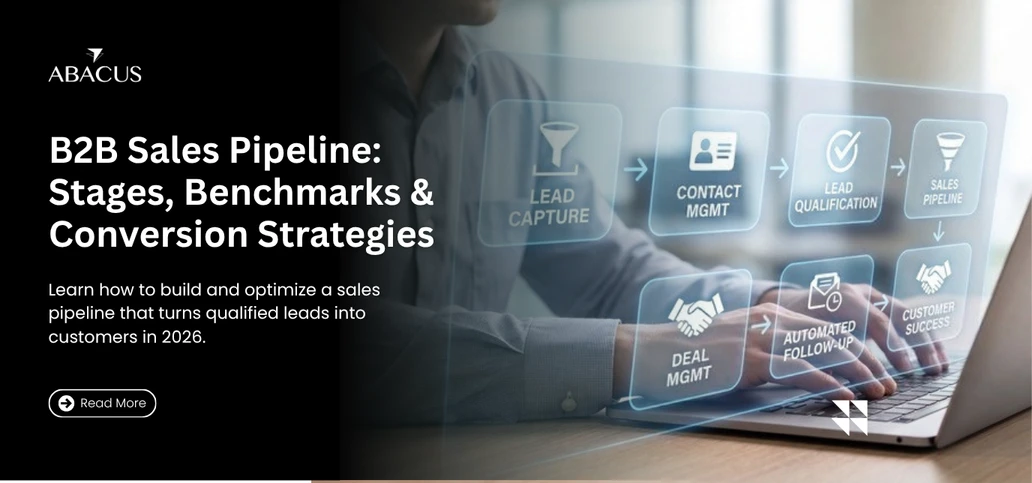
A B2B sales pipeline is a structured, visual representation of where every active deal sits in the sales process, from first contact to closed revenue. It organizes prospects by stage, tracks the activities required to move them forward, and provides a data-based view of expected revenue across a defined time horizon.
A sales funnel represents the buyer's perspective: stages prospects move through based on their readiness to purchase. A sales pipeline represents the seller's perspective: stages your sales reps execute to move deals forward. The funnel focuses on prospect behavior, while the pipeline focuses on sales activities. Both track the same deals but from different angles. Clear definitions prevent sales-marketing misalignment.
The distinction matters operationally. A team that confuses pipeline coverage with funnel health will consistently make poor forecasting decisions. Pipeline management is about what the sales team controls: qualification rigor, activity completion, deal progression, and forecast accuracy. Funnel management is about what the buyer experiences: awareness, interest, evaluation, and decision. Both need to be measured, but with different tools and different accountability structures.
The Core Stages of a B2B Sales Pipeline
While pipeline stage names vary by company and industry, the underlying logic is consistent across most B2B sales processes. Every deal needs to move through a defined sequence of stages, each with clear entry and exit criteria.
Stage 1: Prospecting and Lead Generation
The first stage is identifying potential buyers who match the ideal customer profile (ICP). In outbound programs, this involves building target account lists, researching decision-makers, and initiating first contact through calls, email sequences, or LinkedIn outreach. In inbound programs, it involves capturing and routing leads generated through marketing activity.
The quality of the ICP definition at this stage determines the quality of everything that follows. Loose targeting produces large prospect volumes that convert poorly. Tight, specific targeting produces smaller volumes that convert at meaningfully higher rates.
Stage 2: Lead Qualification
Qualification is the filter between raw prospect volume and genuine pipeline. A prospect moves from the prospecting stage into the pipeline only when they meet defined qualification criteria: typically some version of budget, authority, need, and timeline (BANT), or a more sophisticated framework like MEDDIC for enterprise sales.
67% of lost sales opportunities come from poor qualification. 79% of leads never convert without proper nurturing. The pipeline problem in most B2B organizations is a definition problem, not a lead generation problem.
Stage 3: Discovery and Needs Assessment
Once a prospect is qualified, a formal discovery conversation establishes the specific business problem, the decision-making process, the stakeholders involved, the budget situation, and the timeline. Discovery is where the sales rep confirms or challenges the assumptions from qualification and builds the case for a tailored solution.
Poor discovery is the root cause of proposals that miss the mark, competitive losses that could not have been predicted, and deals that stall after the demo stage.
Stage 4: Proposal or Solution Presentation
Based on discovery findings, the sales team presents a tailored solution. This stage includes product demonstrations, proof-of-concept discussions, pricing presentations, and the formal proposal document. The quality of the proposal is directly determined by the quality of the discovery that preceded it.

Stage 5: Negotiation and Objection Handling
Negotiation covers pricing, contract terms, implementation timelines, and risk mitigation. Objection handling at this stage is qualitatively different from earlier-stage objections: late-stage objections are usually about risk and commitment rather than need or fit, and they require a different response approach.
Stage 6: Closing
The closing stage covers final agreement on terms, contract execution, and handoff to onboarding or delivery. A deal moves to closed-won when the contract is signed and the relationship formally begins.
Stage 7: Post-Sale and Expansion
In B2B relationships with recurring revenue structures, the post-sale stage is as important as any stage before it. Customer success, onboarding quality, and relationship management determine renewal rates and expansion revenue, both of which feed directly back into pipeline as known revenue rather than speculative new business.
B2B Sales Pipeline Conversion Benchmarks: 2026 Data
Understanding where your pipeline is leaking requires benchmarks specific to each stage. The following table reflects current 2026 data compiled from multiple independent research sources.
| Pipeline Stage | Conversion Rate Range | Top Quartile Performance | Notes |
|---|---|---|---|
| Visitor to Lead | 1.5% to 5.0% | 5%+ | Varies by traffic quality and offer type |
| Lead to MQL | 25% to 35% | 40%+ | Depends on ICP targeting precision |
| MQL to SQL | 13% to 26% | 28%+ | Most common leak point in B2B funnels |
| SQL to Opportunity | 50% to 62% | 65%+ | Reflects qualification discipline |
| Opportunity to Demo Completed | 40% to 60% | 65%+ | Depends on outreach speed and relevance |
| Demo to Closed-Won | 20% to 30% | 35% to 40% | Enterprise SaaS typically lower |
| Overall Lead to Customer (blended) | 2.0% to 5.0% | Up to 6.8% | AI-assisted workflows approach upper bound |
| Overall B2B Win Rate (all stages) | 21% median | 35%+ | HubSpot State of Sales, 2024 |
Sources: SPOTIO B2B Sales Funnel Guide 2026, MarketJoy Pipeline Benchmarks 2026, Outreach Pipeline Conversion Benchmarks 2026, SerpSculpt B2B Conversion Report 2026, Martal Group Conversion Statistics 2026
A 15% improvement at three funnel stages can almost double pipeline revenue without adding a single new lead. The 2026 benchmarks reward consistent execution over heroic effort. Most teams underinvest in conversion optimization while overinvesting in traffic acquisition. The cheaper, higher-ROI work is right in front of them.
Pipeline Coverage: How Much Pipeline Do You Actually Need?
Pipeline coverage is the ratio of total pipeline value to quota. It is one of the most important and most consistently miscalculated numbers in B2B sales planning.
Most B2B teams need 3 to 4 times pipeline coverage to hit revenue targets consistently. If your close rate is 25% and your sales cycle is 90 days, you need 4 times coverage. For B2B SaaS companies targeting SMB, a 3-to-1 pipeline coverage ratio is typically required. Enterprise SaaS with longer sales cycles needs closer to 5-to-1.
The calculation is straightforward but the implication is often underappreciated. A sales rep with a $1 million quarterly quota who is managing $2 million in pipeline looks busy. At a 25% win rate, they are actually carrying half the pipeline needed to hit target. Without that visibility, pipeline reviews produce false confidence that does not translate into revenue.
Pipeline coverage also changes throughout the quarter. Healthy pipeline at the start of a quarter means something different from the same dollar amount in the final month, because deals that have not progressed in 30 days are not the same asset as deals that are actively moving through stages.
The Five Most Common B2B Sales Pipeline Problems and How to Fix Them
- Inflated MQL definitions producing poor SQL conversion. When marketing passes contacts to sales before they are genuinely ready, every downstream stage suffers. The median MQL-to-SQL conversion fell to 9.8% in 2026 in one compiled benchmark, largely because many teams inflated MQL definitions and then acted surprised when sales complained. The fix is a shared, written MQL definition agreed between sales and marketing, reviewed quarterly.
- No defined entry and exit criteria per stage. If deals can move between stages without meeting documented criteria, pipeline data is unreliable for forecasting. The CRM becomes a collection of opinions rather than a record of qualified deal status.
- Too much pipeline concentration in early stages. A pipeline where 70% of deals sit in prospecting and qualification looks large but produces little predictable revenue. Healthy pipeline has proportional distribution across stages relative to average sales cycle length.
- Slow follow-up on new leads. The data behind the 5-minute follow-up rule shows that responding to an inbound lead within 5 minutes increases qualification probability ninefold. Most teams consistently miss this window. Speed-to-lead is one of the highest-return, lowest-cost improvements available to most B2B sales operations.
- No pipeline review cadence. Deals that are not reviewed regularly do not stall: they are already stalled, but the CRM does not reflect it yet. Weekly pipeline reviews with defined deal progression questions separate active pipeline from parked opportunities that are inflating the coverage number without contributing to forecast.
How AI and Automation Are Changing B2B Pipeline Management in 2026
AI-powered automation can increase leads by 50% while reducing cost-per-lead by 40 to 60%. The teams beating their industry averages are doing the fundamentals at a higher level of execution, and the data on what those fundamentals look like is more accessible in 2026 than it has ever been.
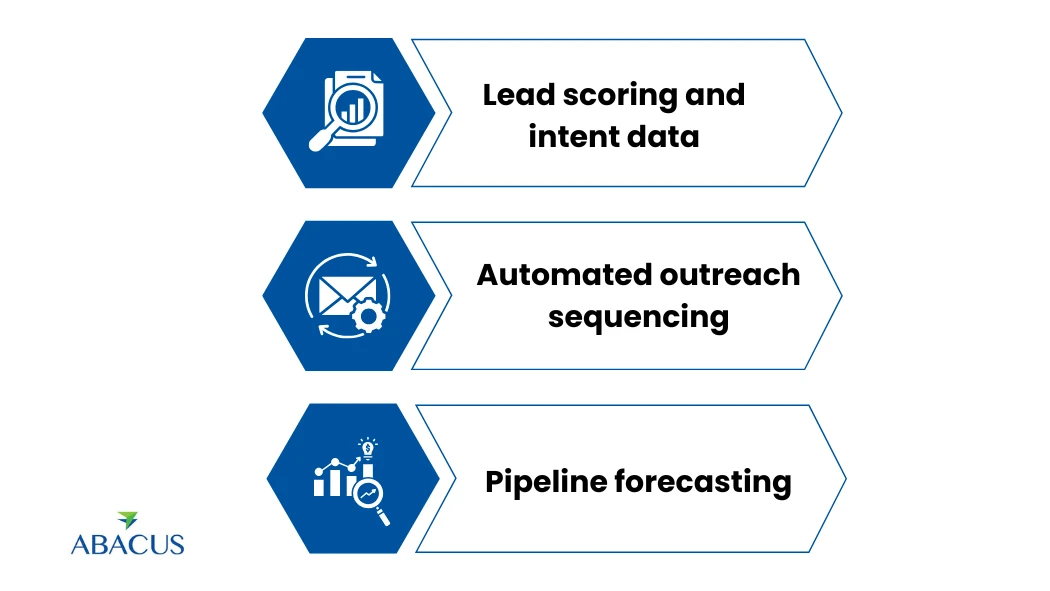
In practice, AI is changing pipeline management at three specific points:
Lead scoring and intent data. AI models trained on behavioral and firmographic signals score prospects by fit and readiness, allowing SDRs to prioritize outreach toward the contacts most likely to convert rather than working a list sequentially.
Automated outreach sequencing. Multi-touch outreach sequences running across email, LinkedIn, and call prompts ensure consistent follow-up without depending on individual rep discipline. The best sequences are personalized by industry, role, and behavior signal rather than generic.
Pipeline forecasting. AI-powered forecasting models trained on historical win/loss patterns produce more accurate revenue predictions than manager-submitted estimates, particularly for long-cycle enterprise deals where end-of-quarter gut calls tend to be optimistically biased.
How Abacus BPO Supports B2B Sales Pipeline Development
At Abacus BPO, our outbound lead generation and appointment-setting programs are designed specifically to feed the top of the sales pipeline with qualified, verified prospects rather than raw contact volume.
In practice, this means:
- ICP definition is built with the client before outreach begins, so the prospects entering the pipeline meet agreed qualification criteria from the first contact
- Qualification criteria aligned to BANT or MEDDIC standards ensure only sales-ready leads are handed to the client's account executive team
- Appointment-setting programs are measured on SQL-to-meeting conversion and meeting-to-opportunity conversion, not just call volume
- Transparent reporting on stage-level conversion rates allows clients to identify pipeline bottlenecks and direct coaching resources toward the stages where improvement generates the highest return
- Follow-up speed and outreach cadence are built into the program structure rather than left to individual SDR discretion
The goal is not to make the pipeline look full. It is to make it produce predictable, closable revenue.