On this page
- What Lead Qualification Actually Means
- Why the MQL-to-SQL Gap Is the Most Expensive Leak in B2B Sales
- The Most Widely Used Lead Qualification Frameworks
- The Real Cost of Skipping Lead Qualification
- How Lead Qualification Has Changed in 2026
- What Lead Qualification Framework Is Right for Lead Qualification in Your Business
- How Abacus BPO Approaches Lead Qualification for Clients
- The Bottom Line
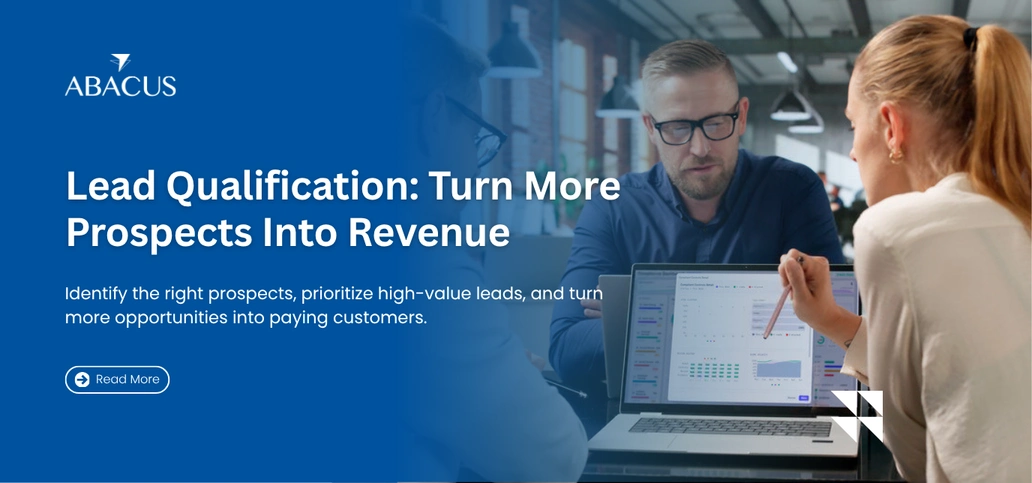
Most B2B sales problems are not lead generation problems. They are lead qualification problems. The funnel is not too narrow at the top. It leaks in the middle, at the point where a prospect moves from showing interest to actually being worth a sales conversation.
The data makes this hard to argue with. According to Salesforce research, 79% of marketing leads never convert into sales, and the primary cause is not a shortage of leads. It is poor qualification and inadequate nurturing after the first contact. Meanwhile, companies with strong qualification processes convert prospects at a 40% rate compared to just 11% for unqualified approaches, a difference that compounds across every campaign and every quarter.
At Abacus BPO, we run lead qualification programs for clients across IT services, SaaS, and BPO sectors. This guide covers the frameworks that actually work in 2026, what the benchmarks look like at each funnel stage, and how to decide whether qualification should sit in-house or with a dedicated outsourced team.
What Lead Qualification Actually Means
Lead qualification is the process of evaluating a prospect against defined criteria to determine whether they represent a genuine sales opportunity worth pursuing. It is the filter between raw interest and real pipeline.
The confusion around the term comes from the fact that "qualified" means different things depending on where the prospect sits in the funnel:
Marketing Qualified Lead (MQL): A contact who has shown enough behavioral engagement, such as downloading content, attending a webinar, or visiting a pricing page, to be considered worth a follow-up. MQLs are not yet vetted for budget, authority, or actual fit.
Sales Qualified Lead (SQL): A prospect that has been reviewed by a sales rep or SDR and confirmed to match the business's specific criteria: right company size, right industry, decision-maker reachable, active need, and budget within range. SQLs are the leads that enter the pipeline as real opportunities.
Most conversion benchmarks that businesses cite when they say "qualified leads" are actually referring to SQLs. Conflating MQL and SQL figures is one of the most common ways teams misread their own funnel health.

Why the MQL-to-SQL Gap Is the Most Expensive Leak in B2B Sales
The transition from MQL to SQL is where the biggest volume of pipeline is lost in most B2B organizations. The 2026 benchmarks illustrate how dramatic that drop is:
| Funnel Stage | Average Conversion Rate | Top Quartile Performers |
|---|---|---|
| Lead to MQL | 31% across all channels | Up to 56% (referral channel) |
| MQL to SQL | 13% industry median | 28% (top quartile, 2026) |
| SQL to Opportunity | 10% to 12% | 15% to 20% (advanced qualification) |
| Opportunity to Closed-Won | 6% to 9% | 20% to 30% (shorter sales cycles) |
| Lead to Customer (blended) | 2% to 5% | Up to 6.8% (AI-assisted workflows) |
Sources: Forrester, Demand Gen Report, MarketJoy, DigitalApplied, 2026
Two things stand out in that table. First, the MQL-to-SQL rate has actually fallen, dropping from 13.1% in 2024 to 9.8% as a median in 2026, largely because more teams are passing unvetted contacts to sales and calling them MQLs. Second, the gap between the median and top-quartile performers at the MQL-to-SQL stage has widened from 15 percentage points in 2024 to 22 points in 2026. The businesses at the top have not changed industries or their product. They have tightened their qualification criteria and improved their follow-up speed.
The Most Widely Used Lead Qualification Frameworks
No single qualification framework works for every business, but the most-used ones share a common structure: they force an explicit decision on each criterion rather than leaving gut instinct to fill in the gaps.
- BANT (Budget, Authority, Need, Timeline): The oldest and still the most recognized framework. A prospect qualifies when they have budget to spend, the authority to decide, a clear need your product addresses, and a realistic timeline to purchase. BANT works well for transactional sales but can feel mechanical in complex, multi-stakeholder B2B deals.
- CHAMP (Challenges, Authority, Money, Prioritization): A variation that leads with the prospect's challenge rather than your product's fit. It is better suited to consultative sales where building trust before qualifying budget is a more natural sequence.
- MEDDIC (Metrics, Economic Buyer, Decision Criteria, Decision Process, Identify Pain, Champion): The enterprise standard. MEDDIC was built for long, complex sales cycles with multiple decision-makers and is now the default qualification structure at most B2B software companies. It requires more from the SDR but produces much higher-confidence pipeline.
- GPCT (Goals, Plans, Challenges, Timeline): Used most frequently in inbound sales contexts. It starts with where the prospect wants to go before getting into whether they can buy, which makes it a good fit for companies where the buyer is already educated and the sale is more about fit than awareness.
Most mature qualification programs layer one of these frameworks on top of intent data and behavioral signals rather than relying on framework questions alone.
The Real Cost of Skipping Lead Qualification
Sending unqualified contacts to sales is not a neutral choice. It has a measurable cost in multiple directions at once.
Across all B2B companies, only 56% verify or validate leads before passing them to sales, meaning nearly half are routinely sending unvetted contacts to account executives. That gap shows up in the data: qualified prospects convert at 40% while unqualified ones convert at 11%, a nearly four-fold gap that applies to every hour a rep spends in conversation.
There is also a speed dimension. Responding to a lead within five minutes makes them nine times more likely to convert. Following up within the first hour increases qualification odds sevenfold compared to waiting longer. For most sales teams, that speed is only achievable when initial qualification is handled by a dedicated SDR function rather than account executives who are also managing pipeline.
And there is the downstream cost of poor data. A contact list with no qualification layer produces lower connection rates, higher spam complaints, and more wasted sales cycles. The average B2B lead-to-customer conversion sits at 2% to 5%. For teams that improve qualification processes, that same traffic and same lead volume can yield conversion rates of 6% or more, without adding a single additional lead at the top.
How Lead Qualification Has Changed in 2026
Three shifts in 2026 have changed how qualification actually runs in practice:
AI-assisted scoring has crossed majority adoption. AI lead scoring adoption rose from 23% of B2B teams in 2024 to 61% by Q1 2026, according to DigitalApplied's benchmark data. Teams using AI-driven scoring are reporting accuracy improvements of up to 40% compared to manual or rules-based scoring, and top-quartile teams using advanced behavioral scoring are hitting MQL-to-SQL rates of 28%, nearly double the industry median.
Intent data has become a qualification layer, not just a targeting tool. Adding behavioral and intent signals to MQL criteria produces an average MQL-to-SQL conversion rate of 16.4%, roughly 70% above the unfiltered median. In practice, this means tracking which pages a prospect visits, which content they engage with repeatedly, and what their company is researching before they ever fill out a form.
Speed-to-lead thresholds have tightened. With buyer attention windows shrinking and most B2B buyers researching multiple vendors simultaneously, following up within five minutes has gone from a best practice to a near-requirement for competitive qualification rates. That threshold is very difficult for in-house teams to hit consistently without dedicated SDR resources or automated first-touch tools.
What Lead Qualification Framework Is Right for Lead Qualification in Your Business
The right qualification framework depends on your deal structure, sales cycle length, and team capacity. A few practical rules apply regardless of which framework you use:
- Define SQL criteria in writing, agreed between marketing and sales. The single most common cause of MQL-to-SQL friction is that marketing and sales are scoring against different definitions. Alignment does not happen by default.
- Set qualification on behavior, not just demographics. Job title and company size tell you who the lead is. Page visits, content engagement, and repeat sessions tell you what they are actually interested in. Strong qualification uses both.
- Build in a speed-to-lead process. Whether that is an automated first-touch sequence or a dedicated SDR on a fast follow-up rotation, the qualification conversation has to happen while the prospect's intent is still active.
- Score disqualification criteria as clearly as qualification criteria. A prospect who fits the target profile but has no decision-making authority, no active budget cycle, or a two-year timeline is not a qualified lead. Knowing when to disqualify is as valuable as knowing when to qualify.
- Review and update criteria quarterly. Markets shift, ideal customer profiles evolve, and qualification criteria that worked a year ago may be sending the wrong signals today.

How Abacus BPO Approaches Lead Qualification for Clients
The most common reason businesses outsource qualification rather than keeping it in-house is not cost. It is capacity and consistency. An in-house sales team that also manages pipeline, account relationships, and demos will always deprioritize top-of-funnel qualification under pressure. A dedicated qualification function does not have that conflict.
Our qualification programs are built around a few consistent principles:
- SQL criteria defined with each client before outreach begins, not after
- Behavioral and intent signals layered into scoring rather than relying on demographic fit alone
- Fast follow-up built into the process structure, not left to individual rep discipline
- Transparent reporting on qualification rate, disqualification reasons, and conversion through each funnel stage
- Regular calibration sessions to update criteria as the client's ICP or market conditions evolve
The goal is not to hand over a list. It is to hand over a pipeline of prospects who have been through a defined evaluation process and confirmed to represent real opportunities for the sales team to close.
The Bottom Line
Lead qualification is not a step you can skip and compensate for with more leads at the top of the funnel. The gap between a 13% MQL-to-SQL rate and a 28% rate is not a marketing gap or a product gap. It is a qualification gap, built from clearer criteria, faster follow-up, and better data at the point of evaluation.
For businesses with a strong lead generation operation that still is not producing the pipeline their sales team needs, qualification is almost always where the answer lies.