On this page
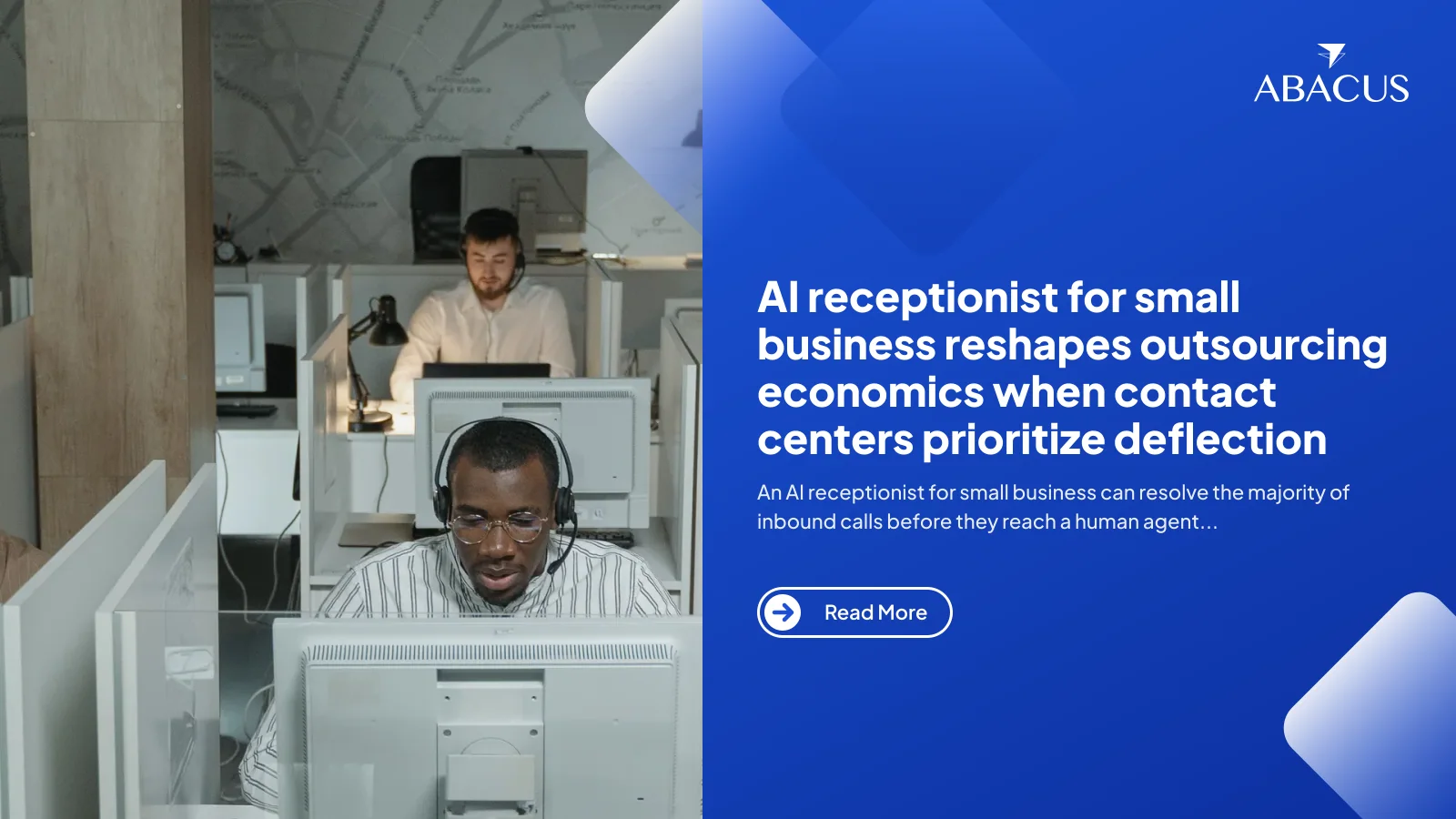
Contact center economics have always rested on a simple premise: more calls mean more agents, and more agents mean higher costs. The emergence of the AI receptionist for small business breaks that premise in a specific and underappreciated way. When automated systems resolve the bulk of inbound volume before a human ever picks up, the entire staffing and pricing architecture that underpins most outsourcing relationships becomes structurally misaligned. That misalignment rarely surfaces in a sales conversation. It surfaces at renewal time, or when a client notices the call volume in monthly reports no longer resembles what either party originally projected.
How AI receptionist for small business reduces the total cost of contact center deflection
Deflection, in contact center terms, means a caller's need is resolved without consuming agent time. Traditional outsourcing prices against the assumption that most calls will reach an agent. When an AI receptionist for small business intercepts and closes a significant share of that volume, the per-call or per-minute cost of the remaining human-handled interactions drops, but only if the contract structure actually reflects the new reality.
What deflection looks like at scale
The numbers from real deployments are striking. RevSquared's 2026 AI Receptionist Industry Report, drawn from analysis of nearly 1.45 million business calls across more than 2,000 small and mid-size businesses, shows AI voice agents handling the majority of routine inbound without escalation. Separately, NextPhone's 2026 benchmark reports 90 to 95 percent of calls resolved without a human for businesses on its platform. Even at the lower end of industry estimates, a deflection rate above 50 percent fundamentally changes staffing requirements.
The three primary deflection mechanisms are automated greeting and triage, qualification routing, and callback or appointment scheduling. Each removes a category of call from the human queue entirely. Appointment booking alone, which platforms such as XBert and Rosie handle natively, eliminates a class of calls that would otherwise consume three to five agent minutes each at no productive outcome beyond the booking itself.
The worked scenario: a travel brand rebooking queue
A 45-agent team supporting two travel client brands ran a rebooking queue during a period of elevated cancellations. A new agent joining in week one found the morning queue already triaged: an AI layer had separated confirmed rebooking requests, general status queries, and escalation-required complaints before shift start. The agent's first fortnight was spent almost entirely on escalation-required calls, the roughly 30 percent the AI did not resolve. That cohort of calls was consistently higher complexity, longer in handle time, and more likely to require supervisor support. The AI had deflected the routine volume, but the human queue that remained was denser, not lighter. That distinction matters for workforce planning: deflection reduces headcount requirements but increases the skill floor for agents who remain.

Pricing model comparison across AI receptionist platforms
AI receptionist pricing and deflection characteristics across platforms, 2026
| Platform | Pricing model | Setup commitment | Deflection mechanism | Source |
|---|---|---|---|---|
| NextPhone | Flat monthly, unlimited inbound | Low, day-one calendar booking | Answers in under 2 seconds, 90-95% resolution rate | NextPhone 2026 |
| Retell AI | Pay-as-you-go, per minute | None, runs on existing number | CRM-connected triage, live in one day | Retell AI 2026 |
| XBert | All-in-one subscription | Low | Answers, books, updates records, multi-channel | YouTube benchmark 2027 |
| Rosie | SMB-focused flat fee | None stated | Lead capture, spam filter, SMS/email follow-up | Smash VC 2026 |
| Generic AI layer (dapta.ai model) | Varies | Low, after-hours and overflow support | Eliminates voicemail, handles repetitive calls | Dapta AI 2026 |
Sources: NextPhone 2026, Retell AI 2026, Smash VC 2026, Dapta AI 2026.
The flat-rate versus pay-as-you-go distinction matters operationally. A flat monthly model rewards high deflection: the more the AI resolves, the lower the effective cost per resolved interaction. A per-minute model, by contrast, charges for every call the AI touches, which can erode the deflection benefit if calls are long or if the AI fails to resolve them quickly. Neither model is universally superior. The right choice depends on inbound volume predictability and the complexity of the call types a business typically receives. For virtual receptionist services for small businesses, flat-rate structures tend to offer more budget predictability when call patterns are uneven.
Deflection rate is a vanity metric unless it is measured against resolution quality. An AI that deflects 80 percent of calls but generates follow-up emails, callbacks, or complaints on 40 percent of those deflections has not reduced the workload: it has redistributed it.
Outsourcing contracts that require renegotiation when deflection rises above 40 percent
Most contact center outsourcing agreements were structured before AI deflection was a realistic operational variable. They typically contain minimum volume commitments, per-minute or per-interaction pricing, and staffing floors that assume a predictable call arrival rate. When an AI receptionist for small business removes 40 percent or more of that volume before it reaches the outsourcer's agents, those agreements develop structural problems that compound over time.

Where the misalignment appears first
The first friction point is the minimum volume commitment. Outsourcing contracts often include a floor, expressed as minimum monthly minutes or interactions, that the client agrees to pay regardless of actual volume. When deflection rises, actual volume falls below that floor, and the client pays for capacity that is no longer being consumed. This is not a theoretical risk. Research published by Deepak Gupta in 2026 found 56 percent of small businesses planning AI receptionist adoption, which signals that outsourcers with SMB-heavy client books will face this volume erosion across multiple accounts simultaneously.
The renegotiation triggers to watch
- Monthly handled volume drops more than 30 percent below the contract baseline for two consecutive billing periods
- Average handle time rises significantly because the AI has deflected routine calls and left only complex interactions
- First-contact resolution on AI-deflected calls falls below the agreed threshold, creating a secondary human workload
- The outsourcer's staffing model no longer matches actual arrival patterns, producing either idle time or queue spikes
What renegotiation actually involves
Renegotiating around deflection is not simply a matter of lowering the volume floor. The composition of the remaining call volume changes too. If AI deflects straightforward inquiries, what remains skews toward complaints, disputes, and high-effort interactions. The outsourcer's cost to handle each of those calls is higher than the blended rate the original contract assumed. A renegotiated agreement needs to address both the volume reduction and the complexity uplift, or neither party ends up with a workable model.
Operations leaders exploring call center solutions for small business that incorporate AI deflection should request contract language that separates routine-interaction pricing from complex-interaction pricing before signing. That separation protects both sides when deflection rates move. Abacus BPO, which has operated contact centre and back-office programmes since 2008 and holds ISO 27001, ISO 27701, and ISO 18295-1 certifications, structures client agreements with volume bands rather than hard floors precisely because deflection variability is now a known planning factor rather than an edge case.
The agent skill floor problem
There is a secondary consequence that rarely appears in contract discussions. When AI deflects the high-frequency, low-complexity calls, new agents entering a queue lose the repetition that builds basic competency. In the travel rebooking scenario described earlier, the new agent's first fortnight contained almost no routine calls to practice on. The ramp period effectively lengthened because the volume that would have built fluency had been deflected. Any outsourcing agreement that includes quality score commitments or ramp-time guarantees needs to account for this shift. Deflection changes what a new agent's first weeks look like, and that changes what a realistic ramp commitment can promise.
Frequently Asked Questions
What is an AI receptionist for small business and how does it differ from a traditional answering service?
An AI receptionist for small business uses voice AI to greet, qualify, and resolve inbound calls automatically, without routing them to a human agent unless escalation is genuinely required. A traditional answering service routes every call to a live agent or takes a message, consuming agent time regardless of call complexity. The key operational difference is that AI deflects resolved calls entirely, while traditional services log and transfer them.
At what deflection rate does an AI receptionist start to affect an outsourcing contract?
Most outsourcing contracts begin showing structural misalignment when AI deflection consistently removes more than 40 percent of the inbound volume the agreement was priced around. Below that threshold, the contract's minimum volume commitments and blended per-minute rates typically absorb the reduction. Above it, the gap between contracted capacity and actual consumption becomes a recurring billing problem.
Does an AI receptionist for small business handle appointment booking natively?
Most leading platforms do. NextPhone, XBert, and Rosie all include native calendar integration that allows the AI to book, reschedule, and confirm appointments without a human agent. This eliminates one of the highest-frequency call types from the human queue and is typically included in the platform's base subscription rather than as an add-on.
How does AI deflection change the complexity of calls that reach human agents?
When an AI receptionist resolves routine inquiries, the calls that escalate to human agents skew toward complaints, disputes, and multi-step problems that require judgment. Average handle time rises and first-contact resolution becomes harder to achieve at the same rate as before deflection. Operations leaders should revise quality and handle-time benchmarks to reflect the new call mix rather than holding agents to targets built for a blended queue.
What contract terms should a small business negotiate before introducing an AI receptionist?
The most important changes are replacing hard volume floors with volume bands, separating routine-interaction pricing from complex-interaction pricing, and adding a clause that adjusts ramp-time commitments if deflection changes the call mix a new agent trains on. Without those adjustments, rising deflection will create a situation where the client pays for unused capacity while the outsourcer absorbs higher handling costs on the calls that remain.