On this page
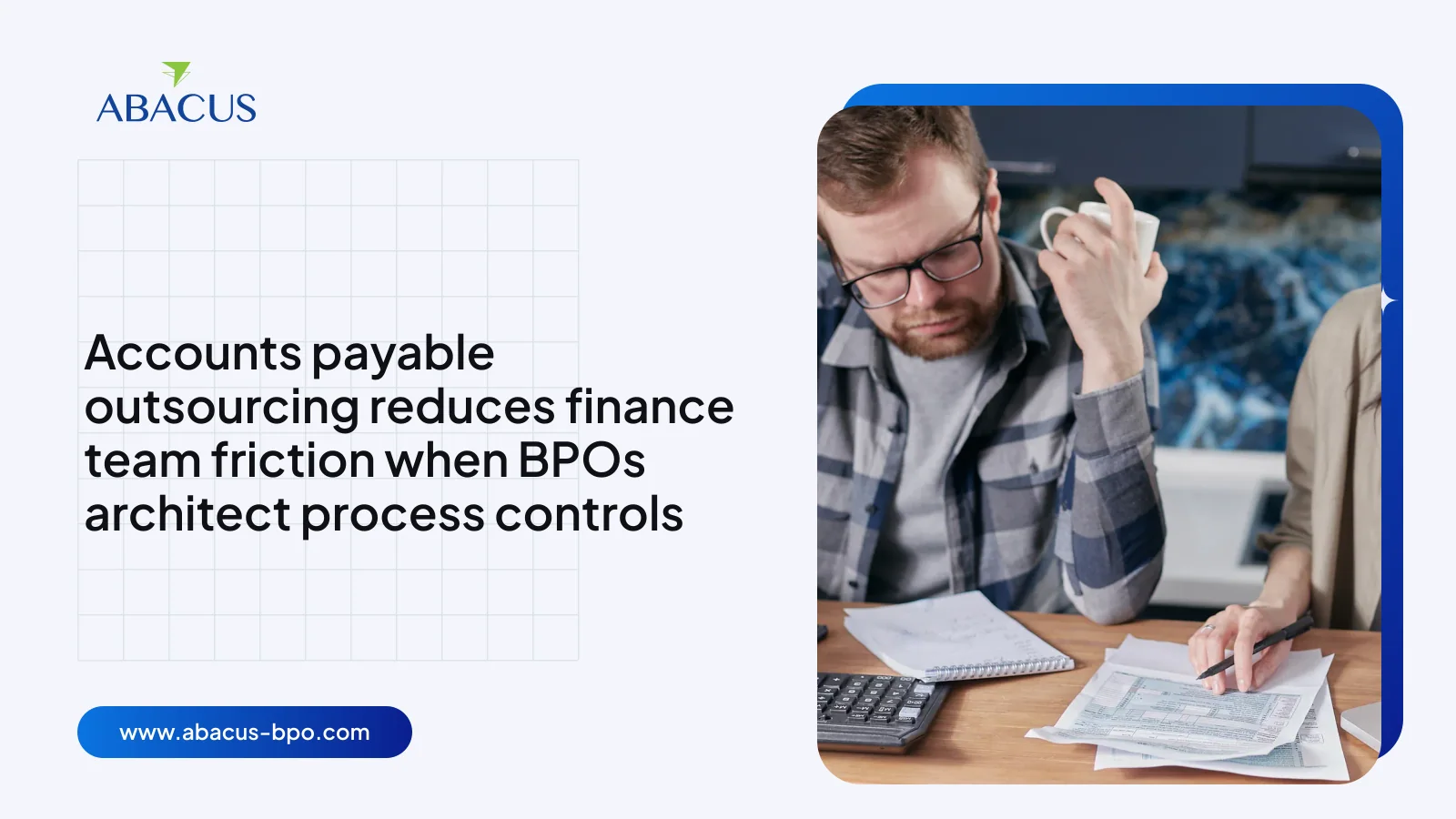
Finance teams at mid-market US companies tend to discover the same painful truth at roughly the same moment: the people they hired to manage vendor relationships and cash flow strategy are spending most of their day keying invoice data, chasing approvals and reconciling mismatches. The backlog grows, month-end closes slip, and skilled accountants burn out on work that frankly does not need their credentials. Accounts payable outsourcing addresses that mismatch directly, but only when the provider does more than lift and shift the same broken process to a cheaper location.
How Accounts Payable Outsourcing Realigns Your Finance Team's Workload
Accounts payable outsourcing reassigns the transactional layer of the function, invoice receipt, data entry, GL coding, three-way matching and payment scheduling, to an external provider whose staff are trained specifically on those tasks. Internal accountants, freed from the queue, can move toward work that genuinely requires institutional knowledge: forecasting payment timing to protect liquidity, negotiating early-payment discounts with strategic vendors, and flagging unusual spend before it becomes a board conversation.
What the reallocation looks like in practice
The shift is not automatic. A provider needs a documented handover of the existing process, including every exception type the internal team currently handles by instinct. That documentation phase typically takes two to four weeks and surfaces a significant number of undocumented workarounds. Those workarounds are often where errors live.
According to Ardent Partners' State of ePayables report, cited by ApprovalMax, top-performing AP teams process invoices in 2.9 days against a global average of 8.5 days. Outsourcing narrows that gap when the engagement includes automation alongside human oversight, rather than manual re-keying at an offshore desk. The trade-off is real: providers who layer automation under their managed service produce faster cycle times, but they require a longer technical onboarding.

Process Controls That Reduce Payment Errors and Compliance Risk
Control frameworks separate credible accounts payable outsourcing providers from those who simply move volume. A well-designed framework addresses three categories of failure: duplicate payments, unauthorized disbursements and regulatory non-compliance. Each has a different root cause and a different control response.
Duplicate and unauthorized payment controls
Duplicate invoices are usually a data problem, not a fraud problem. Vendors submit the same invoice through two channels, email and portal, or a subsidiary re-submits an invoice the parent has already paid. The BPO control here is a header-level match rule that checks vendor ID, invoice number and amount before the record enters the approval queue. Unauthorized payments, by contrast, require a segregation-of-duties structure: the person who codes and approves an invoice must be different from the person who releases the payment file.
Compliance risk at scale
Regulatory exposure grows with transaction volume. 1099 filing accuracy, sales tax on self-assessed invoices and state-specific payment timing rules all create audit risk that internal teams handle inconsistently when volume spikes. BPOs that hold certifications such as ISO 27001 for information security and ISO 27701 for privacy embed those requirements into their standard operating procedures rather than treating compliance as a separate checklist. Abacus BPO, which has operated finance and back-office programmes since 2008 and holds ISO 27001, ISO 27701 and ISO 18295-1 certifications, publishes its control architecture as part of client onboarding documentation, which shortens the internal audit preparation cycle.
Segregation of duties is not a bureaucratic formality. In AP, it is the single control that most reliably catches both honest mistakes and deliberate misuse before a payment clears.
Measuring ROI Beyond the Cost Per Invoice
Finance leaders often frame the outsourcing decision around cost per invoice, which is a useful starting benchmark but a poor ongoing performance signal. The metrics that actually drive business outcomes are days payable outstanding, invoice aging variance and straight-through processing rate.
The metrics that reveal operational health
Key AP performance metrics, what they measure and reference benchmarks
| Metric | What it measures | Reference point | Source |
|---|---|---|---|
| Invoice cycle time | Days from receipt to approval-ready | 9.2 days average; 3.1 days best-in-class | Ardent Partners via QuickPayable |
| Days payable outstanding (DPO) | Average days taken to pay suppliers | Varies by industry; trend matters more than absolute number | Ramp, 2024 |
| Straight-through processing rate | Share of invoices approved with no manual intervention | Best-in-class operations exceed 80% | Auxis Grant Thornton |
| Invoice aging variance | Spread between oldest and youngest open invoices | Tight variance signals consistent queue management | AvidXchange |
| Data entry accuracy | Share of invoices entered with no corrections | Target agreed at contract; sampled regularly | Ardent Partners via QuickPayable |
Sources: QuickPayable / Ardent Partners; Ramp, 2024; Auxis Grant Thornton; AvidXchange.
DPO deserves particular attention because it sits at the intersection of AP performance and working capital strategy. An outsourced provider that accelerates invoice processing without coordinating on payment release timing can actually reduce DPO when the business wants to extend it, or vice versa. The SLA must specify approval cycle targets and payment release windows separately.
Integration Challenges When Connecting BPO Systems to Your ERP
The integration phase is where the majority of accounts payable outsourcing programmes hit their first serious friction. The technical handshake between a BPO's document management platform and a client's ERP, whether SAP, Oracle, NetSuite or a legacy system, involves data mapping, authentication protocols and exception-handling logic that almost always uncovers inconsistencies in how the internal team had been coding transactions.
Where the friction actually surfaces
A useful illustration comes from a finance programme supporting a high-volume travel brand. The operation processed hotel and airline vendor invoices across more than a dozen entity codes, and volume spiked sharply whenever cancellation events triggered mass rebooking. During one particularly heavy week, a batch of roughly 400 vendor credit notes failed to match against their original invoices in the BPO's workflow tool. The team lead escalated the exception report on Tuesday morning, and by Wednesday the root cause was traced to a GL code remapping that had been applied in the client's NetSuite instance on the previous Friday afternoon, two hours after the BPO's weekly data sync. The fix required a same-day sync protocol and a change-control clause in the integration agreement. Without that clause, the BPO had no visibility into ERP configuration changes made outside its operational window.
Practical integration safeguards
- Establish a change-control register that both the client IT team and the BPO operations lead sign off on before any ERP configuration update goes live.
- Map every GL code, cost centre and entity identifier during onboarding, not after go-live.
- Define a data reconciliation cadence, daily for high-volume periods, weekly for steady state, with a named escalation contact on both sides.
- Test exception-handling logic with synthetic edge cases before the first live invoice batch runs.
API connectivity between modern BPO platforms and cloud ERPs is generally more stable than flat-file transfers to legacy systems, but it introduces a different risk: API version deprecation. When the ERP vendor releases a major update, the BPO's connector may break silently, passing no error until a payment file fails to generate. Scheduling a quarterly connector health check into the governance calendar costs almost nothing and catches this category of failure early. For a fuller picture of how outsourced versus in-house finance operations compare on governance and control, that structural comparison is worth reviewing before finalising an engagement model.
Frequently Asked Questions
What does accounts payable outsourcing actually include?
Accounts payable outsourcing typically covers invoice receipt, data entry, GL coding, three-way matching, payment scheduling and vendor query management. The exact scope depends on the engagement: some organisations outsource the full cycle, others retain payment release internally. The provider should document every task in a process map before the first invoice is transferred.
How long does it take to onboard an accounts payable outsourcing provider?
A realistic onboarding for a mid-market AP programme runs four to eight weeks, covering process documentation, ERP integration, staff training and parallel-run testing. Programmes with complex multi-entity structures or legacy accounting systems typically sit at the longer end. Rushing the parallel-run phase is the most common cause of early error spikes.
What controls should an accounts payable outsourcing provider have in place?
At minimum, the provider should operate segregation of duties between coding, approval and payment release, run header-level duplicate detection on every invoice, and maintain an audit trail that satisfies both internal and external audit requirements. Certifications such as ISO 27001 signal that information-security controls are independently verified rather than self-reported.
How is accounts payable outsourcing performance measured?
The most operationally meaningful metrics are invoice cycle time, straight-through processing rate, DPO trend and data entry accuracy. Cost per invoice is a useful baseline but does not capture whether the provider is improving cash flow timing or reducing compliance exposure. Both should be specified as SLA targets in the contract.
What are the biggest risks of accounts payable outsourcing?
The most common risks are ERP integration failures that create processing gaps, loss of visibility into invoice status during transition, and SLA misalignment where the provider optimises for speed while the business needs to manage DPO strategically. Each risk has a known mitigation: change-control protocols, real-time reporting access and separate SLA clauses for approval cycle and payment release timing.