On this page
- Business Process Outsourcing vs. In-House: Which Is Best for You?
- Understanding the Basics: In-House vs. BPO
- Why Businesses Choose Outsourcing
- In-House Operations: The Traditional Approach
- Comparative Overview: BPO vs. In-House
- The True Cost Equation
- Quality, Control, and the Customer Experience Factor
- When In-House Makes More Sense
- Hybrid Models: The Best of Both Worlds
- Key Considerations Before You Decide
- The Bottom Line: Which Is Best for You?
- Final Thought
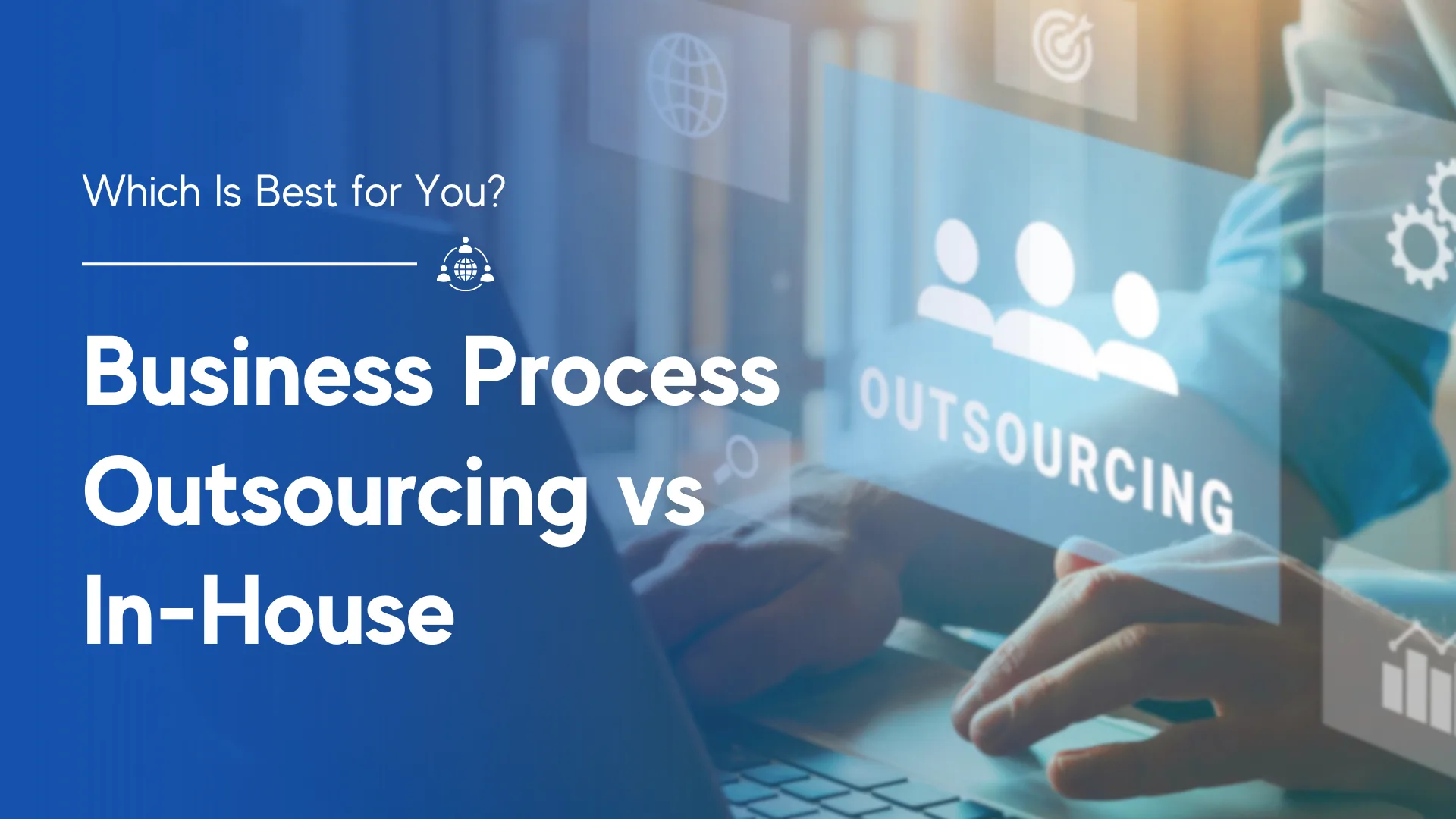
Business Process Outsourcing vs. In-House: Which Is Best for You?
Imagine this: You have a rapidly growing company. Sales are going up, your clientele is growing, but your in-house team is stretching. And then out of nowhere comes a fateful choice: do you expand your in-house capacity, or do you go to work with a Business Process Outsourcing (BPO) firm to take it off your plate?
This is a question that thousands of companies from startups to Fortune 500s wrestle with each year. So, each model has its own strengths and sacrifices. The trick is to know which strategy is right for your business model, budget, and long-term scaling plan.
Here we will dissect in-house vs outsourcing, highlight relevant examples, cite latest statistics, and illustrate how to decide which model holds the definitive winning hand for your business.
Understanding the Basics: In-House vs. BPO

However, before any exploration of pros and cons let us define what each model means in the context of modern digital business.
In-House Operations manages all the business processes within an organization by hiring your own resources, building your own infrastructure, and having 100% control of daily operations.
Business Process Outsourcing (BPO) involves obtaining specialized third-party service providers for targeted functions, such as customer support, payroll, IT services, or data entry.
The global BPO market size in 2024, is expected to reach $525 billion by 2030 and growing at a CAGR of 9.4% - Grand View Research (2024) This jump shows how most of the businesses around the globe are switching to outsourcing for systemization and cost optimization.
Why Businesses Choose Outsourcing
Think of a hyperlocal retail brand entering global markets, instead of establishing robust contact centers in each of these territories, the company can work with a seasoned BPO that possesses existing, multilingual agents, cutting-edge technology, and streamlined processes.
This is not just a cost decision but a scalability strategic decision.
As said by Deloitte Global Outsourcing Survey (2024):
- Outsourcing is mainly for cost-cutting purposes, which is why 70% of the companies do it.
- Half do it to concentrate on key business functions.
- Improved Process Efficiency is in the Top 3 Motivations for 40% of Respondents
Done properly; outsourcing not only reduces cost but also drives growth.
In-House Operations: The Traditional Approach
We will address the complexities of in-house models that are appealing to organizations who value having control, company culture, and brand consistency. For example, a luxury brand may prefer to handle customer service in-house so that the agents reflect the tone and experience of the promise the brand employs.
Although this method allows for inexpensive and intimate communication and control, it generally incurs more expenses and creates a challenge for scalable growth.
Comparative Overview: BPO vs. In-House
Factor |
Business Process Outsourcing (BPO) |
In-House Operations |
| Cost | Lower upfront investment; pay for services used | High setup & maintenance costs |
| Scalability | Easily scale teams up/down as demand shifts | Limited by internal resources |
| Expertise | Access to skilled professionals instantly | Requires hiring & training |
| Technology | Leverage provider’s advanced tools | Must invest in tech internally |
| Control | Moderate control; depends on partner transparency | Full control over operations |
| Speed to Market | Rapid deployment possible | Slower setup and execution |
| Risk Management | Shared with provider | Fully internal responsibility |
| Cultural Alignment | Needs alignment through training | Naturally aligned with company culture |
The True Cost Equation
Outsourcing is All About Cost-Saving, It is a fact that BPO companies can save operational costs as much as 60% (Source: IBM Global Research), but savings is not just the main reason.
Outsourcing helps companies:
- Steer clear of the hefty costs involved in recruitment as well as training.
- Bypass infrastructure and compliance costs.
- Access to global talent pools would be otherwise out of reach.
On the other hand, in-house operations frequently contribute to indirect expenses of turnover, equipment maintenance, HR management, and software licensing to increase the total cost of ownership (TCO), making it higher than expected.
Here is one scenario: US-based SaaS company outsourcing its Tier 1 customer support to the Philippines can save 45% in operation while Statista (2024) states that the speed of a resolution improves by 30%.
Quality, Control, and the Customer Experience Factor
Control is one of the principal arguments for keeping operations in-house. When teams exist in the same physical or cultural space, it becomes easier to align on tone, process, and brand guidelines.
That said, fast forward to the present, and BPO has sprung to life a whole new set of capabilities that outpace the archaic and limited perception of the BPO as a, well, call center. These now even function as strategic partners with seamless CRM integration, AI-driven analytics and omnichannel communication strategies that can directly compete with in-house solutions.
Historically, though some have been proven to beg to differ, a CX Network (2024) report indicated that at least 67% of businesses utilizing BPOs saw increased customer satisfaction scores meaning outsourcing, when properly managed, can amplify customer experience, not dilute it.
When In-House Makes More Sense
Pure outsourcing is not always better for managing medicines, and in some contexts in-house management may be beneficial.
- Top Secret Data: Enterprises with highly sensitive government or military projects may want to keep everything in-house.
- Niche Should be Adept: In-House development is a perfect fit if your processes require unique skills or industry-specific knowledge present in-house.
- Brand Differentiation: For those organizations where the customer's experience closely aligns with brand identity (like luxury fashion), an in-house team may deliver a more authentic look and feel.
41% of companies keep customer-facing functions in-house for the sake of brand voice consistency, according to a 2024 PwC study.
Hybrid Models: The Best of Both Worlds
This trend would translate into the hybrid outsourcing model in 2025, which combines internal and outsourced teams. This enables enterprises to retain key controls while enjoying the scalability and cost benefits of BPO.
A contact center company, for instance, may retain a small team to manage escalations and cases sensitive to their brand, while offshoring a larger volume of customers to a BPO partner.
That balance fosters agility; something key to success in fast-changing sectors such as e-commerce, tech and telecommunications.
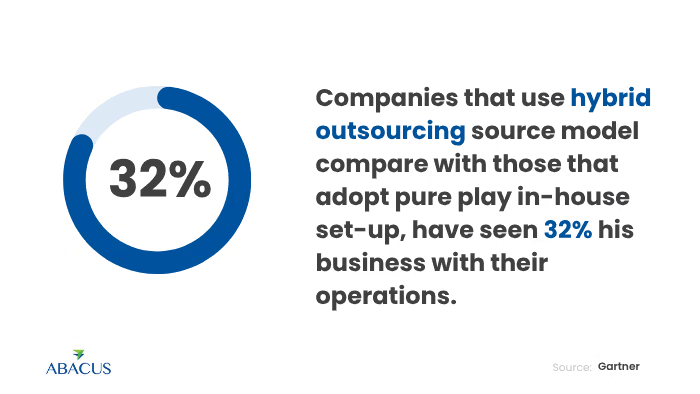
Gartner (2024) report indicates: Companies that use hybrid outsourcing source model compare with those that adopt pure play in-house set-up, have seen 32% his business with their operations.
Key Considerations Before You Decide
Deciding on BPO versus in-house is not a simple matter of one size that fits all. Things like the size of your business, budget constraints, industry focus and long-term strategy.
Ask yourself:
- Fast scalability or long-term stability - which is more essential?
- Should our internal teams handle several non-core functions?
- Cost Reduction vs Brand Uniformity - what do we prioritize?
Such questions usually clarify if they make more sense as a strategic enabler to outsource or should they retain more control and be in-house.
The Bottom Line: Which Is Best for You?
The answer is determined by what matters most to your company.
Business Process Outsourcing has a clear edge, when cost-effectiveness, agility, and access to global talent is one of the prime movers. However, if culture, brand control and confidentiality are higher priority, in-house might be the way to go.
In reality, the most successful organizations today strike a balance between the two using BPO partnerships to extend scale, while keeping teams in-house to drive strategy and innovation.
Final Thought
No matter if you are a startup that wishes to grow in a short span of time or a large enterprise that wishes to develop things faster, the truth is not in BPO or in-house, but in getting aligned with your company’s future vision, data, and customer promise.
Used intelligently, outsourcing is no longer merely a cost-saving measure; it is an engine of strategic growth.