On this page
- What Are Banking BPO Services?
- Banking Process Outsourcing: What It Includes
- Why Banking BPO Services Are Growing Rapidly
- Banking BPO by the Numbers — What US Financial Institutions Are Seeing
- Banking BPO and US Regulatory Compliance — What You Need to Know
- Best Practices for Deploying Banking BPO Services
- Example: How One Bank Transformed through Banking BPO
- Discover the Power of BPO Finance
- What to Consider When Selecting a Banking BPO Partner
- Future Trends in Banking BPO Services
- Why US Banks and Fintechs Choose Abacus BPO
- Conclusion
- Frequently Asked Questions
So, when a Southeast Asian Regional bank embarked on its digital transformation program, it was a matter of time before leadership understood the back-office burden compliance checks. Innovation is being stifled by customer onboarding, loan reviews, and credit-card operations. It was churning out awesome customer-facing products but took 15 days to approve a new credit card, and accounts were still reconciled manually. With growing pressures and mounting regulatory complexity, the executive team looked at banking BPO services as a strategic enabler instead of a cost center.
With the growth of global financial services by Fintech companies, legacy banks, and neo-banks, banking BPO services are essential to ensure pillars such as scalability, compliance, and high return-to-cost ratio operations. Increasing regulatory pressure, the standardization of digital lending platforms, and customer expectation of instant services have contributed to this bowl-style change.
What Are Banking BPO Services?
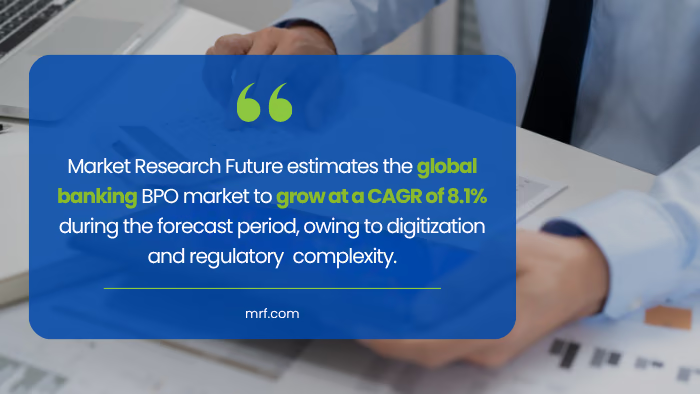
Banking companies during their BPO services outsource their none-core yet essential banking processes to specialized providers. These services encompass various activities such as KYC and compliance outsourcing, loan processing BPO, mortgage processing service, credit card operations outsourcing, risk management BPO, back office banking operations, financial customer service, and Fintech outsourcing services.
The increased operational cost of scaling compliance, customer support, and transaction processing becomes cumbersome as banks open up new markets or decide to launch various digital models. By providing efficient processes, skilled personnel and new technology, BPO providers take care of the non-core processes and let the banks concentrate on growth and innovation.
Banking Process Outsourcing: What It Includes
Banking process outsourcing covers the back-office and customer-facing work that banks hand to specialist partners. In retail banking BPO, that usually means account opening and KYC checks, loan and mortgage processing, card disputes, collections and contact center support for account holders.
Financial services BPO extends the same model to credit unions, fintechs, lenders and insurers. The banking process in BPO generally follows a set path: the bank defines its procedures and compliance rules, the partner turns them into standard operating procedures, agents are trained and certified on them, and quality teams audit a sample of every process against those rules.
Why Banking BPO Services Are Growing Rapidly
Cost and Efficiency Drivers
By outsourcing strategic and high-return banking functions, institutions can turn fixed costs into variable, transactional models, by volume. According to an ISG report (2023), financial services firms that adopted Business Process Outsourcing achieved cost savings of 12–18% in processing operations. (isg-one. com)
Compliance and Risk Management
Compliance continues to be among the largest headaches for banking institutions. According to a study by Thomson Reuters, banks allocate an average of 10% of operating expenses on compliance and risk management related activities. (thomsonreuters. (Your Story: How Banks Gain Competitive Advantage from Regulatory Compliance Outsourcing and KYC and Compliance Outsourcing By Using Specialist BPO Partners is here) Banks leverage domain expertise, automated workflows, and pre‐built frameworks by outsourcing regulatory compliance and KYC and compliance to specialist BPO partners.
Digital Customer Expectations
Customers today expect speed, transparency, and any-time service. Close to 64% of banking customers indicated that they will change banks due to slow processing or delayed onboarding, as per the report by Accenture. Banking BPO services offer automated customer onboarding, efficient credit-card issuance, and channel-agnostic financial customer support across channels.
Banking BPO by the Numbers — What US Financial Institutions Are Seeing
- 12–18% cost savings in processing operations for financial firms using BPO (ISG Report 2023)
- Banks allocate 10% of total operating expenses to compliance and risk management (Thomson Reuters)
- 64% of banking customers will switch banks due to slow processing or delayed onboarding (Accenture)
- Loan processing time reduced by up to 60% through outsourcing and automation (McKinsey)
- 30–50% reduction in KYC compliance costs through outsourced BPO services
- US banks that outsource back-office operations save 25–40% on operational costs
- 15–20% of total banking operational spending now goes toward compliance (PwC)
Banking BPO and US Regulatory Compliance — What You Need to Know
For US banks and fintechs, regulatory compliance is one of the most expensive and complex operational challenges. The right banking BPO partner must understand and support:
- Bank Secrecy Act (BSA) — anti-money laundering transaction monitoring and suspicious activity reports (SARs)
- OCC Third-Party Risk Guidelines — vendor oversight and performance monitoring requirements
- CFPB Consumer Protection Standards — fair lending, transparent billing, complaint resolution
- GLBA (Gramm-Leach-Bliley Act) — customer financial data privacy and security
- FDIC Guidelines — deposit insurance compliance and consumer protection
- SOX (Sarbanes-Oxley) — financial reporting accuracy and audit trail requirements
A banking BPO provider that cannot demonstrate fluency in these frameworks is a compliance liability, not an asset.
At Abacus BPO, our banking teams receive ongoing training on US regulatory standards. We operate under ISO 18295-certified quality processes and maintain full audit trails across every client engagement.
Best Practices for Deploying Banking BPO Services
- Establish clear SLAs and KPIs: turnaround time, accuracy, compliance metrics must be quantifiable.
- Make sure tech integration: providing should integrate along with your core banking device raising, CRM and records systems.
- Choose domain-expert provider: outsourcing to a generic BPO poses the risk of misalignment in process and regulatory perspective.
- Prioritize data security & regulatory frameworks: look for ISO 27001, SOC 2, audit certificates.
- Maintain joint governance structure: regular performance reviews, process improvements, and risk escalation paths.
Example: How One Bank Transformed through Banking BPO
Fraud losses were far lower in this market, and a leading European retail bank was struggling with an average customer onboarding time of 12 days for new accounts, and high costs for card issuance. Results followed after an organization transferred their loan processing BPO, credit card operations outsourcing, and back-office banking operations functions to an experienced service provider:
- Onboarding time from 12 days to 3 for customers.
- Card-issuance cost dropped by 22%.
- While in 12 months, the compliance breach incidents have reduced by 35%.
By delegating transactional and compliance-heavy processes to a BPO partner, the bank could refocus internal teams on customer acquisition and product innovation.
Discover the Power of BPO Finance
Handling complex financial operations in-house can hinder growth and scalability as businesses expand. BPO Finance provides a smarter approach to the future blending expertise, automation, and efficiency to elevate each financial process. [Read More →]
What to Consider When Selecting a Banking BPO Partner
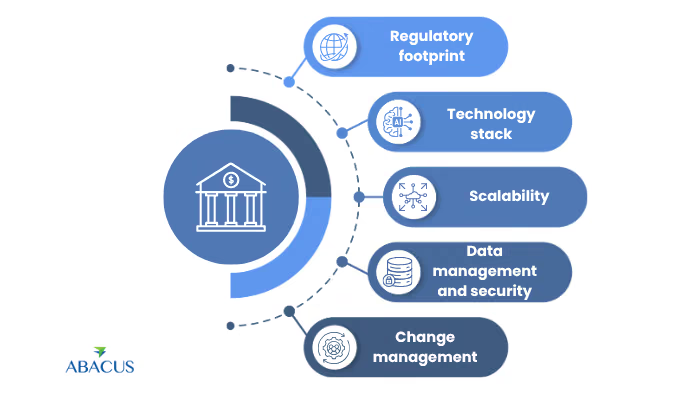
When banks assess an outsourcing partner, it is no longer just about price. The partner needs to be in sync with strategic goals, regulatory requirements, and digital transformation tracks. Key considerations include:
- Regulatory footprint: Does the provider have experience in your jurisdiction(s)?
- Technology stack: Are they able to accommodate RPA, AI, live examination for customer support and risk?
- Scalability: Will they flex with you as you grow products or geographies?
- Data management and security: Vital for financial data management services, and risk operations.
- Change management: Transitioning operations without disruption is vital.
Future Trends in Banking BPO Services
Adding to this, the trends emerging in the evolution of banking BPO are the following, as we are moving towards 2025 and beyond.
- Embedded AI and analytics: Business process outsourcing providers will move beyond transactional outsourcing to decision-support outsourcing, providing insight as well as execution.
- Functional & Tech-Centric Services: BPOs will stop being mere task processors, and will become end-to-end shared-services platforms combining operations, technology, and governance
- On-demand or “pay-as-you-grow” models: Especially useful for fintech outsourcing services and fast-scaling banks where agility matters.
Why US Banks and Fintechs Choose Abacus BPO
Abacus BPO has supported US banking clients — including fintechs, neobanks, lending platforms, and regional banks — with specialized outsourcing solutions:
- ISO 18295 and GDPR-certified operations — compliance ready from day one
- Banking-trained agents — KYC, fraud support, loan processing, dispute resolution
- 94% accuracy rate on fraud and payment issue resolution
- Deployment in 7–21 days — faster than hiring and onboarding one compliance analyst
- 24/7 multilingual customer support for US banking customers
- Scalable teams — expand during peak periods like tax season or open enrollment
- Full audit trails — complete documentation for regulatory review
Talk to Our Banking BPO Team →
Conclusion
In this time when banking is being transformed with fintech innovation, new regulation and changing customer expectations, the old way of running operations no longer fits the need. Banking BPO Services Abacus Outsourcing Banking BPO Solutions are a strategic avenue to scale your finance and accounting operations swiftly, accurately and with resilience. We enable internal teams to do what they do best, innovate and grow customers while back-office operations operate in a highly efficient and compliant manner.
Whether you struggle with speeding up customer onboarding, cutting loan processing costs, optimizing card operations or reducing compliance risk, Abacus Outsourcing brings the proven capabilities to lead change. With banks and financial institutions changing at such a perpetual pace, working with Abacus Outsourcing will also guarantee you are staying light on your feet, staying compliant and building for growth.
Frequently Asked Questions
What are banking BPO services?
Banking BPO services involve outsourcing specific banking operations to a specialized third-party provider — including KYC verification, compliance monitoring, loan processing, customer support, fraud detection, and back-office data management.
How much do US banks save by using BPO services?
US banks typically save 12–18% on processing operations and 25–40% on back-office costs by using BPO services. KYC outsourcing alone delivers 30–50% compliance cost reductions according to ISG and industry research.
Is banking BPO safe for US financial institutions?
Yes, when working with certified providers. Look for ISO certification, GDPR compliance, BSA and OCC awareness, SOX audit trail capabilities, and signed data processing agreements. Reputable banking BPO providers maintain strict financial data governance.
What banking functions can be outsourced?
US banks commonly outsource KYC and identity verification, AML compliance monitoring, loan and mortgage processing, credit card operations, customer support helpdesk, fraud alert handling, back-office data entry, and account reconciliation.
What is the difference between banking BPO and general BPO?
Banking BPO is a specialized subset of general BPO focused specifically on financial services operations. Banking BPO providers have domain expertise in financial regulations, compliance frameworks, and banking workflows — making them better suited for regulated financial environments than general BPO providers.