On this page
- SaaS Customer Support Outsourcing: The Retention Lever Most Software Companies Are Pulling Too Late
- Why SaaS Support Is Genuinely Different From Standard Customer Service
- The Churn Connection Most SaaS Businesses Underestimate
- What SaaS Customer Support Outsourcing Covers
- SaaS Customer Support Outsourcing: Performance Comparison
- The Product Launch Support Surge That Breaks Internal Teams
- Developer and Technical User Support: The Capability Gap Most BPO Providers Can't Fill
- What Reducing Engineering Support Burden Actually Unlocks
- Why Abacus BPO for SaaS Customer Support Outsourcing
- Conclusion: In SaaS, Support Quality Is Retention Strategy
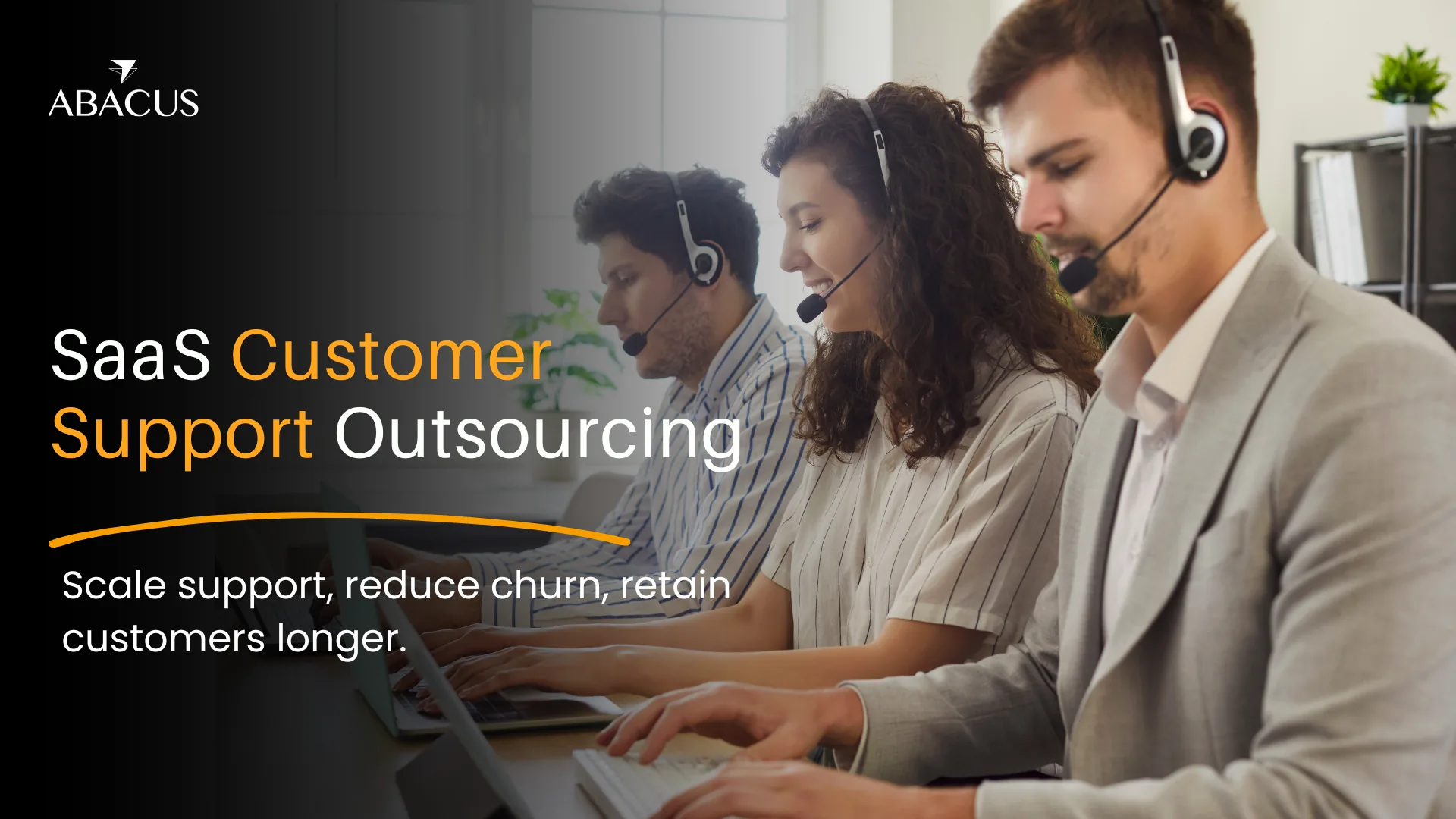
SaaS Customer Support Outsourcing: The Retention Lever Most Software Companies Are Pulling Too Late
In SaaS, the sale is the beginning - not the destination.
Every subscription business understands this intellectually. The revenue model depends on renewal, and renewal depends on value realization, and it depends on customers successfully using the product. But here's where the gap opens: the customer support function responsible for ensuring that success is often the most underfunded, most understaffed, and most reactively managed operation in the entire business.
The consequences show up in the metric every SaaS CFO watches with the most anxiety. Churn. And behind most churn events, when you trace them backward, there's a support interaction - or a series of them - where the customer's confidence in the product eroded because help wasn't there when they needed it, wasn't knowledgeable enough when it arrived, or wasn't fast enough to prevent the frustration from becoming a cancellation decision.
SaaS customer support outsourcing is how product-focused software companies build the support infrastructure their retention metrics demand - without diverting the engineering and product resources that build the product those customers are paying for.
Why SaaS Support Is Genuinely Different From Standard Customer Service

Generic customer service handles queries. SaaS support handles the gap between what a product promises and what a customer has figured out how to get from it. That's a fundamentally different function - and the distinction matters enormously when evaluating outsourcing options.
A SaaS support agent isn't just answering questions. They're diagnosing technical issues across different use cases, operating systems, and integration environments. They're guiding customers through feature adoption that directly affects whether those customers realise enough value to renew. They're handling billing and subscription management with the accuracy that prevents the revenue leakage caused by unmanaged downgrades and cancellations. And they're doing all of this while representing a brand that positioned itself on being better than legacy alternatives.
Generic BPO training doesn't produce this capability. SaaS-specific support outsourcing does - and the difference between the two is visible in every churn rate and NPS score that results from each.
The Churn Connection Most SaaS Businesses Underestimate
The relationship between support quality and churn in SaaS is more direct than most companies model for.
According to Bain & Company's customer loyalty research, a 5% increase in customer retention increases SaaS company profits by 25-95% - a range that reflects the compounding nature of subscription revenue. What drives that retention? Product value is the foundation. Support experience is the structure built on top of it.
Zendesk's Customer Experience Trends Report found that 73% of customers will switch to a competitor after multiple bad experiences - and in SaaS, where switching costs have fallen significantly as alternatives have proliferated, "multiple" is often just two or three interactions before a cancellation decision is made.
The SaaS businesses with the lowest churn rates aren't necessarily the ones with the best products. They're the ones where customers feel genuinely supported - where help is fast, knowledgeable, and resolves the issue at first contact rather than generating follow-up tickets that compound frustration.
What SaaS Customer Support Outsourcing Covers
- Technical Helpdesk and Bug Triage handles product-specific technical issues - configuration errors, integration problems, performance queries, and feature behaviour questions - with agents trained on your specific platform architecture rather than applying generic troubleshooting logic.
- Onboarding Support and Feature Adoption guides new users through the setup and adoption journey - reducing the time-to-value gap that is one of the strongest predictors of early churn in subscription software.
- Billing and Subscription Management handles plan changes, upgrade and downgrade requests, payment issues, and renewal management - with the accuracy and customer sensitivity that financial interactions specifically demand.
- API and Integration Support assists technical users and developers integrating your platform with other tools - a support function that requires genuine technical depth and is often the make-or-break interaction for technical buyers evaluating product fit.
- Churn Intervention and Retention Support identifies cancellation intent signals, handles cancel requests with structured retention conversations, and deploys targeted interventions that convert churn events into loyalty opportunities - directly protecting ARR.
- Customer Success Support supplements your customer success team with the operational bandwidth to handle account health monitoring, QBR preparation support, and proactive outreach to at-risk accounts at a scale that internal CS teams can't always sustain.
- Knowledge Base and Self-Service Management maintain your help documentation - keeping articles current as the product evolves, identifying knowledge gaps from ticket analysis, and building the self-service capability that reduces support contact volume over time.
SaaS Customer Support Outsourcing: Performance Comparison
| Support Criteria | Internal Support Team | Generic BPO Provider | Abacus BPO SaaS Support |
| Product Knowledge Depth | Strong - but months to build | Shallow - generic software training | Deep - structured SaaS-specific onboarding |
| First Contact Resolution Rate | Variable - 55-65% typical | Often below 50% | Targeting 70%+ with specialist training |
| Onboarding Support Capability | Possible - resource-constrained | Rarely included or qualified for | Built-in - feature adoption framework standard |
| API and Technical Support | Strong - developer proximity | Often inadequate - technical depth lacking | Specialist - technical profile agents available |
| Churn Intervention Capability | Inconsistent - not always trained | Rarely included | Structured - retention framework and escalation |
| Scalability During Product Launches | Severely limited - hiring lag | Moderate - quality degrades under pressure | Rapid - surge capacity deployed within days |
| 24/7 Coverage | High cost - multiple shifts required | Available - quality variable | Standard - consistent quality at every hour |
| Ticket Volume Analytics | Basic - dependent on helpdesk | Minimal reporting | Full reporting - FCR, CSAT, churn signals, trends |
| Knowledge Base Maintenance | Reactive - updated when outdated | Not typically included | Proactive - continuous documentation currency |
| Cost Per Ticket Resolved | Highest - engineering time cost | Lower - quality compromised | Optimized - specialist quality, sustainable cost |
The Product Launch Support Surge That Breaks Internal Teams
Every SaaS product launch generates a support spike. New features mean new questions. New user acquisition from launch campaigns means new customer onboarding demand. Bug reports from production environments that behaved differently from staging mean technical issue volume that multiplies in the days following release.
Internal support teams that are adequately staffed for steady-state operations are structurally underprepared for launch surges. The result is response time degradation at the precise moment when new users - who haven't yet decided whether your product is worth their continued investment - need fast, knowledgeable help.
Product Hunt's SaaS Launch Analysis data consistently shows that support responsiveness in the first 72 hours following a product launch is one of the strongest predictors of early user retention. The launches that convert trial users to paying customers at the highest rates are those where support was visibly present and genuinely helpful during the initial discovery period.
SaaS customer support outsourcing with surge capacity protocols eliminates the launch support crisis before it happens. Your BPO partner is briefed on upcoming releases, trained on new features before they go live, and ready to scale capacity within days - so your launch drives conversion rather than creating the support backlog that damages first impressions.
Developer and Technical User Support: The Capability Gap Most BPO Providers Can't Fill

SaaS products with API access, integration capabilities, or developer-facing features create a support requirement that generic customer service training doesn't address. Technical users have zero patience for agents who don't understand the environment they're working in - and a single poor technical support interaction with a developer-buyer can cascade into a public criticism that affects brand perception among exactly the audience your acquisition depends on.
According to Stack Overflow's Developer Survey, developers cite technical support quality as a primary factor in platform selection for tools they adopt professionally. This makes technical support not just a retention function but an acquisition one - the reputation your technical support builds in developer communities shapes purchasing decisions before a sales conversation ever begins.
Abacus BPO's SaaS support engagements include technical profile agents for platforms with developer-facing support requirements - agents with genuine technical background who can engage confidently with API queries, integration debugging, and developer environment troubleshooting rather than escalating every technical contact to your engineering team.
What Reducing Engineering Support Burden Actually Unlocks
This is the benefit that SaaS founders and CTOs consistently cite as the most impactful but least anticipated outcome of specialist support outsourcing.
Engineering time spent on support tickets is engineering time not spent on product development. In a sector where development velocity is a direct competitive advantage, every hour of engineering capacity absorbed by customer support is a measurable cost to your product roadmap.
First Round Capital's SaaS Operations Research found that engineering teams at early and growth-stage SaaS companies spend an average of 20-30% of their time on support-related activities when no dedicated specialist support function exists. At a fully-loaded engineering cost, this represents a significant and unnecessary drag on the product investment that actually drives the company's competitive position.
Specialist SaaS support outsourcing captures the technical support queries that don't require engineering judgment - the configuration issues, integration questions, and feature adoption challenges that a well-trained specialist can resolve - and reserves engineering escalation for the genuine product issues that require development expertise.
Why Abacus BPO for SaaS Customer Support Outsourcing
Abacus BPO delivers SaaS customer support to software companies across B2B, B2C, and developer-focused platforms - from early-stage businesses building their support function for the first time to established operators scaling into new markets.
Every SaaS support engagement begins with deep product immersion - your platform architecture, your user journey, your most common support scenarios, your technical environment, and the churn signals that indicate an account at risk. Your dedicated team is trained on your product before they handle a single ticket. Knowledge base management is included as a standard component. Churn intervention protocols are built and tested before go-live.
Delivery is governed by SLAs covering FCR targets, response time commitments, CSAT benchmarks, and churn intervention performance - all reported transparently with the detail that SaaS leadership teams need to connect support performance to retention outcomes.
Conclusion: In SaaS, Support Quality Is Retention Strategy
Every support interaction is a renewal decision in progress. The customer who gets fast, knowledgeable help at a moment of friction renews with higher probability than the one who waited three days for a response that didn't fully resolve their issue. That difference, compounded across thousands of interactions per month, is the churn rate differential that separates growing SaaS businesses from struggling ones.
SaaS customer support outsourcing from Abacus BPO gives software companies the specialist capability, the technical depth, and the operational infrastructure to make every support interaction a retention investment - not a retention risk.
Contact Abacus BPO today for a free SaaS support assessment. Share your current ticket volumes, churn challenges, and product complexity - and we'll show you exactly what specialist SaaS support outsourcing delivers for your business.