On this page
- BPO vs In-House Customer Support Cost Comparison: What the Numbers Actually Reveal
- Why the "Obvious Cost" Comparison Misleads You?
- The True Cost of In-House Customer Support
- The True Cost of BPO Customer Support
- BPO vs In-House Customer Support: A Direct Comparison
- Three Advantages That Don't Appear on Any Spreadsheet
- The Brand Quality Concern Addressed Honestly
- Why Abacus BPO for Your Customer Support
- Conclusion: The Real Cost of Keeping It In-House
BPO vs In-House Customer Support Cost Comparison: What the Numbers Actually Reveal
At some point, every growing business faces the same decision: do we build our customer support function in-house, or do we outsource it to a specialist BPO provider?
It feels like it should be a simple comparison. In practice, most businesses get it wrong because they only look at the obvious costs and miss the ones that quietly multiply beneath the surface.
This article gives you a complete, honest picture. We'll break down every cost component on both sides, present a direct comparison, and show you what the numbers mean for a real growing business. By the end, you'll have everything you need to make this decision with confidence.
Why the "Obvious Cost" Comparison Misleads You?
The instinctive comparison most businesses make goes something like this: a customer support agent costs a fixed annual salary. A BPO provider charges a monthly fee for equivalent coverage. Simple enough until you realize that salary is only a fraction of what in-house support actually costs you.
When you factor in every cost that genuinely belongs in this calculation, the gap between in-house and BPO widens dramatically. The decision becomes considerably less ambiguous. Here is every component you need to account for.
The True Cost of In-House Customer Support
- Recruitment and hiring. Every in-house hire carries upfront recruitment cost advertising, agency fees, interview time, and management hours spent on the process. Customer support roles carry notoriously high attrition rates, meaning this cost isn't a one-time expense. It recurs continuously, often multiple times per year.
- Salary and Employer Contributions. Base salary is the number businesses focus on but employer contributions add a significant mandatory uplift on top. National insurance, pension obligations, and any statutory benefits mean the true employment cost per agent substantially exceeds what appears on the offer letter.
- Training and Onboarding. A new customer support agent typically requires four to six weeks of onboarding before they're independently productive. That's weeks of full salary cost with limited output. Add ongoing product training, compliance refreshers, and coaching, and training becomes a continuous cost rather than a one-time investment.
- Technology and Infrastructure. Help desk software, CRM licenses, telephony systems, headsets, computers, and desk space all carry costs that are rarely captured in initial cost modelling. For a growing support team, the technology stack alone represents a significant and expanding annual expenditure.
- Management Overhead. An in-house support team requires supervision, scheduling, quality monitoring, and performance management. That means team leaders and managers headcount that adds cost to every level of the hierarchy, scaling upward as the team grows.
- Absence, Attrition, and Contingency. Customer support functions experience some of the highest attrition rates across all business roles. Every departure triggers a new recruitment and training cycle. Sick leave, holiday cover, and underperformance create further unpredictable gaps in coverage that either go unaddressed or get covered at additional cost.
- Facility and Premises Overhead. Physical desk space, utilities, IT infrastructure maintenance, and the administrative overhead of managing a growing in-house team all carry real costs that belong in an honest total cost of ownership calculation and are almost always excluded from the initial comparison.

The True Cost of BPO Customer Support
BPO pricing is structured to be simple. You pay a defined, agreed rate for a defined service. That rate covers everything: the agent's compensation and all associated employer costs, recruitment and replacement at no additional charge, all training — initial and continuous — at no extra cost to you, the full technology infrastructure including telephony, CRM, and performance reporting, quality assurance and ongoing coaching, management and team leadership, and business continuity cover for absence and attrition.
At Abacus BPO, our customer support engagements are priced with a single transparent monthly figure. No variable overhead that spikes when attrition hits. No surprise infrastructure costs when you scale. No management time consumed by HR issues that are now someone else's operational responsibility.
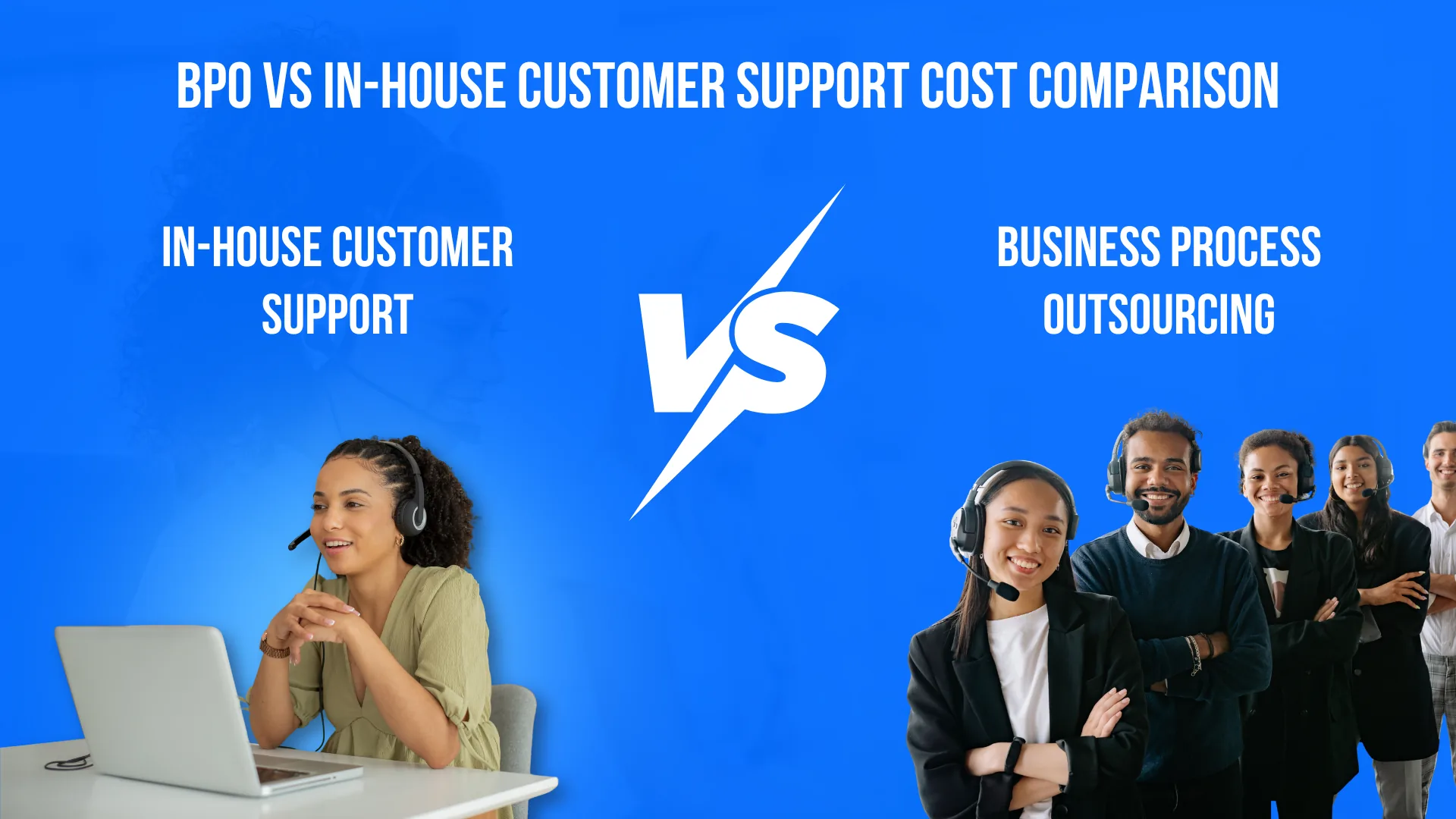
BPO vs In-House Customer Support: A Direct Comparison
| Cost Component | In-House Team | Abacus BPO |
| Agent Salary & Employer Contributions | Significant fixed cost | Included |
| Recruitment & Replacement | Recurring — every departure | Included, no extra charge |
| Onboarding & Training | Weeks of cost before productivity | Included, no extra charge |
| Technology & Infrastructure | Separate procurement & licenses | Included |
| Management & Team Leadership | Additional headcount required | Included |
| Absence & Attrition Cover | Unpredictable, recurring cost | Included, managed externally |
| Facility & Premises Overhead | Attributable per seat | Eliminated |
| 24/7 Coverage | Requires shift premiums & more staff | Standard, no premium |
| Scalability | Slow — constrained by hiring cycle | Rapid — days, not months |
| Quality Assurance | Dependent on internal resource | Structured, contractually governed |
| Pricing Predictability | Variable, prone to surprise costs | Fixed, transparent monthly rate |
| Overall Cost vs. BPO Equivalent | Consistently 40–60% higher | Baseline |
Three Advantages That Don't Appear on Any Spreadsheet
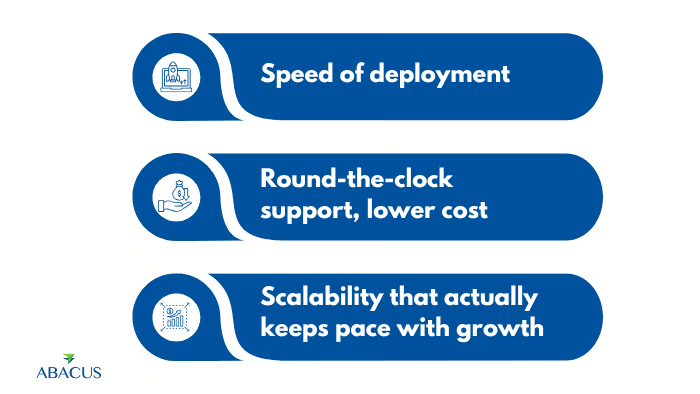
The cost comparison makes a compelling case on its own. But there are further advantages of BPO customer support that numbers alone don't fully capture.
- Speed of deployment. Building an in-house support team from scratch takes months job postings, interviews, notice periods, onboarding, training. Abacus BPO can have an equivalent team operational within days. In a competitive market where customer experience directly affects retention, that speed is a genuine strategic advantage.
- Round-the-clock coverage without round-the-clock cost. Delivering 24/7 support in-house demands shift structures, unsocial hours premiums, and considerably more headcount than daytime-only coverage. BPO providers deliver 24/7 capability as a standard feature of the engagement built into the service model, not added as an expensive premium.
- Scalability that actually keeps pace with growth. When your support volume doubles ahead of a product launch or a seasonal peak, an in-house team cannot respond quickly enough. A BPO partner scales within days. When volumes normalize, you're not carrying excess headcount cost. This flexibility has real financial value that static cost modelling consistently fails to represent accurately.
The Brand Quality Concern Addressed Honestly
Some businesses resist BPO customer support because they fear external agents won't represent their brand as effectively as an internal team. It's a legitimate concern raised by many of the businesses that come to us. It's also, with the right provider, the wrong conclusion.
At Abacus BPO, every client engagement begins with a structured brand immersion process. Your dedicated support team learns about your product in depth, your tone of voice, your escalation protocols, and your customer experience standards before they handle a single interaction. Our quality assurance process monitors every channel continuously against those agreed standards.
What you get is not a generic call center team reading from a script. You get a team that represents your brand with consistency, at scale, around the clock and is held to measurable performance standards that most in-house teams never formally establish.
Why Abacus BPO for Your Customer Support
We have delivered customer support outsourcing for growth-stage and mid-market businesses across multiple industries. We understand that outsourcing a customer-facing function is not a decision taken lightly because it directly touches the experience your customers have with your brand.
That's precisely why we don't ask for blind trust. Every prospective client receives a structured consultation that maps their current support operation honestly, benchmarks it against what Abacus BPO would deliver, and produces a clear projection of the financial and operational impact. You will know exactly what you're getting before you commit to anything.
Conclusion: The Real Cost of Keeping It In-House
When every cost that belongs in the comparison is honestly accounted for, in-house customer support consistently costs significantly more than an equivalent BPO engagement while delivering less flexibility, slower scalability, and greater management overhead.
The businesses that recognize this early gain a compounding advantage: lower operational costs, faster response capability, and leadership attention freed for the work that builds competitive differentiation.
Abacus BPO is ready to show you what the numbers look like for your specific business. Contact us today for a free cost comparison consultation and find out exactly what a smarter customer support model could mean for your growth.