On this page
- Why 24/7 Live Chat Support Matters Specifically for SaaS Products
- Your Three Options for Hiring 24/7 Live Chat Support
- What to Look for When Choosing a BPO Partner for SaaS Live Chat Support
- What Does 24/7 Outsourced SaaS Live Chat Support Cost?
- The Non-Negotiable SLAs for SaaS Live Chat in 2026
- How Abacus BPO Delivers 24/7 Live Chat Support for SaaS Clients
- The Bottom Line
- Frequently Asked Questions
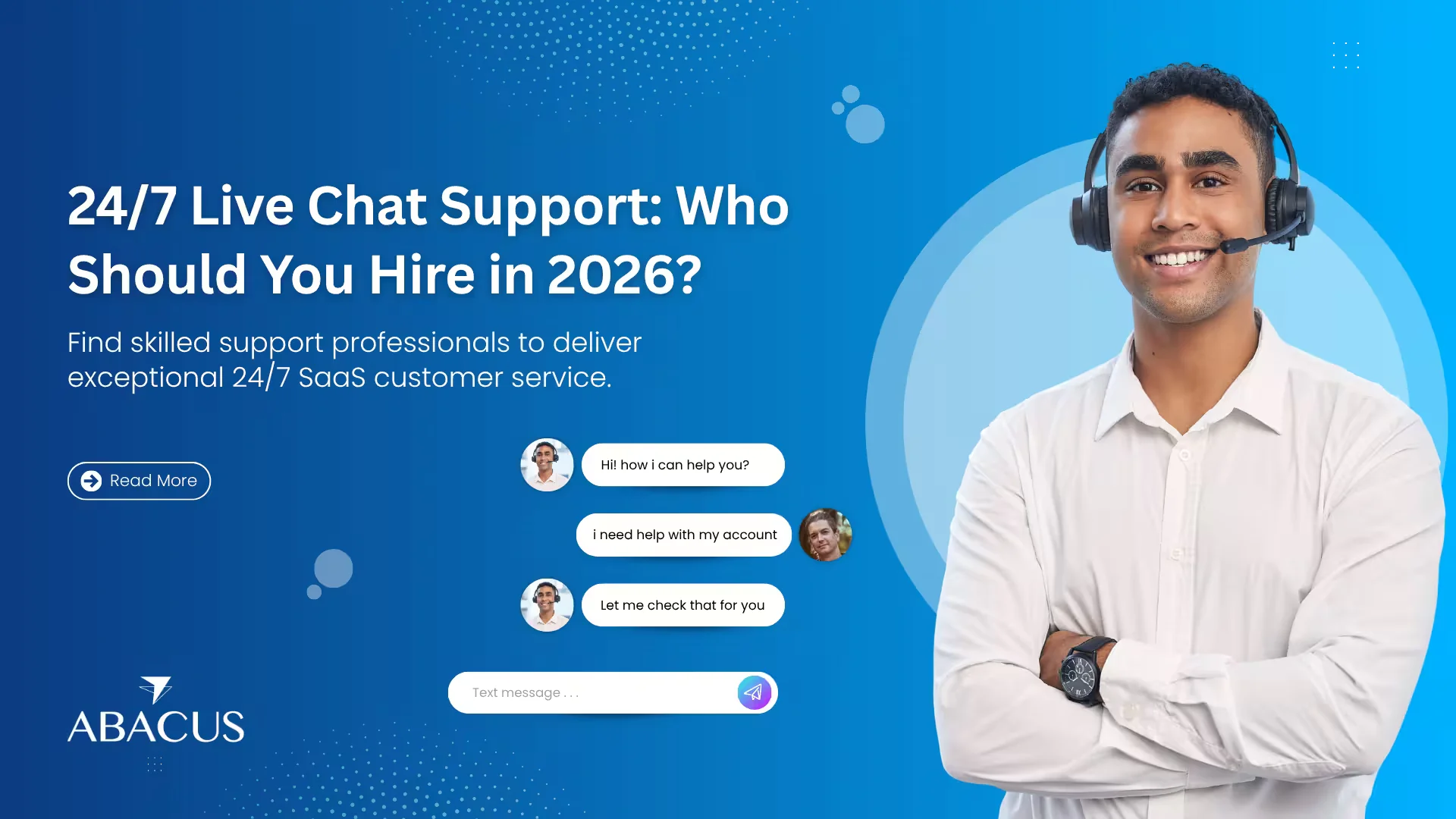
Your SaaS product is live, your user base is growing, and your current support setup is beginning to crack. Response times are slipping past 15 minutes during peak hours. Nothing is covered after 6 PM. Your engineers are fielding Tier 1 tickets that should never reach them, and your CSAT scores are drifting in the wrong direction.
At this point, the hiring question is not whether to get help with live chat support. It is who to hire, what to expect from them, and how to build the program correctly so it scales without breaking.
Companies that offer live chat see conversion rates increase by an average of 20%. Visitors who engage in chat are 2.8 times more likely to convert than those who do not. That is the upside when live chat works. The downside is equally clear: a chat channel that is slow, inconsistently staffed, or handled by agents without genuine product knowledge drives the same customers away faster than having no chat at all.
This guide covers your three main hiring options for 24/7 live chat support for a SaaS product, what each one delivers, what it costs, and the specific criteria that determine which one fits your current stage.
Why 24/7 Live Chat Support Matters Specifically for SaaS Products
SaaS products have a support profile that is different from most other business categories. Your users are distributed globally across time zones. Their issues are often technical, not transactional. The cost of a poor support experience is not just a refund request. It is churn, negative reviews, and in some cases the loss of an account that took months of sales effort to close.
The link between support quality and SaaS retention is direct and well-documented. Response time is the first signal customers use to judge whether a company values their business. For live chat specifically, the industry benchmark for a good first response is under 15 minutes. A response that takes over an hour, or that arrives the next business day because nobody covers overnight, tells a customer more about your company's priorities than any marketing message ever will.
Staffing live chat internally carries significant hidden costs: recruiting, training, turnover management, technology integration, and 24/7 scheduling overhead. These costs compound as the product grows and support volume increases. Understanding them fully before choosing a hiring model prevents the most common mistake in SaaS support decisions, which is under-resourcing the channel and then assuming the channel itself is the problem when results disappoint.
Your Three Options for Hiring 24/7 Live Chat Support
Option 1: Build an In-House Chat Support Team
Building an internal live chat team means hiring, training, and managing your own agents under your direct employment. This gives you maximum control over product knowledge depth, brand voice, and escalation decisions.
The trade-off is the full operational overhead of running a round-the-clock function. True 24/7 coverage in a single location requires at minimum three shifts, which means at least three to four agents per coverage window to account for days off, sickness, and turnover. For a startup or growth-stage SaaS company, that staffing requirement arrives before the support volume that justifies it.
In-house teams are the right model when your product is highly technical, your customers are enterprise-level with bespoke contract terms, or your support interactions regularly involve sensitive business information that cannot leave your internal environment for compliance reasons. For most SaaS companies in the growth phase, the overhead of building in-house before outsourcing is ready is a timing problem, not a quality argument.
Option 2: Hire Freelance or Part-Time Remote Chat Agents
Freelance or contract chat agents provide flexibility without the overhead of full employment. Platforms that facilitate remote agent hiring offer access to individuals with customer service experience who can work defined shift hours, often at lower cost than hiring locally.
The limitation of this model for a SaaS product is quality consistency. Freelance agents working across multiple clients simultaneously divide their attention and their product knowledge. SaaS support requires genuine familiarity with your platform, your most common error states, and your escalation logic. That depth of knowledge does not develop quickly in agents who are not dedicated to your product exclusively.
Freelance agents are most suitable for covering a specific narrow shift gap where your primary support team cannot maintain coverage, handled under close supervision with a well-documented knowledge base and defined escalation paths.
Option 3: Outsource to a Specialist BPO Partner
Outsourcing 24/7 live chat support to a BPO partner who specializes in SaaS and technology products is the most common and most scalable solution for growth-stage SaaS companies. A specialist BPO partner brings agents who are already trained in SaaS support workflows, a technology stack that integrates with your helpdesk and CRM, quality assurance processes, and the geographic distribution needed to provide genuine follow-the-sun coverage without shift premiums.
Many BPO providers operating genuine follow-the-sun models maintain agent teams distributed across 15 or more countries, delivering consistent 24/7 live chat coverage without the single-site overnight premium costs common in traditional contact center arrangements. Launch timelines for dedicated outsourced teams range from two weeks for smaller programs to six to eight weeks for larger enterprise configurations.
Outsourcing live chat is most effective when your product is well-documented, your most common contact reasons are defined, escalation paths are written down, and the provider has demonstrated SaaS-specific experience. When those conditions exist, an outsourced team performs as well or better than an internal team at a fraction of the build cost.
What to Look for When Choosing a BPO Partner for SaaS Live Chat Support
The choice of outsourcing partner determines the outcome more than any other single decision. Here are the criteria that matter most for a SaaS live chat program.
SaaS-Specific Experience
Generic contact center experience is not the same as SaaS support experience. A provider who has operated Tier 1 and Tier 2 technical support programs for software products understands the difference between a billing question and a configuration issue, knows when to escalate to an engineering queue, and can follow a documented troubleshooting tree without being supervised for every step.
Ask prospective partners to describe programs they have run for comparable SaaS products: company size, product complexity, ticket mix, and the performance benchmarks they delivered. If they cannot provide specific examples, they are likely a general contact center describing themselves as SaaS-capable without the operational track record to support it.
Dedicated vs. Shared Agent Model
Shared agent pools distribute a single agent across multiple clients simultaneously. This reduces per-hour cost but limits the product knowledge depth any individual agent can develop for your specific product. For SaaS support, where the difference between a helpful resolution and a frustrating misdirection often depends on product-specific knowledge, dedicated agents who work exclusively on your program consistently outperform shared pools on CSAT and first-contact resolution.
The best BPO partners for SaaS live chat will offer both models and be transparent about where each one is appropriate. Shared pool models work for very simple, high-volume, low-complexity interaction types. Dedicated teams are the right model for anything requiring genuine product expertise.
Coverage Architecture and Response Time Commitments
True 24/7 coverage means coverage at 3 AM on a Sunday, not just business hours plus a few additional shifts. Ask prospective partners to describe exactly how overnight and weekend coverage is staffed, what the first-response time commitment is during each coverage window, and what their escalation process looks like when a complex issue arrives at 2 AM with no senior agent available.
The industry benchmark for live chat first response is under 15 minutes. World-class performers hit under two minutes for median first response. Any provider who cannot commit to a specific SLA for first response time across all coverage windows is not operating a genuine 24/7 support program.
Quality Assurance and Reporting
A live chat program without structured QA is a program where quality drift is invisible until it shows up in your CSAT scores or your churn data. Ask partners to describe their QA process: how many interactions are reviewed per agent per week, what rubric is used for scoring, how scores are calibrated across reviewers to prevent scoring inconsistency, and how coaching is delivered and tracked.
Reporting should include first-response time by hour of day, CSAT by agent and shift, first-contact resolution rate, escalation rate, and ticket handle time. If a prospective partner cannot describe how they report on all of these, they are not running a mature SaaS support program.
Security and Compliance Certifications
SaaS support programs handle customer account data, session information, and in some cases payment and personal data. The minimum security certifications to expect from any serious SaaS support partner are SOC 2 Type II, which covers data security and availability practices, and GDPR compliance for programs serving European customers. Healthcare SaaS products requireHIPAA compliance. Payment-related programs require PCI-DSS certification.
Any partner who treats security certification as a secondary consideration is not suitable for a SaaS support program regardless of their chat performance metrics.
What Does 24/7 Outsourced SaaS Live Chat Support Cost?
Pricing for outsourced live chat support varies significantly by model, location, and agent seniority. The ranges below reflect 2026 market data.
| Support Model | Approximate Cost Range | Best Suited For |
|---|---|---|
| Shared pool agent (offshore) | $8 to $15 per agent hour | High-volume, low-complexity Tier 0 to Tier 1 interactions |
| Dedicated offshore agent | $10 to $18 per agent hour | SaaS Tier 1 to Tier 2 with product-specific knowledge requirements |
| Dedicated nearshore agent | $18 to $28 per agent hour | Programs requiring cultural alignment with North American customers |
| Dedicated onshore agent | $28 to $45 per agent hour | Enterprise SaaS with compliance requirements or complex escalation |
| Pay-per-resolution model | Variable; typically $3 to $8 per resolved ticket | High-volume, well-documented interaction types with clear resolution criteria |
| Monthly program fee (managed) | $3,000 to $15,000+ per month depending on volume and hours | Full-service programs including QA, management, and reporting |
Source: Helpware Live Chat Outsourcing Companies Research 2026, BPO Insight Hub Research 2026
The Non-Negotiable SLAs for SaaS Live Chat in 2026
Before any outsourced live chat program launches, these SLAs should be defined, agreed, and written into the contract.
- First response time for chat: Under 15 minutes for standard programs. Under 2 minutes for high-engagement SaaS products where customers expect near-instant acknowledgment.
- First response time for email: Under 4 hours for standard priority. Under 1 hour for critical account issues.
- CSAT target: 85% or above is the minimum acceptable benchmark. World-class SaaS support programs operate above 90%.
- First-contact resolution rate: 70% or above for Tier 1 interactions. A rate below 65% signals either a knowledge gap in the agent team or an escalation path problem.
- Backlog threshold: Define the maximum number of open tickets older than 24 hours before escalation protocols trigger. A growing backlog is the earliest visible signal of a coverage or capacity problem.
How Abacus BPO Delivers 24/7 Live Chat Support for SaaS Clients
At Abacus BPO, our live chat support programs for SaaS clients are built around dedicated agent teams trained exclusively on the client's product, not shared pools working across multiple brands simultaneously.
In practice, this means:
- Agents complete structured product training before handling any live interactions, with knowledge assessments confirming baseline competence before go-live
- Escalation paths are defined at program design, covering Tier 1, Tier 2, and engineering escalation thresholds with documented criteria for each
- QA scoring covers first-response time, resolution accuracy, empathy in communication, and proper escalation judgment, reviewed weekly for every agent
- CSAT is measured post-interaction through embedded surveys, with individual agent scores reviewed in weekly coaching sessions
- Reporting is delivered in client-defined formats covering all standard SaaS support KPIs at daily, weekly, and monthly cadences
- Coverage is designed around the client's user time zone distribution, with follow-the-sun scheduling ensuring no coverage gap regardless of when the interaction arrives
The Bottom Line
Choosing who to hire for 24/7 live chat support for a SaaS product is not primarily a cost decision. It is a quality decision with cost implications. The right partner brings SaaS-specific experience, a dedicated agent model, genuine 24/7 coverage architecture, structured QA, and the security certifications your product requires.
The best partner is not always the biggest or the cheapest. It is the one that fits your ticket mix, product complexity, support hours, and customer expectations. Shortlist three vendors, test them with real ticket scenarios, and compare QA discipline, reporting quality, escalation integrity, and coverage commitments before you commit.
Frequently Asked Questions
Should a SaaS startup build in-house or outsource live chat support?
For most SaaS startups, outsourcing to a specialist BPO partner is the faster, more cost-effective path to genuine 24/7 coverage with consistent quality. Building in-house before the support volume justifies the overhead creates a cost burden that grows before it delivers value. Outsourcing scales with your volume and can transition to in-house for the most strategic tier of support once the product and customer base are both mature.
What is a good CSAT score for SaaS live chat support?
85% or above is the minimum acceptable benchmark for a well-run SaaS support program. Programs consistently delivering above 90% CSAT are at world-class performance for the live chat channel.
How quickly should a SaaS live chat agent respond?
The industry benchmark for first response is under 15 minutes. The best SaaS support programs in 2026 operate with median first response times under 2 minutes, which significantly improves conversion rates for pre-sale chats and CSAT scores for post-sale support interactions.
What security certifications should a SaaS support BPO partner have?
At minimum: SOC 2 Type II and GDPR compliance. Healthcare SaaS products require HIPAA. Payment-handling programs require PCI-DSS. Any partner without the relevant certifications for your product category is not a suitable SaaS support partner regardless of their pricing or chat performance metrics.