
On this page
- What Is Quantitative Research? A Clear Definition
- The Core Characteristics of Quantitative Research
- The Four Main Types of Quantitative Research
- Quantitative Research Methods: How Data Is Collected
- Quantitative vs. Qualitative Research: Key Differences
- Why Quantitative Research Matters in BPO and Business Operations
- How to Design a Reliable Quantitative Research Study
- How Abacus BPO Applies Quantitative Research Methods
- The Bottom Line
Before a business can make a confident decision, it needs confident data. Not impressions, not assumptions, not the loudest voice in the room. Data that can be measured, counted, replicated, and analyzed with precision. That is the foundation of quantitative research.
Whether a company is trying to understand customer behavior, validate a product concept, measure the impact of a training program, or forecast demand for the next quarter, quantitative research is the methodology that turns raw numbers into reliable answers. It is used across every serious discipline from academic science to clinical trials to market research to contact center operations, and understanding how it works is fundamental to using it correctly.
At Abacus BPO, quantitative research methods sit inside how we measure agent performance, analyze customer satisfaction trends, validate process improvements, and report outcomes to clients. This guide covers the full picture: the definition, the characteristics that distinguish it, the types and methods that matter most, how it compares to qualitative research, and where it applies in real business and BPO contexts.
What Is Quantitative Research? A Clear Definition
Quantitative research is the process of collecting and analyzing numerical data to identify patterns, test relationships, and answer research questions with measurable evidence. Instead of exploring opinions in depth, it focuses on numbers, statistics, and figures that can be measured, compared, and analyzed objectively. This approach is widely used in market research, academic studies, and business decision-making because it produces results that can be tested, replicated, and generalized to larger populations.
The essential question quantitative research answers is not "why do customers feel this way?" but rather "how many customers feel this way, by how much, and does that number hold up across a larger population?"
At its simplest, quantitative research refers to the systematic investigation of phenomena through the collection and analysis of numerical data. It focuses on quantifying variables, identifying patterns, and testing hypotheses using statistical tools. Unlike qualitative research, which often asks "why" or "how," quantitative research seeks to answer "what," "where," and "when" using measurable evidence. This makes it ideal for large-scale studies, policymaking, and business decision-making.

The Core Characteristics of Quantitative Research
Not all data-based work qualifies as quantitative research. The method has specific defining characteristics that shape how studies are designed, how data is collected, and how results are interpreted.
Quantitative research methods focus on objective measurements and numerical analysis. They answer questions about "how many," "how much," "how often," or test specific hypotheses through statistical analysis. Key characteristics include an objective approach that emphasizes impartiality and measurement, numerical data that works primarily with numbers and statistics, large samples often needed for statistical validity, a fixed design that usually follows a predetermined structured format, and generalizable results that can often be applied more broadly to similar populations.
In practical terms, these characteristics mean that a quantitative study needs to be designed before data collection begins. The variables to be measured, the sample size required, the data collection instrument, and the analytical method all need to be specified in advance. Changing them after data is collected undermines the objectivity and replicability that make quantitative findings trustworthy.
The Four Main Types of Quantitative Research
Quantitative research is not a single uniform method. It covers a family of approaches, each suited to a different type of research question. Understanding which type applies to which situation prevents the common mistake of using a descriptive method when an experimental one is needed, or vice versa.
Descriptive Quantitative Research
Descriptive research measures the characteristics of a population or phenomenon without attempting to establish cause and effect. It answers questions like: What percentage of our customers rate their experience as excellent? How many inbound calls does this program receive on Monday versus Friday? What is the average handle time across our agent population?
Surveys, observational records, and structured data pulls from operational systems are all tools of descriptive quantitative research. The output is a precise summary of what exists, not an explanation of why it exists or a prediction of what will change it.
Correlational Quantitative Research
Correlational research examines the relationship between two or more variables to determine whether they move together in a predictable pattern and if so, how strongly. It does not establish causation. It establishes whether a statistical relationship exists.
Quantitative research means collecting and analyzing numerical data to describe characteristics, find correlations, or test hypotheses.
In a contact center context, correlational research might examine whether there is a relationship between agent training hours and CSAT scores, or between average hold time and first-contact resolution rate. Finding a strong correlation is meaningful and actionable, but it does not by itself prove that one variable is causing the other.
Experimental Quantitative Research
Experimental research is designed to establish cause and effect. It does this by manipulating one variable (the independent variable), holding all other conditions constant, and measuring the impact on another variable (the dependent variable). The random assignment of participants to a treatment group and a control group is what makes experimental results interpretable as causal evidence rather than correlation.
In business settings, A/B testing is the most familiar form of experimental quantitative research. Two versions of a call script, a customer communication, or a workflow are tested against each other with randomly assigned groups, and the performance difference is measured under controlled conditions.
Quasi-Experimental Quantitative Research
Quasi-experimental research follows the logic of experimental design but without full random assignment. It is used when true randomization is not practical or ethical. Pre-test and post-test comparisons, interrupted time series analysis, and matched comparison group studies all fall into this category.
In BPO operations, quasi-experimental designs are common for measuring the impact of a training intervention. Comparing QA scores before and after the training, across cohorts that did and did not receive it, is a quasi-experimental approach to establishing whether the training produced an effect.
Quantitative Research Methods: How Data Is Collected
The type of quantitative research determines the question being asked. The method determines how the data is collected to answer it. These are the primary data collection methods used in quantitative research.
Surveys and questionnaires. The most widely used quantitative data collection method in business research. Surveys use structured, closed-ended questions with defined response categories, allowing responses to be counted, compared, and statistically analyzed. Customer satisfaction surveys, NPS surveys, and employee engagement surveys all produce quantitative data through this method.
Structured observation. Researchers observe and count behavior according to a defined coding scheme, without interacting with the subjects. In contact center research, structured observation might involve systematically recording agent behaviors during calls against a predetermined checklist of target behaviors.
Experiments and controlled trials. Participants are assigned to conditions, one or more variables are manipulated, and outcomes are measured. In business contexts, product testing, campaign A/B tests, and pricing experiments all follow this structure.
Secondary data analysis. Researchers analyze numerical data that already exists: transaction records, call logs, CRM data, government statistics, or published industry datasets. This is a highly efficient approach when the data needed is already being captured operationally.
Structured interviews. Unlike qualitative interviews, structured quantitative interviews use a fixed set of questions with pre-defined response options, asked in the same order to every respondent. This standardization allows responses to be aggregated and analyzed statistically.
Quantitative vs. Qualitative Research: Key Differences
The distinction between quantitative and qualitative research is one of the most important in any applied analytics context. They are not competitors but complementary tools suited to different types of questions.
| Dimension | Quantitative Research | Qualitative Research |
|---|---|---|
| Core question | How many? How much? How often? | Why? How does this feel? What does this mean? |
| Data type | Numerical, structured, measurable | Narrative, descriptive, interpretive |
| Sample size | Large, statistically representative | Small, purposefully selected |
| Data collection | Surveys, structured observation, experiments | Interviews, focus groups, ethnography |
| Analysis method | Statistical analysis, regression, significance testing | Thematic analysis, content analysis, coding |
| Output | Generalizable findings with measurable confidence | Rich contextual understanding, not generalizable |
| Strengths | Objectivity, replicability, scalability | Depth, context, discovery of unexpected themes |
| Limitations | Cannot explain the "why" behind numbers | Cannot be generalized at scale |
| Best used when | Testing a hypothesis or measuring a known variable | Exploring a new phenomenon or understanding meaning |
| BPO application | CSAT scoring, SLA measurement, performance tracking | Agent experience research, customer journey mapping |
The most robust research programs use both. Quantitative research identifies the pattern and measures its scale. Qualitative research explains why the pattern exists and what it means to the people inside it. A common example is first using surveys to measure trends or outcomes quantitatively, followed by interviews or focus groups to explain why those trends exist. This approach combines statistical results with deeper contextual insights.
Why Quantitative Research Matters in BPO and Business Operations
The importance of quantitative research lies in its ability to transform raw data into actionable insights. Because of its precision, this method is often considered the backbone of evidence-based decision-making.
Knowing that 70% of your target audience prefers a certain feature is much more powerful than guessing. This numerical evidence also helps predict outcomes and minimize risk. By analyzing large datasets, businesses can forecast trends and adjust their tactics, reducing the uncertainty around new product launches or marketing campaigns. Quantitative research also produces clear metrics like percentages and scores that can be monitored regularly, allowing for straightforward comparisons and benchmarking against competitors or industry averages.
In BPO and contact center operations, quantitative research underpins every layer of performance management:
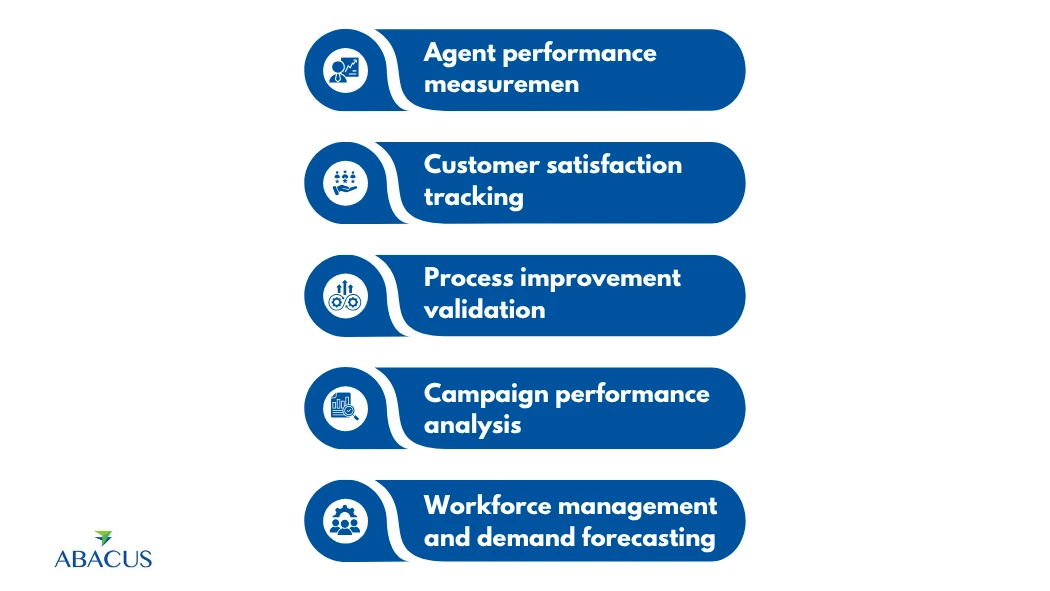
- Agent performance measurement. QA score distributions, handle time averages, and first-contact resolution rates are all quantitative metrics derived from structured measurement of operational data.
- Customer satisfaction tracking. CSAT, NPS, and CES are all quantitative survey instruments that allow satisfaction to be tracked over time and compared across segments, channels, and agent teams.
- Process improvement validation. Before rolling out a process change at scale, quantitative analysis of pilot data confirms whether the change produced a statistically significant improvement or whether the observed difference falls within normal variation.
- Campaign performance analysis. Conversion rates, contact rates, and appointment-setting rates from outbound programs are quantitative measures that drive decisions about which approaches to scale and which to discontinue.
- Workforce management and demand forecasting. Call volume forecasting, staffing ratio modeling, and SLA compliance projections are all built on quantitative analysis of historical operational data.
How to Design a Reliable Quantitative Research Study
Producing reliable quantitative results requires getting the design right before data collection begins. The most common failures in quantitative research happen at the design stage, not the analysis stage.
Define the research question precisely. A vague question produces a vague study. "What factors affect customer satisfaction?" is not a quantitative research question. "Does average wait time predict CSAT score in our inbound channel?" is.
Select the right research type. Descriptive if you are measuring what exists. Correlational if you are examining relationships. Experimental if you are establishing cause and effect. Quasi-experimental if true randomization is not possible.
Determine required sample size before collecting data. Sample size determines whether the study has enough statistical power to detect the effect being measured. A study that is too small will fail to detect real effects. A study that is too large wastes resources on precision beyond what the decision requires.
Use validated measurement instruments. Surveys should use established, tested scales where possible, or be piloted before full deployment to identify ambiguous questions that would produce unreliable data.
Specify the analytical method in advance. Deciding how data will be analyzed after seeing the results introduces bias. The analytical approach should follow logically from the research question and be determined before data collection begins.
How Abacus BPO Applies Quantitative Research Methods
At Abacus BPO, quantitative research is not a theoretical exercise. It is applied across the performance measurement and improvement cycles of every client program:
- CSAT and NPS surveys are designed as structured quantitative instruments with consistent questions asked in the same format across all interactions, allowing results to be aggregated, trended, and compared meaningfully.
- QA scoring uses structured rubrics that produce numerical scores, enabling statistical analysis of performance distributions, identification of outliers, and trend measurement over time.
- Process improvement pilots are evaluated using pre- and post-measurement designs with defined sample sizes and significance thresholds, so scale decisions are based on statistically validated results rather than favorable short-window averages.
- Call volume forecasting uses historical operational data analyzed with quantitative time-series and regression methods, producing staffing models built on evidence rather than assumption.
The Bottom Line
Quantitative research is one of the most widely used approaches in academia, business, healthcare, and the social sciences. At its core, it deals with measurable data, statistical analysis, and numerical insights. Because of its precision, this method is often considered the backbone of evidence-based decision-making.
For any organization serious about making decisions from data rather than intuition, understanding what quantitative research is and how to apply it correctly is not optional. It is the difference between knowing something is happening and knowing how much it is happening, how reliably, and what is likely driving it.