On this page
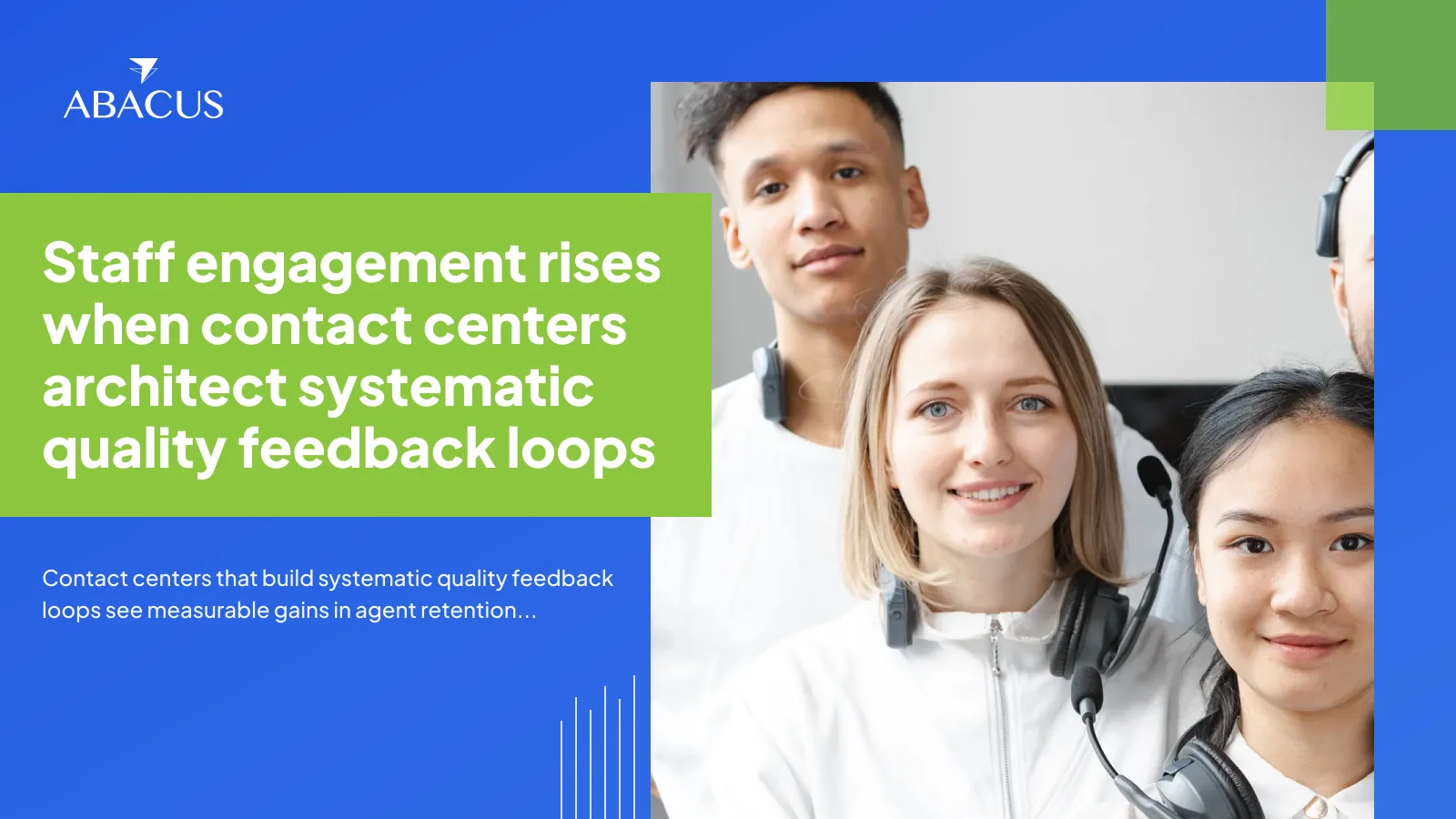
Attrition in contact centers rarely announces itself. It accumulates quietly through disengaged agents who stop volunteering ideas, go through the motions on calls, and leave within eighteen months. The feedback cycle, or more precisely the absence of one, is often the mechanism behind that pattern. When agents receive structured, timely, two-way feedback tied to quality criteria they helped shape, the relationship between the agent and the organisation changes in a measurable way. Staff engagement stops being a survey result and starts being an operational condition that supervisors can observe shift by shift.
How systematic feedback loops transform staff engagement metrics
Structured feedback systems do something that annual or quarterly reviews cannot: they close the gap between a behaviour and the information about that behaviour. In a contact center, that gap is almost always where disengagement begins. An agent handles three hundred calls a week but learns about a recurring error six weeks after the fact, long after the habit has calcified.
What the research shows about engagement and performance
According to Gallup's workplace research, one of the most common mistakes organisations make is treating engagement as a sporadic exercise rather than a continuous discipline. The finding holds especially in high-volume operations where agents cycle through identical task types all day and can lose the sense that any individual interaction matters. Systematic feedback loops counter that by making each interaction a data point in an ongoing conversation, not a forgotten transaction.
The CIPD's employee engagement factsheet notes that engaged employees are consistently healthier, more motivated, and associated with higher organisational performance. For contact centers, that translates directly to quality scores, first-contact resolution rates, and average handle time, all metrics that move when agents feel the feedback they receive is fair, timely, and actionable.

Designing feedback processes that center agent input, not just performance monitoring
Most quality assurance frameworks are designed by QA managers and handed to agents as a fait accompli. The criteria, weightings, and thresholds reflect what leadership thinks matters. That design choice has a cost: agents who had no voice in setting the standard are less likely to own their performance against it.
Making agents co-authors of the quality framework
A practical alternative is to run a quarterly criteria review where agents nominate call behaviours they believe the current scorecard misses or underweights. A team leader facilitates, a QA analyst documents the suggestions, and the output is a revised scorecard that reflects floor-level knowledge. Agents who contributed a criterion are noticeably more attentive during calibration sessions when that criterion comes up, because the standard is partly theirs.
Workforce engagement frameworks that include agent input at the design stage also surface practical intelligence that supervisors rarely see: which call types generate the most customer frustration, which knowledge base articles are consistently wrong, which process steps agents routinely work around. That intelligence improves both the feedback system and the underlying operation.
A scorecard that agents helped write is one they will actually defend in a coaching session. A scorecard handed down is one they will quietly resent.
Structuring the weekly review for two-way exchange
A 35-agent team serving an education provider's enrolment period ran a weekly review that illustrated this well. Every Monday morning, the team leader opened a shared dashboard showing each agent's top three quality flags from the prior week, drawn from a QA tool the team had helped configure. The meeting was not a performance tribunal. The first fifteen minutes were reserved for agents to comment on their own flags: what they saw, what context the QA scoring missed, what they would do differently. A recurring flag around
Frequently Asked Questions
What is the connection between staff engagement and feedback frequency in contact centers?
Staff engagement rises when feedback is frequent, specific, and tied to criteria agents understand. Infrequent or generic feedback leaves agents uncertain about how their daily work is judged, which erodes motivation over time. Weekly or bi-weekly structured feedback cycles are more effective than quarterly reviews at sustaining engagement.
How can contact centers measure improvements in staff engagement from feedback programmes?
Useful indicators include voluntary attrition rate, internal quality scores, first-contact resolution trends, and absenteeism. Measuring employee engagement formally through pulse surveys tied to feedback programme milestones also gives operations leaders a before-and-after baseline. Tracking these metrics together gives a more complete picture than any single data point.
What technology supports continuous feedback without overloading supervisors?
Quality management platforms with automated call scoring, AI-assisted evaluation flags, and agent-facing dashboards reduce the manual effort of feedback delivery significantly. When agents can view their own quality data in real time, supervisors shift from data gatherers to coaching facilitators. That shift typically reduces the time a team leader spends preparing feedback by a meaningful margin each week.
Why do agents disengage when feedback is purely top-down?
Top-down feedback positions agents as recipients of judgements rather than participants in improvement. According to the CIPD, employees who feel engaged are more fulfilled and motivated, a state that requires some degree of agency over their own work standards. When agents have no input into what gets measured or how flags are discussed, feedback sessions feel like compliance checks rather than development conversations.
How does real-time feedback specifically reduce attrition in contact centers?
Real-time feedback shortens the gap between a behaviour and the opportunity to correct it, which prevents small habits from becoming entrenched problems that eventually lead to performance-managed exits. Agents who receive actionable coaching close to the moment of the interaction also report higher job satisfaction, a direct driver of retention. Lower attrition in turn reduces the ramp time and quality variance that come with constant new-hire cycles.