On this page
- What SaaS Customer Onboarding Outsourcing Actually Covers
- Technical Onboarding Support: What to Outsource and What Not To
- Customer Success Outsourcing: What Changes and What to Watch For
- Technical Support vs Customer Success: Deciding What to Outsource First
- What an Outsourced SaaS Onboarding Program Needs Before It Launches
- How Abacus BPO Approaches SaaS Customer Onboarding Programs
- Frequently Asked Questions
The first 90 days of a SaaS customer relationship determine whether that customer renews. The data on this point is consistent across research sources. 40 to 60% of SaaS users who churn do so within the first 90 days, with the highest drop-off concentrated in days 1 to 30 (GigaBPO, June 2026). Companies with strong onboarding programs, specifically those that achieve time-to-first-value under 7 days, see 50% lower churn rates than those without a structured onboarding function (Fungies.io, July 2026, citing McKinsey).
For SaaS companies at the growth stage, delivering effective onboarding at the scale that expanding customer acquisition creates is one of the hardest operational problems to solve internally. The answer for a growing number of SaaS businesses is outsourcing the onboarding function, or significant portions of it, to a specialist partner.
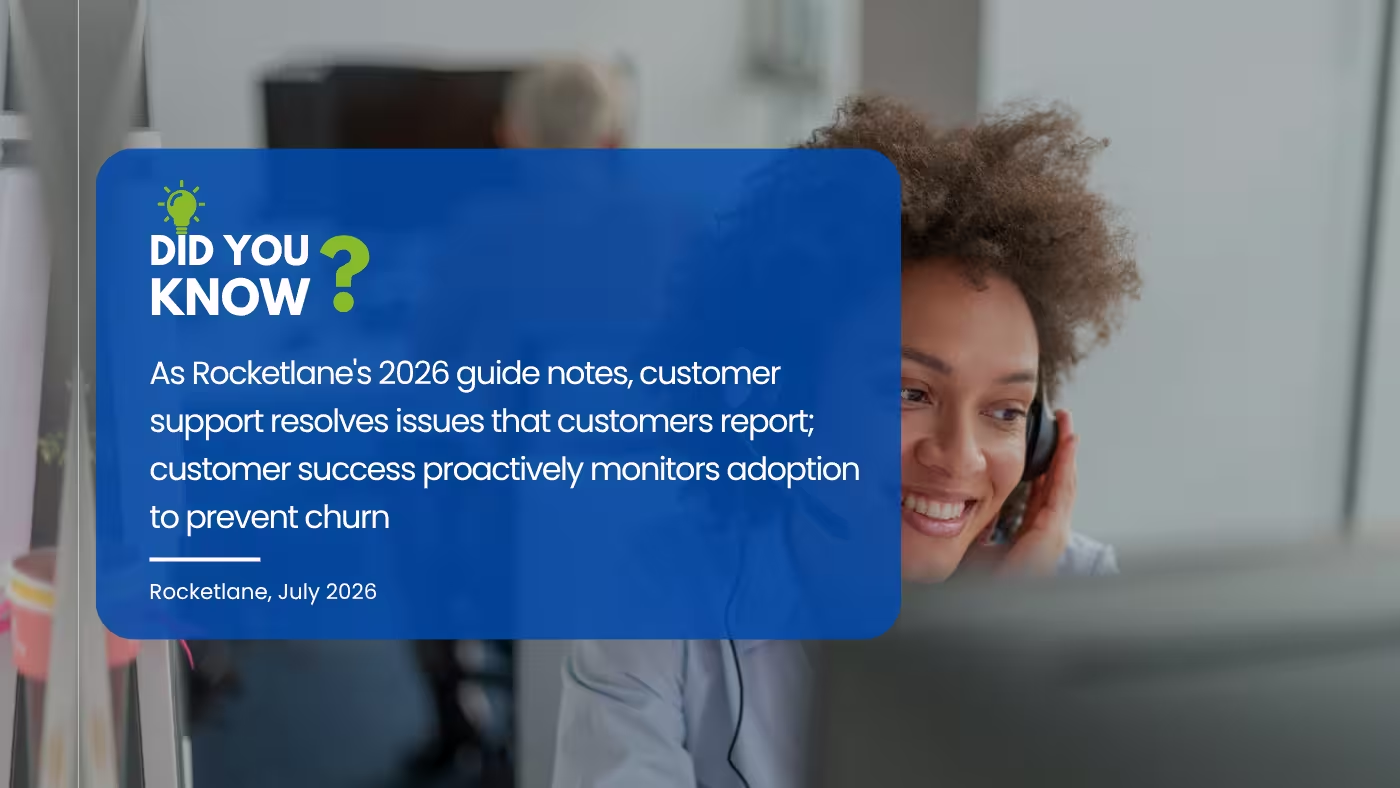
But onboarding is not a single function. It sits at the intersection of technical support, which resolves product configuration problems reactively, and customer success, which proactively manages adoption and outcome progress. Outsourcing each requires different skills, different metrics, and different partner selection criteria.
This guide separates the two clearly and builds the framework for deciding which to outsource, in what sequence, and what to look for in each type of provider.
What SaaS Customer Onboarding Outsourcing Actually Covers
Customer onboarding support for SaaS is the outsourced work of getting new users familiar with a software product and keeping them engaged through the early lifecycle. It sits where customer support, customer success, and technical support meet. The goal is to shorten the gap between signup and the first real win, because that first win is what turns a trial into a renewal (Helpware, July 2026).
Within that broader definition, two distinct functions operate with different objectives, different interaction types, and different performance indicators.
Technical onboarding support is reactive and product-focused. It handles configuration questions, error messages, integration problems, and setup issues that users encounter during initial product adoption. The agent's job is to resolve a specific technical problem so the user can continue moving through onboarding.
Customer success is proactive and outcome-focused. A customer success manager (CSM) monitors adoption, engagement, and outcome progress across the full onboarding period, identifies risk signals early, and intervenes before a user's low engagement becomes a decision to cancel.
Technical Onboarding Support: What to Outsource and What Not To
Technical onboarding support is the more straightforward of the two to outsource because it is fundamentally reactive and resolution-focused. A user sends a message or opens a chat with a specific technical problem. The agent resolves it.
The outsourcing case is strongest when:
- Your onboarding queue has more inbound technical questions than your internal team can handle at acceptable response times
- Your most common technical questions are well-documented in a knowledge base and follow predictable resolution paths
- Your product does not require engineering-level system access to resolve Tier 1 and Tier 2 issues
- Your internal engineers are regularly being pulled into support interactions they should not be handling
The conditions that make technical onboarding support harder to outsource are product complexity that requires frequent escalation to engineering, rapid product iteration where documentation consistently lags behind the product, and compliance requirements around the data that agents need to access to troubleshoot.
When the conditions are right, outsourced technical onboarding support can achieve first-contact resolution rates of 70% or above for well-documented interaction types, reduce response times significantly through follow-the-sun coverage, and free internal teams to focus on the escalations and product improvements that actually require their expertise.
SupportNinja, one of the providers most commonly cited for SaaS-specific onboarding support, structures its programs specifically around the SaaS customer journey rather than as isolated ticket queues, covering onboarding, support, renewals, and customer success as connected functions rather than separate programs (Virtustant, August 2026). That journey-based structure is the model most effective for SaaS onboarding because it prevents the handoff gaps between reactive support and proactive success from producing churn that neither function individually addresses.
Customer Success Outsourcing: What Changes and What to Watch For
Customer success outsourcing operates differently from technical support outsourcing. An outsourced CSM is not resolving tickets. They are monitoring health scores, running QBRs, identifying risk signals, and managing the post-sale relationship in ways that are designed to keep the customer engaged through adoption and into renewal.
The rise of Onboarding-as-a-Service reflects the growing recognition that even well-funded SaaS companies cannot always hire CSMs fast enough to keep pace with new customer acquisition (Onramp.us, August 2026). AI-augmented hybrid roles are enabling CSMs to manage larger customer portfolios while maintaining personalization, with predictive analytics and automated workflows reducing manual effort so smaller teams can onboard more customers without proportional headcount increases.
The outsourcing case for customer success is strongest when:
- You are at seed or early growth stage and cannot yet justify a dedicated CS hire
- You have more accounts than your internal CS team can engage proactively without some contacts falling through to a check-in only at renewal
- Your product has a well-defined onboarding pathway with clear success milestones that an outsourced CSM can monitor and report against
- Your internal team needs to focus on the highest-complexity enterprise accounts while a BPO partner manages mid-market and SMB segments
Outsourced CS teams typically operate as an extension of your brand using your tools, your processes, and your voice to engage customers (MasCallNet.ai, June 2026). The areas most commonly outsourced are onboarding coordination, health score monitoring, proactive outreach based on usage signals, QBR preparation, and renewal support for lower-complexity accounts.
What is harder to outsource is the relationship depth required for strategic enterprise accounts, where the CSM's knowledge of the client's internal politics, multi-stakeholder dynamics, and long-term expansion potential is not easily transferred to an external team. Enterprise CS is best retained internally. The mid-market and SMB tiers, where proactive engagement and structured outreach drive the most scalable retention gains, are where outsourced CS delivers the highest value.
Technical Support vs Customer Success: Deciding What to Outsource First
| Dimension | Technical Onboarding Support | Customer Success Outsourcing |
|---|---|---|
| Interaction type | Reactive: user initiates with a specific problem | Proactive: CSM initiates based on health signals |
| Primary objective | Resolve a specific technical issue | Drive adoption, engagement, and renewal readiness |
| Agent skill requirement | Product knowledge, troubleshooting ability, escalation judgment | Relationship management, data interpretation, business outcome awareness |
| Volume profile | High-volume, multiple short interactions | Lower volume, longer-duration, ongoing account relationships |
| Outsourcing readiness | Easier: well-documented, measurable, scalable | Harder: requires deep brand alignment and product context |
| Key performance metric | First-contact resolution rate, response time, CSAT | NRR, churn rate, health score trends, time to first value |
| Outsource this first if... | Inbound technical queue is outpacing internal capacity | You have more accounts than CSMs can proactively engage |
| Keep internal if... | Requires engineering escalation for most issues | Accounts are enterprise-tier with complex stakeholder environments |
For most growth-stage SaaS companies, the right sequencing is to outsource technical onboarding support first. It has clearer documentation requirements, more measurable performance metrics, and lower brand risk if execution quality varies. Customer success outsourcing follows once you have confirmed that your onboarding pathway is well-defined enough to be managed by an external team and that your internal tools surface the health signals that an outsourced CSM needs to act on proactively.
What an Outsourced SaaS Onboarding Program Needs Before It Launches
Regardless of whether you are outsourcing technical support, customer success, or both, the following must be in place before the outsourced team handles a live customer:
Documented onboarding pathway. The specific steps a new user or account should complete, in what sequence, and what success looks like at each milestone. Without this, an outsourced team cannot follow or measure the onboarding process consistently.

Knowledge base and troubleshooting guides. Technical onboarding agents need accurate, current reference material for the most common configuration and setup questions. This documentation should be tested against real new-user questions before go-live, not assembled from internal engineering notes.
Health scoring logic. For customer success outsourcing, the signals that define a healthy versus at-risk account must be defined and surfaced in the tools the outsourced CSM uses. An outsourced CSM who cannot see product usage data cannot identify risk early enough to prevent churn.
Escalation path to internal team. Not every onboarding issue or customer risk flag should be resolved at the outsourced tier. A documented escalation path, with specific criteria for when internal team involvement is triggered, must exist before the outsourced team launches.
Defined success metrics agreed before go-live. Time to first value, first-contact resolution rate for technical support, CSAT, churn rate by cohort, and health score distribution are the metrics that should be defined, baselined, and agreed between the client and the outsourcing partner before the program begins, not retrospectively derived from early data.
How Abacus BPO Approaches SaaS Customer Onboarding Programs
At Abacus BPO, SaaS onboarding programs are built around the specific onboarding pathway, product context, and lifecycle stage of each client rather than a generic support model.
For technical onboarding support, agents complete structured product training covering the most common setup and configuration questions before handling live interactions. Escalation criteria are defined at program design with documented thresholds for Tier 1, Tier 2, and engineering escalation. QA covers resolution accuracy, response time, and escalation judgment weekly for every agent.
For customer success support, outsourced CSM activity is aligned to the client's health scoring logic, with proactive outreach triggered by specific usage signals rather than by calendar cadence alone. Reporting covers both activity metrics (outreach cadence, QBR completion rate) and outcome metrics (health score trends, churn rate by cohort, NRR trajectory) to give the client visibility into whether the program is actually driving retention.
Frequently Asked Questions
What is the difference between outsourced technical onboarding support and outsourced customer success?
Technical onboarding support is reactive: users initiate contact with a specific problem and agents resolve it. Customer success is proactive: a CSM monitors adoption signals, identifies risk, and intervenes before problems lead to churn. Both are relevant to SaaS onboarding but require different skills, different tools, and different performance metrics.
What percentage of SaaS users churn during onboarding?
40 to 60% of users who churn do so within the first 90 days, with the highest concentration in the first 30 days. Achieving time-to-first-value under 7 days is associated with 50% lower churn rates.
What should be documented before launching an outsourced onboarding program?
The specific onboarding pathway with success milestones at each stage, a tested knowledge base for common technical questions, health scoring logic for customer success programs, escalation criteria for internal team involvement, and agreed performance metrics baselined before the program goes live.
Which function should a SaaS company outsource first: technical support or customer success?
Technical onboarding support first. It has clearer documentation requirements, more measurable performance metrics, and lower execution risk for the customer relationship. Customer success outsourcing is most effective once the onboarding pathway is well-defined and the internal tools surface the health signals that an outsourced CSM needs.
How does outsourcing onboarding reduce SaaS churn?
By ensuring every new customer receives structured guidance to their first meaningful product use within the first week, by resolving setup and configuration issues quickly enough that users do not give up on the product before experiencing its value, and by identifying low-engagement accounts early enough to intervene before renewal conversations are already lost.