On this page
- How Retail Customer Service Agents Develop Through Structured Coaching Programs
- Building Accountability Systems That Connect Agent Performance to Customer Retention
- Technology Infrastructure Requirements for Scaling Personalized Coach-Agent Interactions
- Vendor Selection Criteria for BPO Partners With Demonstrated Retail Coaching Capabilities
- Frequently Asked Questions
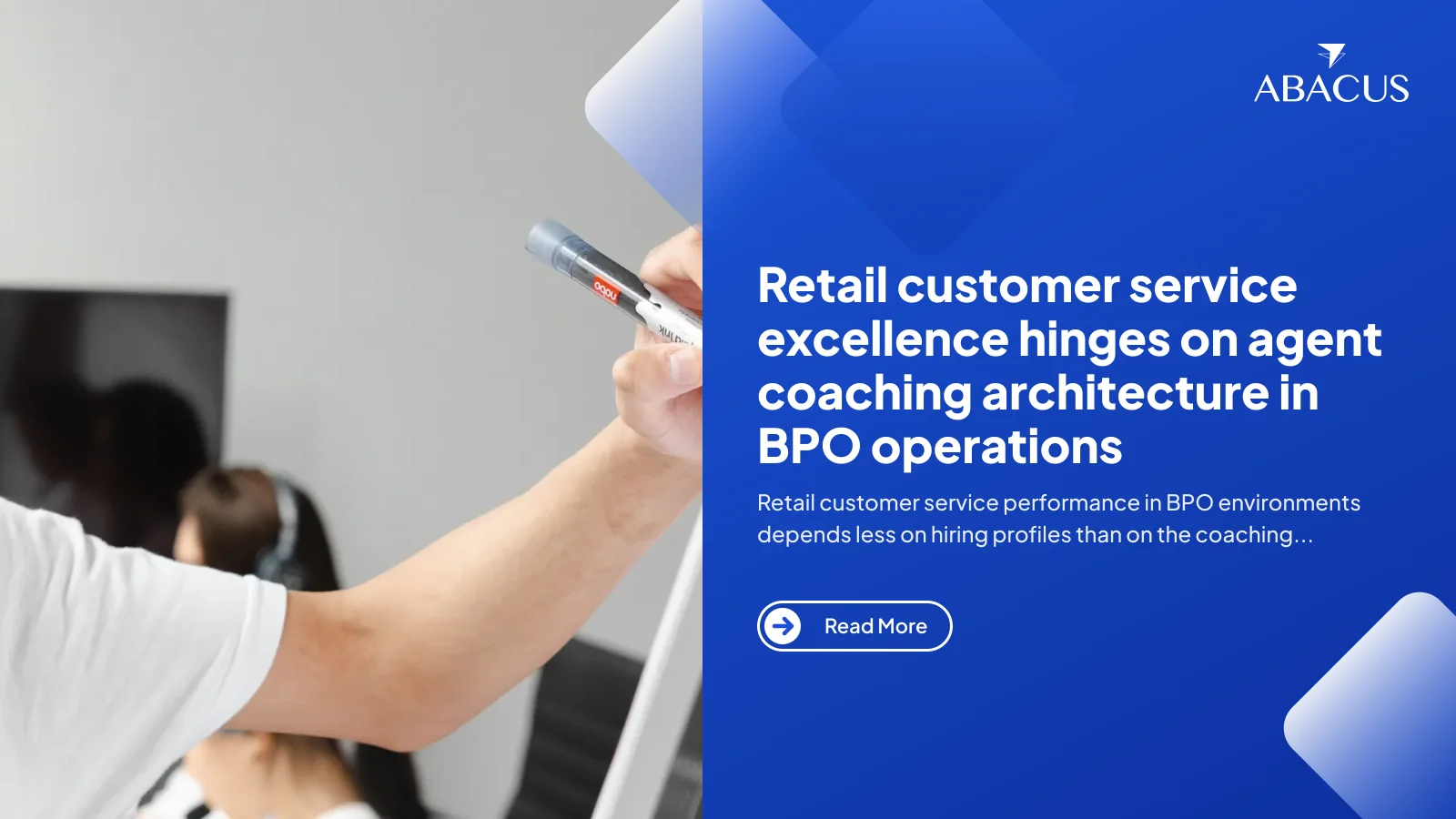
Retailers who outsource their customer service often focus intensely on the pre-launch phase: workforce sizing, training curricula, channel routing. Then, three months in, quality scores plateau and attrition climbs. The issue is rarely the agents. It is the absence of a structured coaching architecture that keeps skill development active after go-live. Retail customer service demands more than product knowledge; it requires agents who can read shopper sentiment, adapt tone across channels, and resolve complex issues like returns and loyalty disputes without escalating. Building that capability at scale inside a BPO is a design problem, not a hiring one.
How Retail Customer Service Agents Develop Through Structured Coaching Programs
Retail-focused agent development starts with a skills taxonomy. BPO programmes that produce consistent quality map the competencies specific to retail: empathy signalling, product substitution logic, returns policy navigation, and loyalty programme mechanics. Each competency sits on a progression ladder, typically four levels, from scripted handling to autonomous problem-solving. Agents are placed on the ladder at intake, not after training, so coaches have a baseline from day one.
Calibration Sessions as a Coaching Mechanism
Weekly calibration sessions are the core ritual. A team leader pulls six to eight calls or chat transcripts from the prior week, selects two that hit SLA and two that missed it, and walks through them with the agent against the skills taxonomy. The goal is not to score the interaction again but to isolate the specific moment the interaction diverged from the ideal path. This is more precise than a generic quality score because it names the competency gap rather than describing the symptom.
- Role-play practice follows each calibration to rehearse the corrected behaviour, not just discuss it
- Agents track their own ladder position on a visible dashboard, which shifts ownership from coach to agent
- Monthly cross-team calibrations surface pattern gaps that individual coaching cannot catch, such as systemic mishandling of a new return policy
According to HubSpot Research cited by Help Scout, 93% of customers are likely to make repeat purchases with companies that offer excellent customer service. The coaching architecture that produces that excellence starts with observable skill progression, not motivational training.

Building Accountability Systems That Connect Agent Performance to Customer Retention
Accountability in retail BPO programmes breaks down when metrics live in the quality team's spreadsheet and never reach the agent's daily workflow. The fix is a closed-loop system: coaching observations generate a documented action, the action has a two-week review date, and the outcome feeds back into the agent's ladder position. Nothing is left open-ended.
Linking Micro-Metrics to Retail Outcomes
First-contact resolution rate is the metric most directly tied to retention in retail. An agent who resolves a return dispute on the first interaction produces a measurably different customer trajectory than one who transfers or promises a callback. BPO programmes that surface FCR at the individual agent level, not just the queue level, give coaches a retention-linked number to anchor every conversation.
The most common accountability failure is measuring what is easy to count, handle time and occupancy, rather than what the retail client actually cares about: whether the shopper comes back.
Operational metrics and their retail retention relevance in BPO coaching programmes
| Metric | Coaching Lever | Retention Link | Common Misuse | Source |
|---|---|---|---|---|
| First-Contact Resolution (FCR) | Decision-tree coaching | Direct: reduces repeat contact friction | Measured at queue, not agent level | Help Scout |
| CSAT after returns | Empathy and policy coaching | Strong: returns are a loyalty test | Averaged across all interaction types | Salesforce |
| Average Handle Time (AHT) | Navigation and system fluency | Indirect: only when balanced with quality | Used as a primary performance target | Gladly |
| Transfer rate | Competency expansion coaching | Direct: transfers erode shopper confidence | Not tracked at agent level | RetailDoc |
| Repeat contact rate | Resolution confirmation skills | Strong: signals unresolved root cause | Attributed to product issues, not agent gaps | Nextiva |
Source: Help Scout, Salesforce, Gladly, RetailDoc, Nextiva.
Seasonal programmes add a specific challenge. When an 110-agent retail programme ramps for peak, a team leader arriving for the 6 a.m. shift on the first heavy-volume Monday checks three things before the queue opens: which agents are on their first week post-coaching review, which are flagged for a returns-handling gap from the prior calibration, and which new seasonal agents have not yet cleared the tier-two policy certification. Those three lists dictate who gets a five-minute side-by-side before the phones open and who handles overflow routing. The accountability architecture makes that triage possible; without it, the team leader is managing by intuition under pressure.
Technology Infrastructure Requirements for Scaling Personalized Coach-Agent Interactions
One-on-one coaching does not scale through headcount alone. A BPO running a retail programme at volume needs a technology layer that automates the data collection so coaches spend time coaching, not pulling reports. The essential components are interaction analytics, a coaching workflow tool, and a learning management system integrated tightly enough that a flagged call can become a coaching session within the same shift.
Speech and Text Analytics as Coaching Inputs
Interaction analytics tools that auto-score calls against retail-specific criteria, empathy markers, policy accuracy, resolution confirmation, reduce the manual sampling burden dramatically. Rather than a coach reviewing ten random calls per agent per week, the system surfaces the two or three that show a deviation worth addressing. This is not a replacement for human judgment; the coach still interprets and contextualises. But it shifts the coach's time from search to analysis.
- Coaching workflow tools log each session, the competency addressed, the action agreed, and the follow-up date
- LMS integration means a coach can assign a micro-learning module on the spot when a knowledge gap surfaces
- Agent-facing dashboards showing their own trend data reduce the defensiveness that slows coaching conversations
For retailers exploring how AI fits into this stack, the distinction between interaction analytics and conversational AI customer service platforms matters: analytics tools observe and score, while conversational AI tools operate in the live interaction. Both have a role, but conflating them creates procurement mistakes.

Vendor Selection Criteria for BPO Partners With Demonstrated Retail Coaching Capabilities
Retail customer service outsourcing decisions hinge on whether a BPO can produce evidence of coaching execution, not just coaching philosophy. Any vendor can describe a coaching programme in a pitch deck. The qualifications that distinguish capable partners are demonstrable in due diligence.
What to Ask and What to Verify
Ask for the skills taxonomy the vendor uses for retail programmes. If they cannot produce one specific to retail, they are applying a generic framework, which typically underperforms on returns handling, loyalty programme complexity, and seasonal volatility. Ask how coaching hours are protected during peak periods. Many BPOs sacrifice coaching when occupancy rises; the answer to this question reveals whether coaching is structural or aspirational.
- Request the ratio of coaches to agents: anything above 1:18 in a retail programme is a warning sign
- Ask how the LMS is connected to the QA system: a manual handoff suggests the tools are not genuinely integrated
- Verify whether the vendor holds ISO 18295-1 certification, the international standard for customer contact centres, which specifies requirements for people management and service delivery
- Confirm information security and privacy certifications, particularly ISO 27001 and ISO 27701, which are non-negotiable for retail programmes handling payment and loyalty data
Abacus BPO, which has operated contact centre and back-office programmes since 2008, holds ISO 27001, ISO 27701, and ISO 18295-1 certifications, giving retail clients a documented standard against which to hold the programme. For a broader view of what the outsourcing decision involves operationally, the analysis on outsourcing ecommerce customer service covers the structural considerations that precede vendor selection.
Finally, ask for a sample coaching report from a live programme, anonymised if necessary. The format and specificity of that document reveals more about actual coaching practice than any reference call. A vendor confident in their coaching architecture will not hesitate to share it.
Frequently Asked Questions
What makes retail customer service coaching different from general customer service training?
Retail customer service involves recurring high-stakes interactions like returns, loyalty disputes, and product substitutions that require specific competency frameworks, not generic service skills. Coaching in retail BPO programmes must map to these interactions explicitly and track agent progression on them individually. Generic training frameworks tend to underperform on the scenarios that most directly affect shopper retention.
How often should BPO agents handling retail customer service receive coaching sessions?
Weekly calibration sessions are the industry standard for maintaining quality in retail programmes, supplemented by brief side-by-side observations during peak periods. Monthly cross-team calibrations catch systemic gaps that individual sessions miss. The frequency should be protected contractually so it does not collapse when occupancy rises.
Which metrics best connect retail customer service agent coaching to customer retention?
First-contact resolution rate and repeat contact rate are the most direct indicators because they measure whether the underlying issue was actually resolved. CSAT scores after returns interactions add a sentiment dimension that pure resolution metrics miss. Handle time and occupancy are operational efficiency metrics, not retention metrics, and should not dominate coaching conversations.
What technology does a BPO need to scale retail customer service coaching without proportional cost increases?
Interaction analytics tools that auto-score calls against retail-specific criteria reduce the manual sampling burden and surface the interactions worth coaching rather than requiring coaches to review everything. A coaching workflow tool that logs sessions and follow-up dates keeps accountability intact at scale. An LMS integrated with the QA system allows coaches to assign targeted micro-learning in the same workflow.
What certifications should a BPO hold to handle retail customer service programmes?
ISO 18295-1 is the international standard for customer contact centres and specifies requirements for people management, service delivery, and continuous improvement. ISO 27001 and ISO 27701 cover information security and privacy, which are critical for retail programmes that handle payment data and loyalty account information. Verifying these certifications during vendor selection provides a documented standard rather than relying on self-reported claims.