On this page
The global outsourcing market reached $358.58 billion in 2026, with projections to hit $525 to $696 billion by 2030 (Insignia Resources, May 2026). Three countries sit at the center of how US companies access that capacity: India, the Philippines, and Pakistan. Each has a distinct value proposition, a different talent profile, and a different risk profile. Choosing the wrong one for your specific function does not just mean accepting a trade-off. It means paying for a capability your program does not need while missing the one it does.
This guide covers what each destination actually delivers in 2026, where each one wins, where each one falls short, and how to match your specific outsourcing need to the right geography.
The Market Position of Each Destination in 2026
India is the world's largest outsourcing market by revenue, generating over $250 billion annually and employing more than 5 million technology professionals across 1,800 global capability centers (Sourcefit, May 2026). India's IT industry commands 55% of the global outsourcing market (ConnectOS, July 2026). GitHub already counts India as the largest open-source contributor base on earth, projecting it to pass the US entirely by 2030 at 57.5 million developers (FullScale, August 2026).
The Philippines is the world's second-largest outsourcing destination, generating approximately $35 billion annually with over 1.7 million direct BPO employees and 1.4 to 1.8 million BPO workers total (Sourcefit, May 2026, Insignia Resources, May 2026). The Philippines ranks number one globally for outsourcing competitiveness and has built its identity around English-first, Western-aligned service delivery.
Pakistan is a fast-rising market operating significantly below the scale of India or the Philippines but growing rapidly. Pakistan generated $320 million in call center export revenue in FY 2024-25, marking 24.6% year-over-year growth, with over 1,000 registered call centers employing more than one million professionals (HRBS, January 2026).
Cost Comparison: What US Companies Actually Pay in 2026
| Role Type | Pakistan | Philippines | India |
|---|---|---|---|
| Customer service agent (hourly) | $5 to $12 | $10 to $14 | $6 to $14 |
| Software engineer (annual) | Well below $20k | ~$35,000 | ~$20,000 |
| Virtual assistant (hourly) | Competitive with India | ~$2.0/hour (local rate) | ~$2.7/hour (local rate) |
| Technical / IT support (hourly) | $15 to $35 | $12 to $20 | $18 to $45 |
| BPO agent cost vs US in-house | Up to 70% lower | 50 to 70% lower | 50 to 70% lower |
| Managed BPO program (per agent, monthly) | Highly competitive | $1,200 to $3,500 | $1,000 to $3,000 |
Sources: Stealth Agents, July 2026, Wishup, July 2026, Wisemonk, May 2026, GigaBPO, July 2026, AB7, June 2026
Both India and the Philippines deliver 50 to 70% savings over Western labor costs, with the cost gap between them typically 10 to 20% in India's favor for technical roles, narrowing further for customer-facing work where communication quality determines outcomes more than raw cost (Wisemonk, May 2026). Pakistan's customer service rates are among the most cost-competitive in Asia, with agent costs typically $5 to $12 per hour for customer service and back-office roles (Stealth Agents, July 2026).
Where Each Country Wins: A Function-by-Function Breakdown
Voice-Heavy US Customer Service
Winner: Philippines.
The Philippines has built its outsourcing identity specifically around English-first, US-culturally-aligned voice support. Filipino professionals are widely described as service-oriented, loyal, and collaborative, with neutral-accent English spoken in a communication style that US customers find natural from day one (ConnectOS, July 2026). The country overtook India as the preferred voice BPO destination for US programs on the back of this cultural and accent alignment.
Pakistan is competitive for voice support, particularly for programs where British-adjacent English and cultural familiarity with English-language business norms is sufficient. However, for US-accent-sensitive voice programs, the Philippines remains the stronger default.
India is competitive for voice in price, often running $6 to $14 per agent hour versus $10 to $14 in the Philippines, but dedicated India pods carry under 15% annual turnover compared to 30 to 40% in Philippine voice BPO, which matters substantially over a 12-month program when re-training costs are included (AB7, June 2026).
Software Development and Technical IT
Winner: India.
India is not just cheaper than the Philippines for software engineering. It is the most cost-effective technical hiring destination in the world by a significant margin (Wisemonk, May 2026). Annual software engineer costs in India average approximately $20,000 versus $35,000 in the Philippines, $52,000 in Poland, and $130,000 in the United States (Wisemonk, May 2026). India's talent pool of approximately 5.95 million technology professionals and 2.5 million STEM graduates annually dwarfs every other outsourcing market (ConnectOS, July 2026).
Pakistan's IT outsourcing sector is growing and competitive for earlier-stage technical work, with IT development hourly rates at $15 to $35. For companies that need engineering scale, proven enterprise delivery, and access to a talent pool that has serviced Fortune 500 clients for decades, India remains the dominant choice.
Back-Office, Data Processing, and Administrative Work
Winner: Pakistan for cost; Philippines for integration; India for scale.
Pakistan offers genuinely the most cost-competitive rates in Asia for back-office and data processing work at 60 to 70% below Western markets (HRBS, January 2026). For US companies whose primary objective is cost reduction in structured, process-intensive back-office functions with straightforward English-language requirements, Pakistan's emerging BPO sector delivers the highest cost efficiency.
The Philippines delivers better cultural integration and Western-facing team dynamics for back-office functions that require ongoing collaboration with a US-based team. India provides the largest available talent pool for scaling back-office operations quickly.

Hybrid Programs Covering Multiple Functions
Winner: No single country.
Many mature outsourcing programs run both markets simultaneously rather than choosing one, deploying the Philippines for customer-facing voice and chat support, India for technical development and KPO, and Pakistan for cost-sensitive back-office and digital marketing functions (Wisemonk, May 2026). This multi-destination model is increasingly the norm rather than the exception among US companies with significant outsourcing operations.
Risk Factors: What to Assess Before Committing
Philippines: Turnover in voice BPO runs 30 to 40% annually, creating re-training costs that are often excluded from initial cost comparisons (AB7, June 2026). The talent pool for deep technical roles is smaller than India's. For programs where agent continuity matters, dedicated India or Pakistan pods consistently outperform the Philippines on turnover metrics.
India: Time zone overlap with US business hours is limited for real-time collaboration-intensive work. Management communication overhead is higher than the Philippines for programs requiring ongoing US-team integration. The Philippines is generally easier for first-time outsourcers to integrate due to cultural alignment.
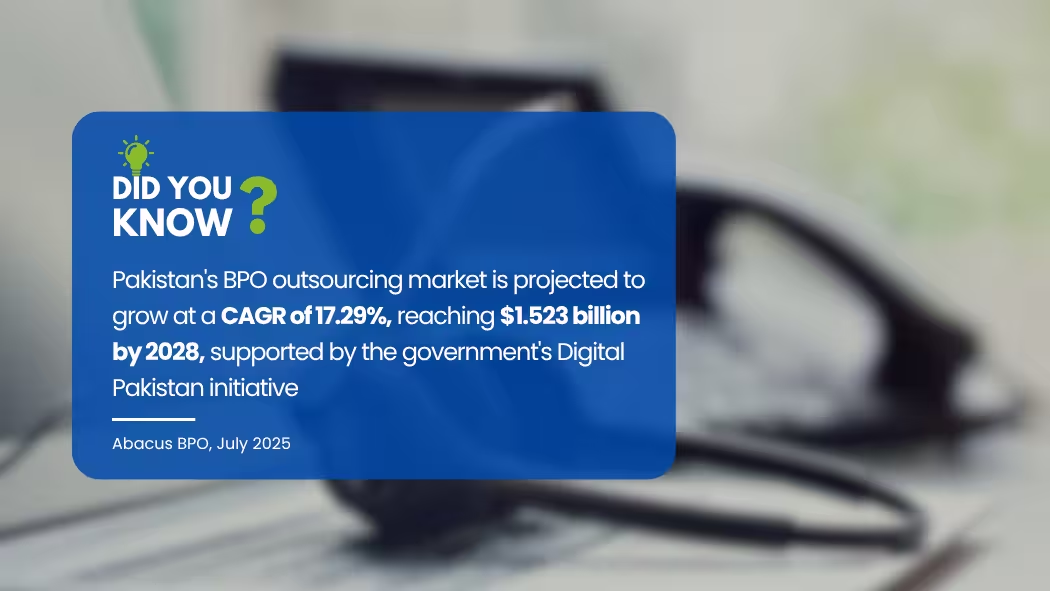
Pakistan: As an emerging BPO market, Pakistan has a smaller pool of enterprise-grade providers with the compliance infrastructure, security certifications, and quality management systems that US enterprise clients require. The market is growing at 17.29% CAGR, but vendor selection requires more rigorous due diligence than in the more mature Philippines and India markets. Geopolitical and infrastructure considerations should also be factored into continuity planning.
What Abacus BPO Offers as a Pakistan-Based BPO for US Clients
Abacus BPO operates from Pakistan, combining the cost competitiveness of the Pakistani market with enterprise-grade quality management systems, multilingual capability, and the service breadth that US clients expect from a mature BPO partner.
A Chicago-based tech startup that delegated customer onboarding and support functions to Abacus BPO achieved over 60% cost savings on overall customer service while maintaining exceptional service quality, with the savings reinvested into growth initiatives (Abacus BPO, July 2025). Programs span customer support, lead generation, data processing, back-office administration, and digital marketing services, structured around client-defined quality standards and SLA targets.
Frequently Asked Questions
Is Pakistan a legitimate outsourcing destination for US companies?
Yes. Pakistan's BPO sector is growing at 17.29% CAGR and generated $320 million in call center export revenue in FY 2024-25 with 24.6% year-over-year growth. The government's Digital Pakistan initiative is accelerating infrastructure investment. The market is less mature than India or the Philippines, which makes vendor selection more important, but the cost efficiency and English-speaking talent pool make Pakistan a strong option for cost-sensitive US buyers.
Which country is cheapest for outsourcing customer service?
Pakistan offers the most competitive rates for customer service in Asia at $5 to $12 per agent hour. India and the Philippines run $6 to $14 per hour depending on role complexity. All three deliver 50 to 70% savings versus equivalent US in-house staffing.
Which country is best for US voice support?
The Philippines. Neutral-accent English, deep Western cultural alignment, and a 1.4 to 1.8 million-strong BPO workforce built specifically around US and UK voice programs make the Philippines the default choice for accent-sensitive US customer service.
Which is better for software development, India or the Philippines?
India, by a significant margin. India software engineers cost approximately $20,000 per year versus $35,000 in the Philippines, with a talent pool of 5.95 million technology professionals versus the Philippines' estimated 800,000. India is the most cost-effective technical hiring destination in the world.
Can a US company outsource to more than one country simultaneously?
Yes, and many mature outsourcing operations do. The most common multi-destination model deploys the Philippines for voice and chat customer support, India for technical development, and Pakistan for cost-sensitive back-office and digital marketing functions.