On this page
- How Knowledge Management Systems Compress Ramp-Up Timelines in High-Volume Operations
- What Gets Lost When Onboarding Relies on Peer Training Instead of Documented Processes
- Measuring Adoption and Agent Reliance on Knowledge Resources During the First 90 Days
- Building Knowledge Workflows That Match High-Volume Call Patterns, Not Generic Best Practices
- Frequently Asked Questions
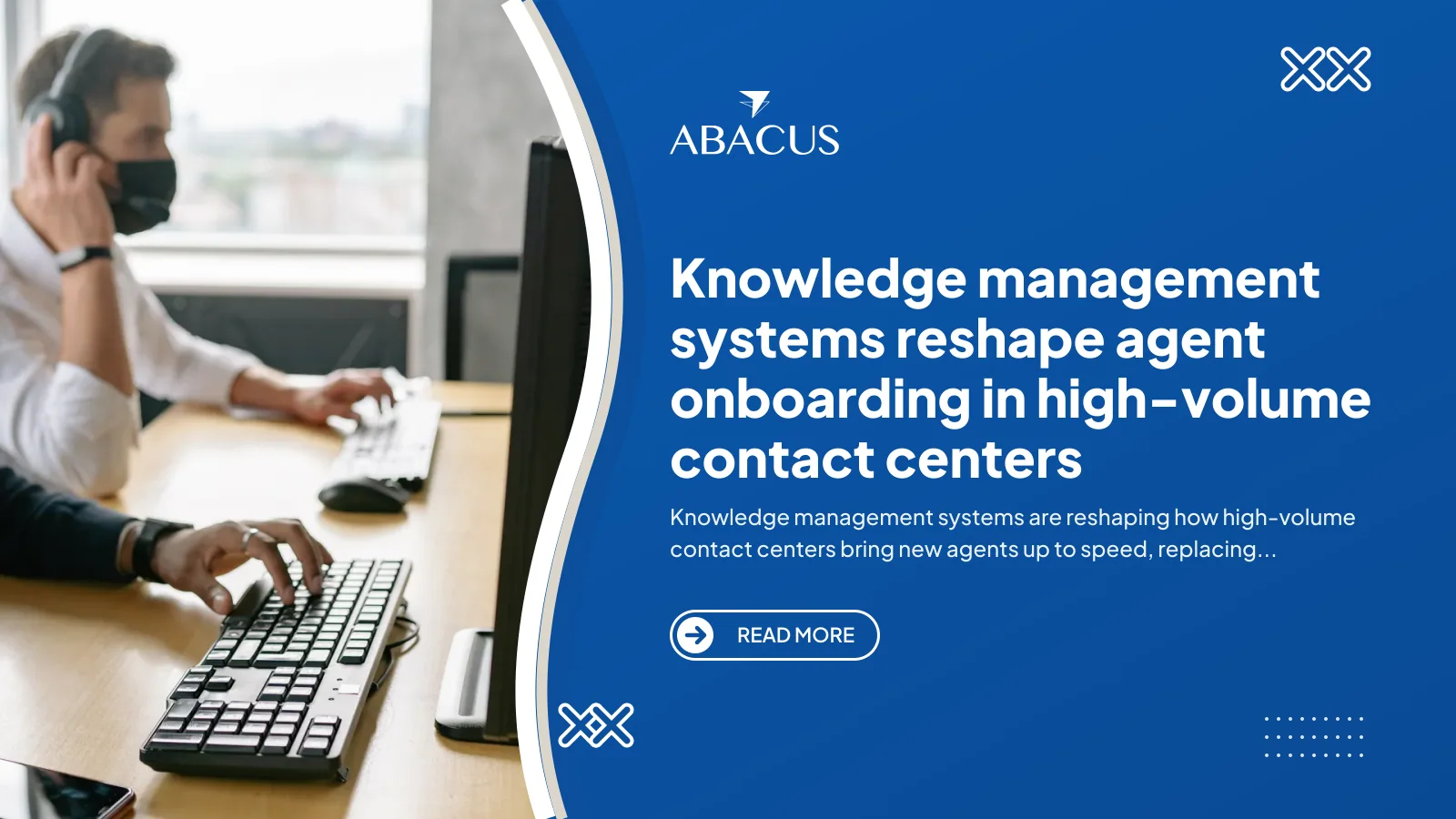
A new agent's first week in a contact center handling five thousand interactions a day is not a gentle introduction. Queues do not pause, call types do not simplify themselves, and the tribal knowledge held by a tenured colleague two seats over is unavailable the moment that colleague goes on break. The gap between what a new hire knows and what the job demands gets measured in real time, through misrouted calls, escalations, and first-contact resolution rates that slip every time a cohort ramps up. Knowledge management systems address exactly that gap, and how a center designs and deploys them determines whether new agents reach full productivity in weeks or months.
How Knowledge Management Systems Compress Ramp-Up Timelines in High-Volume Operations
The mechanism is straightforward even if the execution is not. A knowledge management system gives a new agent a single place to resolve an unknown during a live call, without leaving the interaction to search a file share, ask a neighbor, or guess. The lookup happens inside the flow of work rather than interrupting it, which keeps handle time from ballooning while the agent builds recall over time.
From lookup dependency to independent recall
In a high-volume center, the ramp arc follows a predictable pattern. In weeks one through three, agents rely on the knowledge system for almost every non-scripted question. By weeks five through eight, lookup frequency drops as recall replaces search for common call types. The system accelerates that arc by ensuring that every lookup reinforces the same correct answer, so recall builds on accurate information rather than on whatever a peer happened to say on a Tuesday afternoon.
According to Zendesk's knowledge management guide, a centralized KMS improves productivity, consistency, and knowledge retention across teams by making searchable, trusted content available at the point of need. For a 200-seat inbound center processing billing and technical support calls simultaneously, that consistency matters most during the first ninety days, when agent decisions are least reliable and quality scores are most volatile.
Speed through structure, not volume
The compression comes from structure, not content volume. A knowledge base loaded with five hundred articles that require three clicks and a keyword guess to reach does not compress ramp time; it adds cognitive load. Centers that see genuine timeline reductions tend to use decision-tree formats for high-frequency call types, surface contextually relevant articles through CRM integration, and limit the initial article set to the thirty or forty scenarios that account for the majority of inbound volume during the first month of a new hire's tenure.

What Gets Lost When Onboarding Relies on Peer Training Instead of Documented Processes
Peer training is not inherently flawed. An experienced agent modeling how to handle an irate caller or how to navigate a complex escalation path has real value. The problem is exclusivity: what gets modeled depends entirely on which peer the new hire shadows, on that peer's habits, and on what call types happen to arrive during the observation period.
Consistency risk at scale
When a center onboards twenty agents at once, as is common after a seasonal ramp-up announcement, peer dependency fragments process consistency across the cohort from day one. Agent A learned the refund policy from someone who interprets it generously; agent B learned it from someone who reads it strictly. Both are now live on the queue, and the compliance exposure that follows is not hypothetical. Regulatory scripts, data-handling steps, and escalation triggers are exactly the categories where informal transfer creates the highest risk.
Peer training scales knowledge at the speed of conversation; a knowledge management system scales it at the speed of search. The difference shows up in QA scores within the first calibration cycle.
IBM's knowledge management overview notes that KMS platforms enable organizations to customize permission and document-security controls, ensuring information reaches only the correct channels. In onboarding terms, that means sensitive process guidance, pricing rules, or compliance scripts can be versioned, access-controlled, and updated centrally, so every agent in every cohort reads the same current version rather than a third-hand verbal interpretation.
The hidden attrition link
There is a less-discussed cost to peer dependency: it concentrates onboarding burden on senior agents, pulling them partially off the queue and increasing their own occupancy. Centers that track attrition carefully often find that tenured agents who carry heavy informal training loads burn out faster than peers who do not. A well-maintained knowledge base management system distributes that burden onto documented content instead, which also means it does not leave when a top performer quits.
Knowledge transfer method compared across key onboarding dimensions
| Dimension | Peer-led transfer | KMS-supported onboarding | Primary risk if unaddressed |
|---|---|---|---|
| Process consistency | Varies by peer interpretation | Standardized, version-controlled | Compliance and QA variance |
| Compliance script accuracy | Depends on peer recall | Current version always accessible | Regulatory exposure |
| Senior agent load | High, informal coaching burden | Reduced, self-serve lookups | Tenured agent burnout |
| Knowledge longevity | Lost when peer leaves | Retained in the system | Repeated ramp failures |
| Update propagation | Ad hoc, inconsistent | Centralized, immediate | Agents operating on outdated policy |
Source: Zendesk knowledge management guide; IBM knowledge management overview; eGain KMS overview.

Measuring Adoption and Agent Reliance on Knowledge Resources During the First 90 Days
Deploying knowledge management systems without measuring adoption is a common failure mode. The system exists, agents have credentials, and leadership assumes use. Weeks later, QA scores reveal that agents are still calling across the floor for answers, and the knowledge base has become a compliance artifact rather than a live operational tool.
Leading indicators worth tracking
Useful adoption metrics in the first thirty days include search volume per agent per shift, article click-through rate on surfaced suggestions, and the ratio of escalations to total contacts. A high escalation rate in week two alongside low search volume is a signal that agents are bypassing the system, not that the system lacks content. By day sixty, the metric that matters more is lookup frequency per call type: a downward trend on high-frequency scenarios indicates that recall is replacing search, which is the intended trajectory.
According to Speakwise's knowledge management statistics report, 71 percent of organizations now report having a data governance program in place, up from 60 percent in 2023, reflecting growing recognition that knowledge quality, not just volume, determines whether employees trust and use what the system surfaces. An agent who runs two searches and finds outdated or contradictory articles stops searching. Governance cadence, the frequency with which articles are reviewed and retired, is therefore a direct adoption lever.
The 90-day independence benchmark
A practical benchmark: by day ninety, a new agent in a well-supported center should resolve the top fifteen call types without a knowledge lookup more than half the time. That threshold is not universal; a center handling complex insurance claims will see a longer dependency curve than one handling simple order status calls. The point is to define the benchmark before the cohort arrives, measure against it, and use deviations to trigger targeted content improvements rather than blanket retraining. Connecting this to a broader performance management approach lets team leaders tie knowledge adoption directly to individual development plans.
Building Knowledge Workflows That Match High-Volume Call Patterns, Not Generic Best Practices
Generic knowledge base templates, organized alphabetically or by product category, are built for browsing. High-volume contact centers do not have browsing agents; they have agents mid-conversation, with a caller waiting and a queue building. The architecture has to match the operational reality, not the vendor's default setup.
Designing for actual call distribution
The starting point is call type analysis: what are the top twenty scenarios by volume, what is the average handle time for each, and where do new agents most frequently stumble? Those stumble points, usually policy exceptions, multi-step verification flows, and cross-department escalations, are where knowledge articles need to be the most tightly structured. A decision-tree format works better than a prose explanation for a new agent under time pressure. Prose belongs in the deeper reference layer, available for agents who have time to read context.
Peak-period and skill-level layering
Centers with pronounced seasonal peaks face an additional design challenge. The knowledge content that serves a steady-state queue in March may not serve the same queue in November when volume doubles and the agent mix skews toward recently hired staff. Some centers address this by maintaining a
Frequently Asked Questions
What are knowledge management systems and how do they differ from a standard intranet?
Knowledge management systems are purpose-built platforms that capture, organize, and retrieve an organization's collective knowledge at the point of need, typically integrated with the tools agents already use. A standard intranet is a general-purpose repository; a KMS adds searchability, version control, and often contextual surfacing based on the active interaction. The distinction matters in contact centers because speed and accuracy of retrieval directly affect handle time and first-contact resolution.
How do knowledge management systems reduce ramp time for new agents?
They replace the lookup-and-ask cycle with a single, trusted source that new agents can search mid-call without escalating or covering the mouthpiece to ask a colleague. Over the first few weeks, consistent lookups build accurate recall faster than informal training because every search reinforces the same correct answer. The result is a measurable drop in escalation rate and a faster rise in quality scores during the first ninety days.
What metrics should a contact center track to measure KMS adoption during onboarding?
Search volume per agent per shift, article click-through rate on surfaced suggestions, and escalation-to-contact ratio are the most useful leading indicators in the first thirty days. By day sixty, tracking lookup frequency per call type reveals whether recall is replacing search on high-frequency scenarios. A flat or rising lookup rate on simple call types after sixty days signals a content quality or accessibility problem, not a training gap.
What are the compliance risks of relying on peer training instead of knowledge management systems?
Peer transfer produces version drift: each agent learns a slightly different interpretation of the same policy, and compliance scripts or data-handling steps become inconsistent across the cohort. Regulatory scripts, opt-out language, and verification sequences are particularly vulnerable because they depend on exact wording. A centralized knowledge management system with version control and access permissions eliminates that drift by ensuring every agent reads the current, approved text.
How should a high-volume contact center structure its knowledge base articles?
High-frequency call types that require fast resolution benefit from decision-tree formats rather than prose, since agents under time pressure need branching logic, not paragraphs. Deeper policy context and exception handling belong in a secondary reference layer that agents access when they have time. The architecture should be built from actual call distribution data, not from product categories or alphabetical indexes, so the content structure mirrors how work actually arrives.