On this page
91% of customer service leaders are under executive pressure to implement AI in 2026, according to Gartner research cited by MavenAGI (MavenAGI, August 2026). The pressure is real. What is less consistent is the discipline with which the investment is measured after it is made.
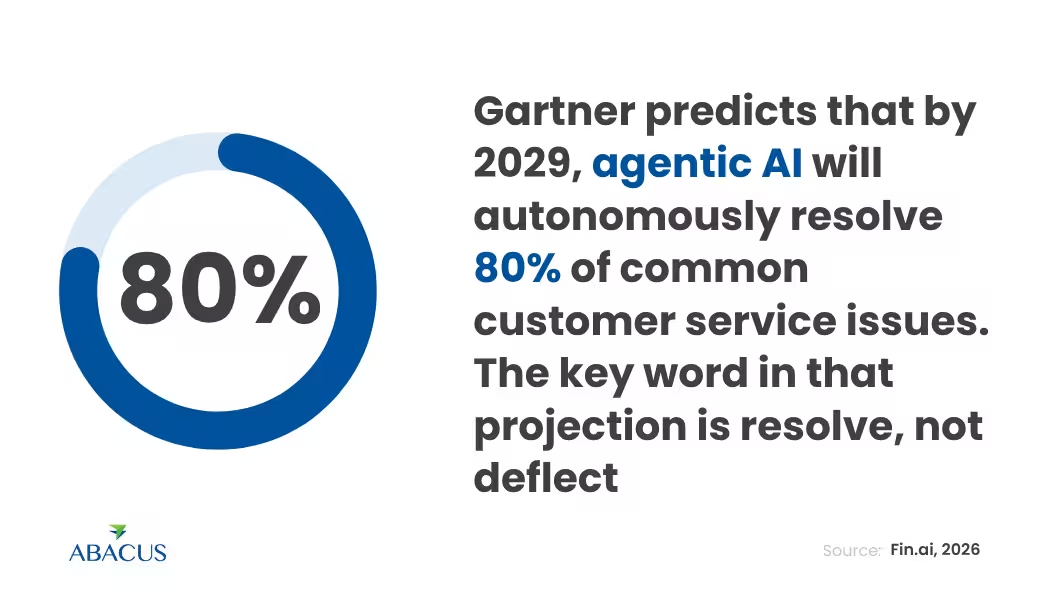
AI deployments that look successful on superficial metrics frequently underperform when the right numbers are examined. A chatbot that deflects 70% of contacts but resolves only 40% of them is generating 30 percentage points of customers who gave up, not customers whose problems were solved. Those are not the same outcome, and measuring deflection instead of resolution is the most common and most expensive measurement mistake in AI customer service investment.
This guide covers the correct ROI framework for AI in customer service operations: the metrics that actually matter, how to calculate the business case, what the 2026 benchmarks show for each measurement tier, and how to set up the reporting structure before deployment rather than reconstructing it afterward.
Why Most AI ROI Calculations Are Wrong
The standard pitch deck for AI in customer service shows one number prominently: ticket deflection rate. It looks compelling. If AI deflects 60% of tickets that would otherwise require a human agent, and each human-handled ticket costs $7.40 while an AI-handled one costs $0.62, the math looks like a massive win.
The problem is that deflection is not resolution. A customer who abandons a chatbot because it cannot solve their problem and calls back later is counted as a deflection in most standard reporting. That customer has experienced a worse outcome than if they had reached a human on the first contact, and the cost of their second contact (now emotionally escalated) is higher than a first-contact human interaction would have been.
Fin.ai's 2026 analysis of AI customer service ROI is direct on this point: measuring deflection instead of resolution is the single most common cause of teams failing to realize projected returns (Fin.ai, 2026). Resolution rate, not deflection rate, is the metric that correlates with customer satisfaction and actual cost savings.
The Four-Tier ROI Measurement Framework for AI in Customer Service
Twig's 2026 analysis of AI support ROI metrics identifies a tiered framework that addresses different stakeholder needs in a single coherent reporting structure (Twig, June 2026). The framework below integrates that structure with benchmark data from Fin.ai, MavenAGI, Helply, and DigitalApplied.
Tier 1: Resolution Metrics
These are the most fundamental metrics. They answer whether the AI is actually solving customer problems, not just handling contacts.
Autonomous Resolution Rate: The percentage of customer conversations the AI agent resolves end-to-end without any human agent involvement. This is the single most important operational metric. Targets should be set based on platform type: basic chatbots limited to FAQ deflection top out at 20 to 40%; standard AI assistants reach 40 to 60%; agentic platforms connected to backend systems and capable of taking real actions routinely achieve 70 to 85% (Helply, June 2026).
AI Resolution Accuracy: The percentage of AI-resolved interactions where the resolution was correct. The target benchmark is 85% or above. Accuracy below this threshold signals either gaps in the knowledge base, intent recognition errors, or interaction types that have been incorrectly assigned to AI handling (Twig, June 2026).
Escalation Rate: The percentage of AI-handled interactions that are transferred to a human agent. A healthy escalation rate sits at 15 to 25% (Twig, June 2026). Below 15% may indicate that AI is attempting to resolve interactions it should be escalating. Above 25% may indicate that the AI layer is not handling enough of its eligible interaction types.
Recontact Rate: The percentage of customers who contact again within 5 to 7 days after an AI-handled interaction for the same issue. A recontact rate that is measurably higher for AI-handled interactions than human-handled ones is the clearest signal that deflection is being measured instead of resolution.
Tier 2: Customer Experience Metrics
These metrics answer whether AI is delivering the customer experience quality that the business case assumed.
CSAT for AI-Handled Interactions: Benchmarks from Intercom and Zendesk show AI-handled CSAT averaging 4.10 out of 5.0 for structured interactions. That average conceals important variation: password resets score 4.41 and complaint handling scores 3.34 (DigitalApplied, April 2026). Reporting CSAT by interaction type rather than as a blended average reveals the specific areas where AI is and is not meeting customer experience standards.
Customer Effort Score (CES) for AI Interactions: CES measures how easy it was for the customer to get what they needed. For AI-human hybrid journeys, tracking CES separately for the AI-handled portion versus the human-handled portion identifies whether the AI layer is reducing or adding to customer effort. Customer Effort Score CES is particularly important for catching poor escalation design, where customers must repeat their situation after being transferred.
NPS Impact: Bain and Company research shows pure-AI handling producing minus 3 NPS points versus the all-human baseline, while hybrid models produce plus 1 point (DigitalApplied, April 2026). Tracking NPS by service model rather than as a single program-level average allows the business to quantify the loyalty impact of the hybrid architecture.
Tier 3: Cost and Efficiency Metrics
These are the metrics most commonly presented in AI business cases. They are important, but they belong in Tier 3 rather than Tier 1 because cost savings that come at the expense of resolution quality or customer experience are not genuine savings.
Cost Per Resolution: Total support costs divided by the number of issues actually resolved. This is distinct from cost per contact, which includes contacts that ended in abandonment or recontact. AI-handled resolutions average $0.62 per interaction versus $7.40 for human-handled interactions in the McKinsey AI in Customer Service 2026 sample, with chat at $0.41 and voice AI at $1.18 (DigitalApplied, April 2026).
Agent Productivity Ratio: How much more volume the existing human agent team handles after AI integration compared to before, without a proportional headcount increase. This metric proves capacity gained without new hiring, which is part of the ROI that is often excluded from cost savings calculations.
Handle Time Reduction: Average handle time reduction attributable to AI assist tools for human-handled interactions. AI knowledge management and agent assist tools reduce handle time by identifying the correct resolution path faster, surfacing account context at interaction start, and generating post-call summaries automatically. Average handle time reduction with AI chatbots is reported at 45% in comparable interaction types (WifiTalents, July 2026).
Cost Per Conversation (Total): Total blended cost including AI platform costs, implementation costs, ongoing management overhead, and the cost of human-handled interactions. This is the total cost of ownership figure that Fin.ai identifies as the correct denominator for ROI calculation (Fin.ai, 2026). Excluding platform and oversight costs from the AI cost side and including only agent cost on the human cost side produces misleading ROI comparisons.
Tier 4: Strategic and Long-Term Value Metrics
These metrics capture value that does not appear immediately in cost-per-interaction comparisons but compounds significantly over time.
Churn Rate Impact: AI enabling personalized service at scale has been linked to 19% lower churn with personalized service, according to Gitnux's BPO AI statistics (Gitnux, June 2026). Tracking customer retention rates for segments receiving AI-enhanced versus baseline service quantifies the revenue protection value of AI investment.
First-Contact Resolution Rate Improvement: Comparing FCR before and after AI integration accounts for both the interactions AI resolves autonomously and the improvement in human agent FCR attributable to AI assist tools. The 18% FCR improvement documented in 2024 industry benchmarks is a strategic metric that affects customer lifetime value, churn, and total support cost simultaneously (Gitnux, June 2026).
Data and Insights Quality: Every AI-handled interaction generates structured data: topic distribution, sentiment trends, resolution pattern analysis, and product feedback signals. This data asset compounds in value over time and is frequently excluded from ROI calculations despite being one of the most strategically valuable outputs of AI deployment at scale.

The ROI Calculation: A Practical Example
Here is a straightforward ROI calculation that accounts for total cost of ownership rather than comparing only labor costs.
Starting baseline:
- Monthly interaction volume: 50,000
- Current cost per human-handled interaction: $8.00
- Current total monthly support cost: $400,000
Post-AI deployment:
- AI autonomous resolution rate: 60% (30,000 interactions resolved by AI)
- AI cost per resolved interaction: $0.65
- AI monthly cost: $19,500
- Remaining human-handled interactions: 20,000
- Human cost per interaction (with AI assist, reduced): $6.50
- Human monthly cost: $130,000
- AI platform, implementation amortized, and oversight: $15,000 per month
- Total monthly cost post-AI: $164,500
Net monthly savings: $235,500. ROI in first year: well above 100% on this volume.
This calculation uses conservative AI deflection and a realistic platform cost. Companies report $3.50 return for every $1 invested in AI customer service, with top performers achieving 8x returns (Fin.ai, 2026). Gartner projects conversational AI will save $80 billion in contact center labor costs globally by the end of 2026 (Fin.ai, 2026).
Most organizations see positive ROI within 3 to 6 months when using outcome-based pricing models, according to Fin.ai's 2026 analysis.
AI Customer Service ROI Benchmarks at a Glance
| Metric | Benchmark or Range | Source |
|---|---|---|
| Autonomous resolution rate (standard AI) | 40% to 60% | Helply, June 2026 |
| Autonomous resolution rate (agentic platform) | 70% to 85% | Helply, June 2026 |
| AI resolution accuracy target | 85%+ | Twig, June 2026 |
| Healthy escalation rate range | 15% to 25% | Twig, June 2026 |
| Cost per AI-handled chat interaction | $0.41 | DigitalApplied, April 2026 |
| Cost per human-handled interaction | $7.40 | DigitalApplied, April 2026 |
| Handle time reduction with AI chatbots | 45% | WifiTalents, July 2026 |
| FCR improvement from AI agent assist | 18% | 2024 benchmark, Gitnux 2026 |
| NPS impact: hybrid vs AI-only vs baseline | Hybrid +1, AI-only -3 vs all-human baseline | Bain / DigitalApplied 2026 |
| Churn reduction from AI-personalized service | 19% lower churn | Gitnux, June 2026 |
| ROI per $1 invested in AI customer service | $3.50 average; up to 8x top performers | Fin.ai, 2026 |
| Time to positive ROI (outcome-based pricing) | 3 to 6 months | Fin.ai, 2026 |
| Global contact center labor cost savings from AI (2026) | $80 billion | Gartner, via Fin.ai 2026 |
Setting Up the Measurement Framework Before Deployment
The most important ROI discipline is establishing the measurement framework before deployment, not after. Setting KPI baselines, defining what counts as a resolution versus a deflection, and agreeing on the reporting structure with all stakeholders before the first AI interaction goes live prevents the retrospective disagreements that undermine post-deployment ROI claims.
The specific steps are:
Define resolution explicitly. Write down what counts as a resolved interaction for each contact type in your program. A resolved interaction is one where the customer's issue was fully addressed and no further contact was needed for the same reason. Get this definition agreed before go-live.
Establish pre-deployment baselines. Current cost per interaction, current FCR rate, current CSAT by interaction type, current handle time, and current recontact rate by contact reason. These baselines are the denominator in every ROI calculation you will make.
Build a tiered KPI reporting structure. Executive stakeholders see business impact: cost per resolution, total savings, ROI. Operations managers see operational health: containment rate, escalation rate, agent productivity. Analysts see granular signals: accuracy rate, intent recognition, confidence scores by interaction type. Keep the core set to 8 to 12 KPIs reviewed weekly, as Helply's 2026 KPI framework recommends (Helply, June 2026).
Monitor recontact rate from day one. Recontact rate is the earliest visible signal of the gap between deflection and resolution. If it increases after AI deployment, the AI layer is creating customers who gave up rather than customers whose problems were solved.
How Abacus BPO Measures AI ROI in Client Programs
At Abacus BPO, AI ROI measurement is structured into the program design before deployment begins. Baseline metrics are established in the two weeks before go-live. Resolution is defined specifically for each contact type in the program's scope. Post-deployment reporting covers autonomous resolution rate, AI resolution accuracy, escalation rate, recontact rate, CSAT by interaction type, cost per resolution, and FCR trend, reviewed weekly for the first 90 days and monthly thereafter.
Client reporting connects all AI metrics to the corresponding human agent metrics in a single unified view, so the business impact of the hybrid model is visible as a whole rather than as two separate performance streams. When AI performance falls below defined thresholds on any metric, root cause analysis is conducted within 48 hours and corrective action is documented with a defined resolution timeline.
Frequently Asked Questions
What is the most important metric for measuring AI ROI in customer service?
Autonomous resolution rate combined with resolution accuracy. These two metrics together tell you whether AI is actually solving customer problems (resolution rate) and whether it is doing so correctly (accuracy). Cost metrics are secondary because cost savings derived from deflection without genuine resolution are not real savings when recontact and churn costs are included.
What counts as a resolved interaction for AI ROI measurement?
A resolved interaction is one where the customer's issue was fully addressed in the interaction and no further contact was made by the customer about the same issue within the defined recontact window (typically 5 to 7 days). An interaction where the customer abandoned the chatbot and called back is not resolved. It is deflected.
How long does it take to see positive ROI from AI in customer service?
Most organizations see positive ROI within 3 to 6 months with outcome-based pricing models, according to Fin.ai's 2026 analysis. The timeline depends on implementation scope, the share of interaction volume eligible for AI handling, and whether platform and oversight costs are properly included in the total cost of ownership calculation.
What is a realistic autonomous resolution rate to plan for?
Basic chatbots limited to FAQ-style responses reach 20 to 40%. Standard AI assistants reach 40 to 60%. Agentic platforms with backend system access routinely achieve 70 to 85% for eligible interaction types. The right expectation depends heavily on the interaction mix: a program dominated by structured, high-volume, low-complexity contacts will sustain higher resolution rates than one with a high share of complex or emotionally sensitive queries.
How should AI performance be reported to executive stakeholders?
Executives should see business impact metrics: total cost per resolution versus the pre-deployment baseline, total monthly savings, ROI as a ratio of investment to net savings, and CSAT trend across AI and human-handled interactions. Operational and analytical metrics belong in the operational and analyst tiers of the reporting framework rather than in the executive view.