On this page
- How to handle angry customers on the phone: The verbal techniques that defuse tension
- Why contact center leaders struggle to sustain de-escalation training
- What ROI looks like when agents master emotional regulation
- Building intake processes that separate high-stress calls from routing errors
- Frequently Asked Questions
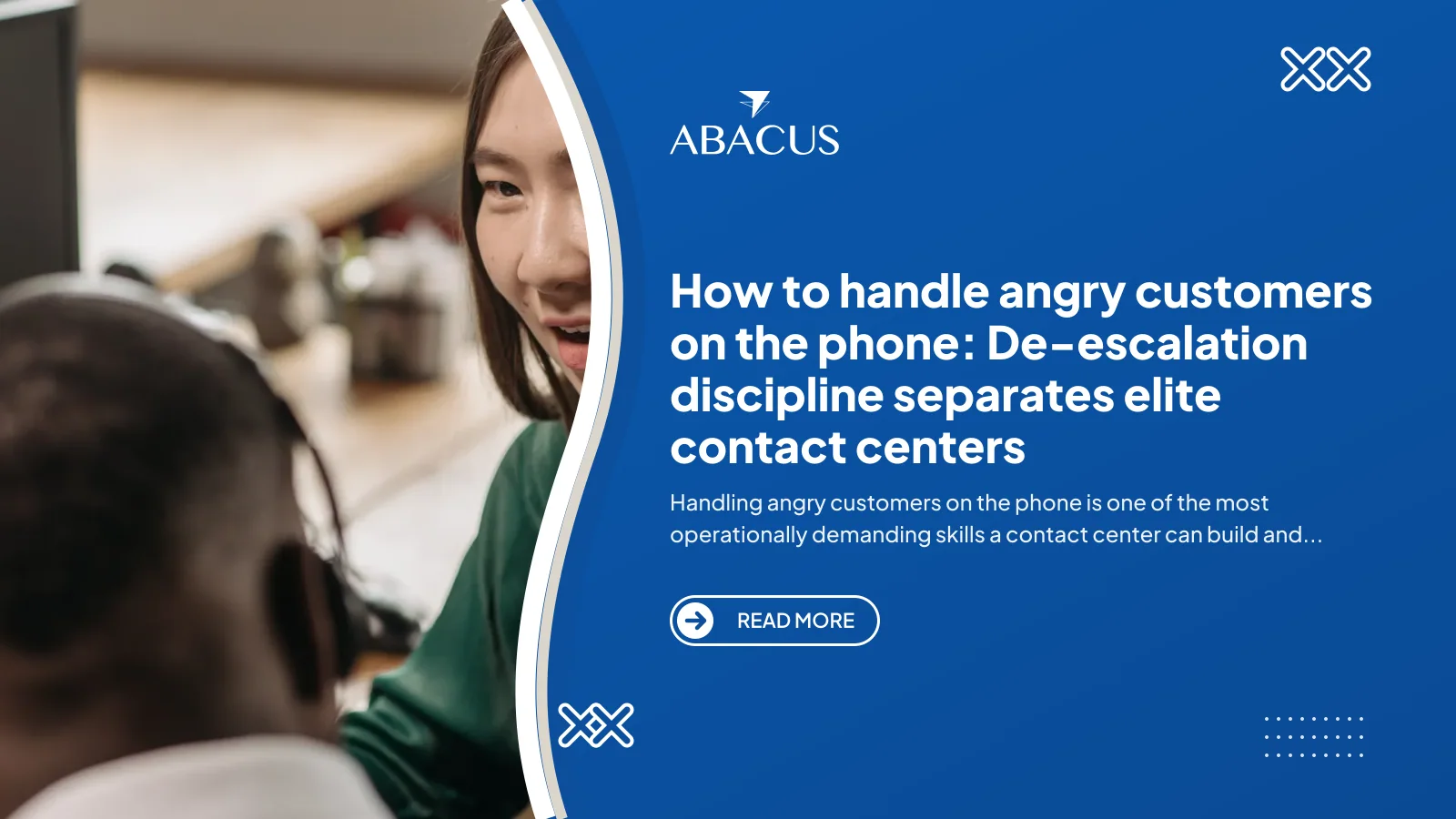
Angry callers are not an anomaly. They are a predictable, recurring feature of any contact center operation, and the teams that manage them well do not simply hire calmer agents. They build specific disciplines: phrase-level verbal techniques, reinforced in calibration, supported by intake design that catches the conditions for anger before a call even connects. The gap between a center where escalations routinely spike and one where agents routinely close difficult calls with a resolved CSAT is almost never about staffing ratios. It is about how to handle angry customers on the phone as a repeatable, coachable, measurable skill.
How to handle angry customers on the phone: The verbal techniques that defuse tension
The first mechanism to understand is the emotional acknowledgment gap. Agents who jump straight into troubleshooting before a customer feels heard consistently produce longer calls, not shorter ones. According to guidance from Compassionate Geek's de-escalation phrase library, prioritizing a calm tone and a sincere apology before any solution framing is the single most effective opening move on a high-hostility call.
Vocal pacing matters as much as word choice. Matching a raised-volume caller at their own pace amplifies hostility; deliberately dropping volume and slowing cadence pulls a conversation toward the agent's register rather than the caller's. The technique is sometimes called the vocal anchor, and it works because mirroring is neurologically compulsive: most callers unconsciously match the energy they hear back.
Phrases that structurally reduce call duration
- "I can see why that would be frustrating, and I want to fix this for you." (Acknowledgment plus commitment in one sentence.)
- "Let me make sure I have this right." (Signals active listening, slows the caller, reduces repeat-explanation cycles.)
- "What I can do right now is..." (Pivots from complaint to action without dismissing the emotion.)
- "I'm going to stay with you on this until it's resolved." (Reduces transfer anxiety, a leading driver of re-escalation.)
NICE's contact center agent guidance frames minimal encouragers, short verbal cues like "I see" and "I understand" delivered without interruption, as the structural layer beneath these phrases. They signal presence without breaking the caller's flow, which prevents the frustration that comes from feeling talked over. The trade-off is discipline: an agent who over-uses them turns acknowledgment into a reflex that callers perceive as scripted.

Why contact center leaders struggle to sustain de-escalation training
Most centers train de-escalation once, at onboarding, and measure it rarely after that. The deterioration pattern is consistent: scores improve for four to six weeks post-training, then drift as agents revert to instinctive responses under queue pressure. High occupancy is the primary accelerant. When an agent is handling back-to-back calls with under ninety seconds of wrap time, the cognitive load leaves little room for deliberate phrase selection.
The organizational factor that compounds this is calibration frequency. Teams that run calibration sessions monthly, reviewing actual difficult-call recordings against a defined de-escalation rubric, maintain technique far longer than those that calibrate quarterly or only after complaints. The session itself is less important than what it produces: a shared, specific vocabulary for what good handling looks like, so coaching conversations reference the same standard.
The behavioral factors behind skill decay
- Agents model the fastest path to call closure, not the best one, when under sustained queue pressure.
- Team leaders who were not trained as de-escalation coaches give feedback on outcomes (CSAT score) rather than technique (phrase use, pacing, transfer avoidance).
- Attrition resets the skill baseline constantly: a center with thirty percent annual attrition is effectively retraining a third of its floor every year.
De-escalation skill decay is an occupancy problem as much as a training problem. An agent managing twelve calls per hour in a shrinkage-constrained environment has no cognitive surplus for deliberate technique, regardless of what was covered in onboarding.
Abacus BPO, which has operated contact centre and back-office programmes since 2008 and holds ISO 18295-1 certification for customer contact centres, treats calibration cadence as an operational metric rather than an HR activity, tracking it alongside shrinkage and occupancy in weekly programme reviews.
What ROI looks like when agents master emotional regulation
Competitive contact centers measure de-escalation performance through three operational proxies: escalation transfer rate, first-contact resolution on complaint-type calls, and repeat-contact rate within seventy-two hours. A reduction in any of these tells a clearer story about technique improvement than a standalone CSAT survey score, which lags the interaction by hours or days and captures only the callers who respond.
Operational metrics that signal de-escalation performance
Key metrics used to measure de-escalation effectiveness in contact centers
| Metric | What it signals | Source |
|---|---|---|
| Escalation transfer rate | Frequency agents pass calls to supervisors; high rates indicate technique gaps | ReflexAI, 2024 |
| First-contact resolution (FCR) on complaint calls | Whether the root issue was closed without callback or transfer | Zendesk CX Trends, 2026 |
| Repeat-contact rate (72-hour window) | Whether unresolved emotion drove a second contact | Helply, 2025 |
| Average handle time on high-hostility call type | Shorter AHT after acknowledgment training indicates technique is working | ACXPA practitioner panel |
| Post-call survey verbatim sentiment | Qualitative indicator of whether callers felt heard, not just processed | NICE contact center guidance |
Sources: ReflexAI 2024; Zendesk CX Trends 2026; Helply 2025; ACXPA practitioner panel.
According to Zendesk\'s CX Trends 2026 report, 74% of customers find it frustrating to retell their story to different agents, which means every unnecessary transfer on a high-hostility call compounds the original frustration rather than addressing it. Reducing that transfer rate is the single fastest lever for improving customer lifetime value on complaint segments. Understanding how average handle time is defined and measured is essential for isolating whether AHT changes on difficult calls reflect genuine technique gains or simply faster disconnects.
Building intake processes that separate high-stress calls from routing errors
A significant share of angry calls are not fundamentally emotional events. They are routing failures, incorrect IVR paths, accounts flagged for the wrong queue, or customers calling back after a previous contact that left an action unresolved. Treating these as de-escalation problems places the burden on agent technique that should sit in process design instead.
A back-office pod before and after intake redesign
A twelve-agent pod supporting a fintech app\'s escalated account queries ran a consistent pattern before any intake changes: agents received calls from a general queue without prior context, discovered mid-call that the customer had already spoken to someone forty-eight hours earlier, and spent the first three minutes reconstructing that history while the caller\'s frustration compounded. Wrap-time notes were inconsistent, and the CRM flag for \'pending resolution\' was used by fewer than half the team. Three weeks after the pod introduced a mandatory prior-contact screen at call open, requiring agents to check CRM history before greeting, the average time-to-acknowledgment on returning-caller calls dropped by roughly ninety seconds. More importantly, the rate of calls escalated to the team leader in the first four minutes fell noticeably because agents were no longer caught off-guard by a situation they had no context for. The redesign required no new tooling, only a queue note discipline enforced in the morning briefing.
Intake redesign at the routing level works alongside agent technique rather than replacing it. Callers who arrive with their account history visible, their prior interaction summarized, and their issue pre-tagged to the right skill group are objectively easier to acknowledge and resolve. That upstream work is what makes the verbal techniques in section one consistently executable rather than occasionally heroic. Teams managing strategies for improving average handle time often find that intake accuracy delivers faster gains than technique coaching alone, because it removes the information-recovery phase that inflates early-call duration on difficult contacts.
Intake checks that reduce angry escalations at source
- Tag repeat-contact reasons in the IVR so agents know before answering whether the caller has been transferred or called back within seventy-two hours.
- Flag accounts with open cases in the CRM so agents open with context, not questions.
- Route calls involving billing disputes or service outages to agents with specific handling authorization, removing the \'I need to check with my supervisor\' friction that amplifies hostility.
- Document every prior-contact commitment in wrap notes, standardized to a three-field format: action promised, owner, deadline.
Frequently Asked Questions
How do you handle angry customers on the phone without escalating to a supervisor?
The key is moving through acknowledgment before attempting any solution. Phrases that name the customer's frustration explicitly, combined with a commitment to stay on the call until the issue is resolved, remove the two main drivers of supervisor escalation: feeling unheard and fearing abandonment. Agents who hold the call with clear next-step language rarely need to transfer.
What is the most effective de-escalation phrase for a very hostile caller?
"I can see why that would be frustrating, and I want to fix this for you" consistently outperforms generic apologies because it combines acknowledgment with a forward commitment. The specificity of "fix this for you" signals agency rather than sympathy alone. Delivery matters as much as wording: a slower pace and lower volume anchor the caller\'s register more reliably than the words alone.
How long does it take to train agents to handle angry customers on the phone effectively?
Initial phrase-level technique can be introduced in a single training session, but reliable execution under queue pressure takes four to six weeks of coached practice. Skill decay without ongoing calibration is near-universal, so the training timeline is less important than the reinforcement cadence that follows it.
How should contact centers measure whether de-escalation training is working?
Escalation transfer rate, first-contact resolution on complaint-type calls, and seventy-two-hour repeat-contact rate are the three most direct indicators. CSAT alone is insufficient because survey response rates on difficult calls are low and the score lags the interaction. Pairing quantitative metrics with verbatim sentiment from post-call surveys gives a fuller picture.
Can intake process changes reduce the volume of angry calls reaching agents?
Yes, and often more quickly than technique training. Routing errors, missing CRM context and unresolved prior commitments are structural sources of caller anger that arrive with the call rather than developing during it. Fixing queue tagging, enforcing wrap-note standards and routing high-stress call types to appropriately authorized agents removes a large category of preventable escalations before they reach the floor.