On this page
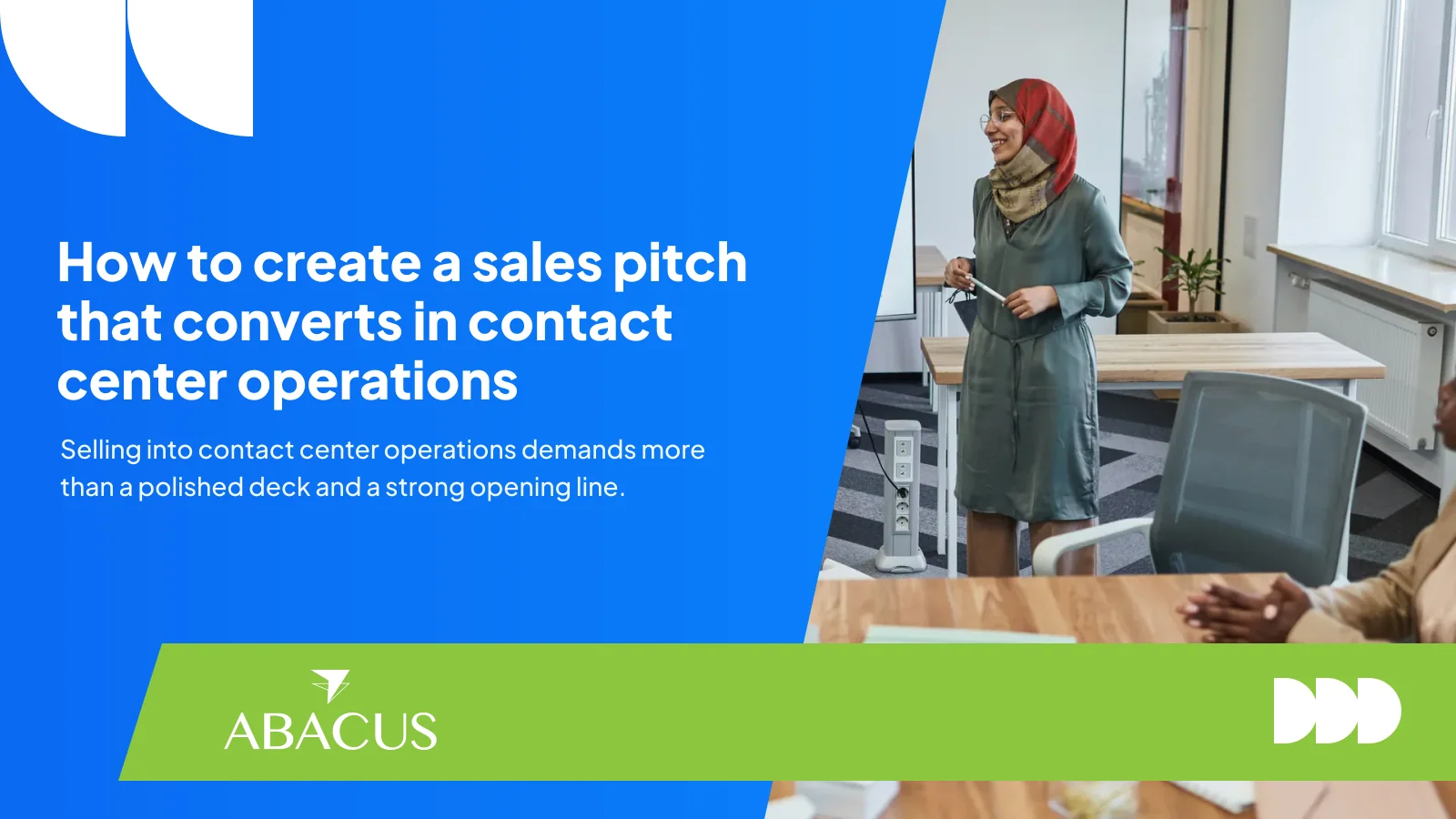
Most sales pitches aimed at contact center buyers fail before they reach the second slide. The problem is rarely the product. It is that the pitch speaks the wrong language: too much about features, too little about first-call resolution rates, shrinkage targets or the specific headache a team leader faces at 8 a.m. on a Monday when three agents call in sick and the queue is already backing up. Contact centers run on operational data, and the pitches that advance through approval layers are the ones that speak to that data directly. Knowing how to create a sales pitch for this environment means understanding the floor before you frame the offer.
How to Create a Sales Pitch Focused on Contact Center Metrics
Contact center decision-makers evaluate every vendor through the lens of their current performance benchmarks. Average handle time, first-contact resolution, occupancy rate, customer satisfaction score and agent attrition are not abstract measures for these buyers: they are the numbers that appear in their weekly business reviews. A pitch that references those KPIs with specificity signals that the seller understands the operational stakes.
Lead with the metric, then the mechanism
The most effective structure opens by naming a measurable problem the buyer recognizes, then explains the mechanism by which the solution addresses it. Stating that a tool reduces AHT is less persuasive than explaining that it surfaces the three most relevant knowledge-base articles during the first 30 seconds of a call, which removes the average 47-second hold a rep takes to search manually. The mechanism makes the claim credible.
- Name the KPI the solution directly moves: AHT, FCR, CSAT or attrition
- Describe the specific workflow step where the improvement occurs
- Tie the improvement to a second-order effect the buyer also owns, such as reduced supervisor escalations
- Avoid generic claims about productivity: contact center managers have heard them all
According to Crunchbase's sales pitch research, 45 percent of prospective buyers report a negative experience with sales representatives due to insufficient pre-call research. In contact center sales, that failure is especially visible: if a rep does not know the difference between occupancy and utilization, the credibility gap opens immediately.

Pitch framing by contact center KPI: what to emphasize and what to avoid
| KPI | What resonates in a pitch | What undermines credibility | Source |
|---|---|---|---|
| First-contact resolution (FCR) | Workflow steps that reduce transfer rates | Vague claims about agent empowerment | Allego |
| Average handle time (AHT) | Specific screen-pop or knowledge-base mechanics | Generic speed claims without a mechanism | Highspot |
| Agent attrition | Onboarding timeline and ramp period data | Culture-fit language without operational proof | Salesforce |
| Occupancy rate | How scheduling or routing logic changes the mix | Capacity promises without shrinkage discussion | Highspot |
| CSAT / customer effort score | Channel-specific resolution paths | Satisfaction guarantees with no measurement plan | Allego |
Sources: Allego; Highspot; Salesforce sales pitch examples.
Customizing Your Pitch for Different Contact Center Personas
A contact center purchase rarely involves a single decision-maker. The operations manager, the IT director and the finance stakeholder each sit at the same table, and each one is evaluating the pitch through a completely different filter. A pitch built for one will quietly lose the other two.
Operations managers: the daily-run lens
Operations managers want to know what changes on the floor and how quickly. Their primary objection is disruption: a new tool or a new vendor partner that breaks a workflow mid-shift is a visible failure they own personally. The pitch for this persona should walk through what the first day of adoption looks like, what the ramp period involves and which SLA commitments hold during transition.
IT directors: the integration question
IT directors in contact center environments are protective of the telephony stack. Their first question is almost always about API availability and CRM compatibility. Pitches that lead with business outcomes and bury the integration architecture lose this audience early. Address the technical layer directly, name the specific platforms the solution connects with, and acknowledge the testing window required before go-live.
Finance stakeholders: the operational case
Finance reviewers in contact center buying committees are not moved by feature lists. They want to understand what changes in headcount planning, in SLA penalty exposure or in training hours per new hire. Frame those operational outcomes in terms the finance team can model, without making promises about specific figures. Building a smarter B2B outbound approach starts with knowing which stakeholder controls the decision gate at each stage.
Pitching an operations manager and a finance director with the same deck is the contact center equivalent of routing every call type through a single queue: technically possible, reliably inefficient.
Overcoming Objections Specific to Contact Center Operations
Contact center buyers raise objections that are more operationally specific than most sales training anticipates. Integration complexity and training load are the two most common, and both require a prepared, detailed response rather than a reassurance.

Integration complexity
A 70-agent B2B distributor's order desk scaling to full production illustrates this well. On the first morning of a new tool rollout, the team leader arrives to find three agents unable to log into the new interface because their CRM credentials did not transfer during the overnight provisioning run. The queue is already at 14 contacts waiting. The supervisor must triage: pull two experienced agents off inbound to handle manual order entry, escalate the credential issue to IT, and notify the client of a likely SLA miss before 9 a.m. That scenario is not exceptional. It is what a poorly planned integration produces. A pitch that anticipates this and explains the pre-go-live credential audit process, the parallel-run window and the escalation protocol will land differently than one that does not.
Training and ramp time
Training objections in contact centers centre on ramp period length and on who carries the load. New agent onboarding typically competes directly with live queue coverage. When pitching a solution that requires a training investment, specify the format, the hours per agent, whether it can be done in non-peak windows and what the expected time-to-proficiency looks like. Vague references to
Frequently Asked Questions
How to create a sales pitch for a contact center audience?
Start by identifying the two or three KPIs the buyer defends in their weekly business review, then build the pitch around the specific workflow mechanism that moves those numbers. Avoid generic productivity claims and speak to the operational context: queue management, ramp periods and SLA commitments. A pitch that reads like it was written by someone who has spent time on the floor will advance faster than one that leads with features.
What KPIs should a sales pitch reference when selling to contact centers?
First-contact resolution, average handle time, agent attrition and occupancy rate are the metrics most operations managers track daily. Referencing them with a clear mechanism, explaining how the solution affects a specific step in the workflow, distinguishes a credible pitch from a generic one. CSAT and customer effort score matter most when the buyer owns the customer experience outcome directly.
How long should a sales pitch be for a contact center buyer?
Verbal pitches for contact center buyers should run no longer than 60 seconds for an opening statement, with the deeper operational detail reserved for a follow-up discovery call. Written executive summaries perform best under 120 words, according to Salesmate's pitch research. The goal at first contact is to earn the next conversation, not to close the deal.
How do you handle objections about integration complexity in a contact center pitch?
Address integration architecture before the buyer raises it, naming the specific platforms the solution connects with and the pre-go-live testing window required. Describe the credential audit process and the parallel-run period so the operations manager can visualize what the first shift looks like. Buyers who have survived a failed rollout will reward a seller who plans for the messy details.
How many stakeholders are typically involved in a contact center buying decision?
Most contact center purchases involve at least three distinct approvers: an operations manager, an IT director and a finance stakeholder, each with different priorities and objection patterns. A pitch built for only one persona will stall at the approval layer owned by another. Mapping the buying committee early and preparing persona-specific materials is one of the clearest ways to shorten the sales cycle.