On this page
- Why BPO Operations Cannot Rely on AI Alone
- How BPOs Are Structuring the Hybrid Model
- The BPO AI and Human Hybrid: Benchmark Data for 2026
- How BPO Workforce Planning Has Changed
- What Changes When AI Fails the Handoff
- Outcome-Based Pricing and the Hybrid Model
- How Abacus BPO Builds AI and Human Agent Programs
- Frequently Asked Questions
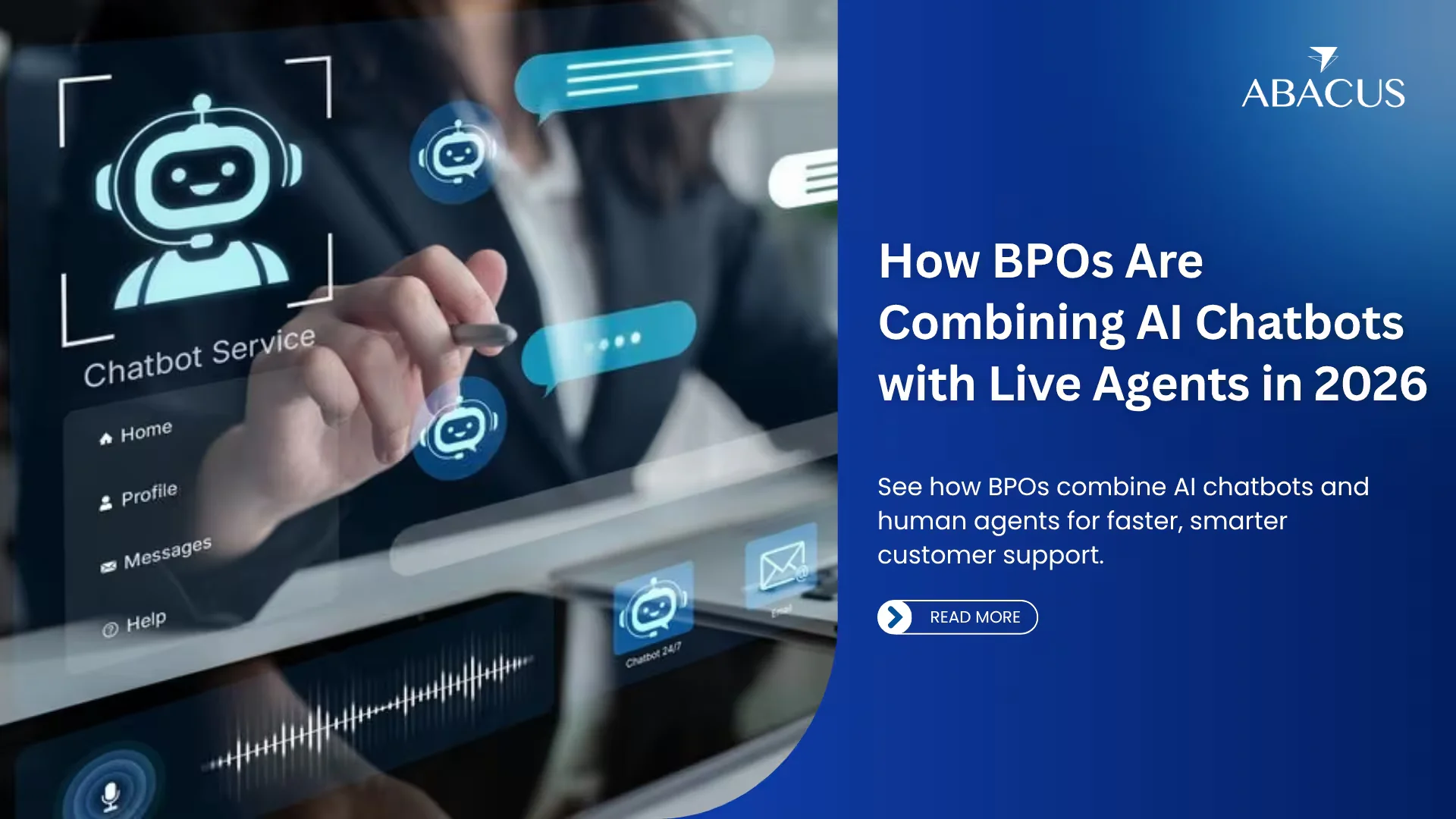
The era of "chatbot versus live agent" thinking in BPO has ended. The operations producing the strongest customer experience and cost outcomes in 2026 are not the ones that deployed AI instead of agents. They are the ones that deployed AI alongside agents, with a deliberate architecture that defines exactly where each one is responsible.
Up to 80% of routine customer interactions can now be resolved automatically with sub-3-second response times, according to BPO chat automation benchmarks published by Monobot.ai (Monobot.ai, June 2026). Yet AI chatbots only resolve a median of 41.2% of Tier 1 tickets on their own without a human backup, according to Zendesk and Salesforce CX benchmarks cited by Kore BPO (Kore BPO, July 2026). The gap between those two numbers is the business case for the hybrid model: AI resolves everything it can, and a human closes what AI cannot.
This guide explains exactly how leading BPO operations have structured the AI plus live agent combination in 2026, why the handoff quality matters more than the deflection rate, and what this shift means for how BPO programs are staffed, priced, and measured.
Why BPO Operations Cannot Rely on AI Alone
AI chatbots in 2026 are significantly more capable than the rule-based decision-tree systems that produced the poor customer experience reputation chatbots earned between 2018 and 2022. Modern agentic AI uses reasoning loops to interpret complex intent, executes multi-step backend tasks autonomously, and carries context across sessions. These are structural capability improvements, not incremental ones.
But even with those improvements, 85% of consumers still want a human for complaint-level issues, according to Qualtrics and Forbes research cited for 2026 (Kore BPO, July 2026). The AI chatbot alone model has a consistent failure mode: it handles the easy interactions well and fails the complex ones in ways that are expensive to recover from. CSAT for AI-handled complaint interactions scores 3.34 out of 5.0, against 4.10 for structured intents like password resets and account lookups (DigitalApplied, April 2026).
A contact center that deploys AI without a human escalation layer is optimizing for the 60 to 80% of volume it can deflect while degrading the experience for the 20 to 40% of customers with the most complex and highest-stakes needs. Those are frequently the customers with the highest churn risk and the most damage potential if the experience fails them.
How BPOs Are Structuring the Hybrid Model
Leading BPO operations in 2026 have settled on a layered architecture. The specifics vary by client, contact mix, and platform, but the structural logic is consistent across most mature deployments.
Tier 0: AI Self-Service and Automated Resolution
The first layer handles interactions that require no human involvement at any stage. AI agents integrated with backend systems can reset passwords, retrieve order status, process standard refunds, update account details, and provide balance information without a human agent entering the conversation at any point.
BPO chat automation benchmarks show sub-3-second response times and 24/7 availability for these interaction types (Monobot.ai, June 2026). The cost at this tier runs $0.41 to $0.70 per interaction depending on channel and platform (DigitalApplied 2026, Kore BPO 2026). Volume coverage at this tier depends entirely on interaction mix: agentic platforms connecting to backend systems routinely reach 70 to 85% containment for eligible interaction types (Helply, June 2026).
Tier 1: AI Triage, Routing, and Partial Resolution
The second layer covers interactions where AI handles the intake and initial resolution attempt but maintains awareness of escalation triggers. AI performs intent detection, collects the relevant context, attempts resolution, and monitors for signals that the interaction is exceeding its capability: sentiment shift, repeated failed resolution attempts, explicit escalation requests, or interaction types flagged as requiring human judgment.
When an escalation trigger fires, the AI transfers to a live agent with the full conversation context, the customer's account history, and a suggested resolution path already populated in the agent's interface. The customer does not repeat their situation. The agent begins where the AI left off.
This is the layer where the quality of the handoff determines whether the hybrid model delivers on its promise or produces the frustration associated with poor chatbot implementations. As Monobot.ai notes, the quality of the escalation behavior reveals more about a platform's maturity than its FAQ resolution rate (Monobot.ai, June 2026).
Tier 2: Live Human Agents with AI Assist
Human agents at this tier handle the interactions that require contextual judgment, empathy, or domain expertise beyond what the AI layer has documented as a resolution path. AI remains active during these interactions, not as the primary responder but as an assist tool: surfacing relevant knowledge base articles, flagging account notes from prior interactions, suggesting response language that matches the customer's tone, and automatically drafting the post-call summary.
42% of BPO operations were using AI for agent assistance in 2023, a figure that has grown significantly in 2026 as the tools have matured (Gitnux, June 2026). The impact on agent performance is measurable: AI knowledge management and agent assistance produced an 18% improvement in first-contact resolution in 2024 industry benchmarks (Gitnux, June 2026).
Tier 3: Specialist Escalation
The final layer handles compliance-sensitive, legally significant, or safety-critical interactions that require a specialist agent with specific domain training or regulatory authorization. This tier is staffed with the smallest headcount and the most experienced agents, and it exists because some interaction types cannot be safely handled at any lower tier regardless of AI capability.
The BPO AI and Human Hybrid: Benchmark Data for 2026
| Metric | Benchmark | Source |
|---|---|---|
| AI chatbot cost per interaction | $0.50 to $0.70 | Kore BPO, July 2026 |
| Offshore live agent cost per month | $1,200 to $3,500 | Kore BPO, July 2026 |
| AI median Tier 1 deflection (standalone chatbot) | 41.2% | Zendesk / Salesforce benchmarks, via Kore BPO 2026 |
| AI containment (agentic platform with backend access) | 70% to 85% | Helply, June 2026 |
| Routine interactions resolvable by AI automation | Up to 80% | Monobot.ai, June 2026 |
| CSAT improvement with hybrid vs AI-only model | Hybrid: +1 NPS vs baseline; AI-only: -3 NPS vs baseline | Bain and Company, via DigitalApplied 2026 |
| Organizations reporting success with hybrid model | 67% of high-performing service orgs | Qualtrics / Forbes, via Kore BPO 2026 |
| FCR improvement from AI agent assist | 18% improvement | 2024 industry benchmark, Gitnux 2026 |
| BPO cost reduction from AI integration | Up to 40% | MasCallNet.ai, April 2026 |
| Organizations using AI in active BPO engagements | 66% of BPO providers | BPO Insight Hub, May 2026 |
| AI chatbot reduce ticket volume for human agents | 45 to 50% | Atidiv, May 2026 |
How BPO Workforce Planning Has Changed
The hybrid model changes what a BPO contact center looks like from a staffing perspective. Agents are no longer measured primarily by the volume of tickets they personally close. They are measured by the outcomes of the blended team: combined resolution rate, CSAT across AI and human interactions, escalation quality, and the percentage of AI-escalated interactions resolved on the first human contact.
Job roles in BPO have shifted visibly. Agents who were handling Tier 1 volume that AI now covers have moved toward oversight, coaching, and exception handling. New roles have emerged: AI operations specialists who monitor AI performance and identify gaps in resolution logic, conversation designers who build and refine the scripts and intent models that determine what AI can handle, and quality analysts who review the AI-to-human handoffs rather than just human-to-human interactions.
Unity Connect's August 2026 analysis of AI agents in BPO notes that performance metrics now track blended team results rather than headcount alone, and that managers take on new responsibilities supervising AI output and quality alongside human agent performance (Unity Connect, August 2026).
What Changes When AI Fails the Handoff
The most consistent failure mode in hybrid BPO deployments is not AI performance on the interactions it handles. It is AI performance on the interactions it cannot handle but handles anyway. An AI agent that attempts to resolve a complex billing dispute, gets it wrong, and then escalates to a human who has to apologize for and explain the AI's response has produced a worse outcome than routing the billing dispute directly to a human agent in the first place.
The BPO operations with the strongest hybrid outcomes define escalation triggers explicitly before deployment, not based on what the AI cannot do generally but based on what it cannot do reliably for specific interaction types in the client's specific context. Confidence scoring on intent recognition, sentiment monitoring, and interaction type classification are all used to trigger escalation before a failed resolution attempt damages the customer experience.
Outcome-Based Pricing and the Hybrid Model
One of the structural changes driven by AI integration in BPO is the shift from seat-based to outcome-based pricing. When AI handles a growing share of volume, pricing a contract by the number of agent seats no longer reflects the value delivered.
66% of BPO providers now use AI tools in active client engagements, and the industry is moving toward pricing models that charge per resolution rather than per seat or per hour (BPO Insight Hub, May 2026). This pricing shift aligns provider incentives with client outcomes rather than with headcount, and it makes the ROI calculation on AI investment more transparent for the client.
How Abacus BPO Builds AI and Human Agent Programs
At Abacus BPO, the hybrid model is not a default template. It is configured specifically for each client's contact mix, interaction complexity, compliance requirements, and CSAT targets.
Before any AI tool is deployed, we map the client's actual inbound contact reasons by volume, resolution path clarity, and escalation sensitivity. This mapping determines which interaction types are eligible for AI handling at each tier, what the escalation triggers are, and what the agent interface needs to surface when an AI-to-human handoff occurs.
AI tools are configured with specific confidence thresholds below which human escalation triggers automatically. Handoff quality is reviewed in QA cycles alongside human-to-human interaction quality. The AI layer's performance is reported as part of the overall program metrics rather than as a separate technology report, because from the client's perspective, both layers are delivering one customer experience.
Frequently Asked Questions
How do BPOs decide which interactions go to AI and which go to humans?
The decision is made at program design based on contact reason analysis. Structured, high-volume, repeatable interaction types with documented resolution paths are eligible for AI handling. Interactions involving emotional complexity, financial disputes, compliance-sensitive language, or novel issues are routed to human agents. The classification is refined continuously based on escalation data and resolution outcomes.
What is the right AI deflection rate for a BPO program?
There is no universal right number. Standard chatbots handle 41% of Tier 1 tickets on their own. Agentic platforms with backend access reach 70 to 85% for eligible interaction types. The right target depends on the client's contact mix: a program with a high share of structured transactional contacts can sustain higher deflection than one where most contacts involve account disputes or technical escalations.
Does AI integration in BPO reduce the need for human agents?
It reduces the number of human-handled interactions without necessarily reducing headcount proportionally in the near term. 95% of CX leaders plan to retain human agents according to Gartner 2026 data. Human roles shift toward exception handling, coaching, and AI oversight rather than disappearing. 50% of organizations that planned to cut headcount due to AI will reverse those plans by 2027.
What makes a good AI-to-human handoff?
A good handoff transfers the full conversation context, the customer's account history, and a suggested resolution path to the human agent before the customer says another word. The customer should not have to explain their situation again. Any handoff that requires the customer to repeat information they already provided signals a gap in either the platform integration or the handoff design.
How is the hybrid BPO model priced?
Increasingly through outcome-based models: cost per resolution, per ticket closed, or per qualified interaction rather than per agent seat or per hour. This pricing structure aligns provider incentives with actual client outcomes rather than with activity volume.