On this page
- What Generative AI Does in Customer Support That Previous AI Could Not
- The Five Areas Where Generative AI Is Changing BPO Operations
- What Generative AI Does Not Change
- Generative AI in BPO: Key Statistics for 2026
- What This Means for How BPO Contracts Are Being Renegotiated
- How to Evaluate Whether a BPO Partner Is Actually Using Generative AI Effectively
- How Abacus BPO Integrates Generative AI in Client Programs
- Frequently Asked Questions
The BPO industry was built on a specific value proposition: labor cost arbitrage. Access lower-cost talent in offshore markets, deliver the same work at a lower price, and pass the savings to the client. That model is not dead, but it is under structural pressure from a technology that does not charge by the hour.
80% of customer service operations now embed generative AI in agent processes, up from just 5% a few years prior, according to Portage Perspectives' AI Disruption in Business Process Outsourcing report (Portage Invest, March 2026). 53% of service leaders said generative AI will impact customer service in the next 12 months, and 72% of business leaders believe it will affect how work is performed within their organization in the same period (Gitnux, June 2026).
The market reflects the investment. The generative AI market in BPO sectors is projected to grow at a 25.1% CAGR from 2024 to 2029 (GoodCall, May 2026). The global BPO market overall is projected to reach $434.99 billion in 2026 and $491.15 billion by 2030, with AI, automation, and cloud adoption cited as the primary growth drivers (DesignRush, May 2026).
This guide covers specifically what generative AI changes in outsourced customer support, where its impact is most significant in 2026, and what BPO buyers need to understand to evaluate whether their current or prospective partner is actually deploying it effectively.
What Generative AI Does in Customer Support That Previous AI Could Not
The distinction between rule-based chatbots, standard machine learning classification, and generative AI matters for understanding what has actually changed in BPO operations.
Rule-based chatbots follow decision trees. They match keywords to scripted responses and fail immediately when the customer's request falls outside the predefined flow. They were capable at narrow, high-confidence FAQ deflection and poor at anything requiring contextual understanding.
Generative AI operates differently. It interprets natural language at a level of contextual comprehension that is significantly closer to how a human agent reads a message. It generates responses rather than selecting from a library, meaning it can handle requests it has never seen before by reasoning from its training and the context of the current conversation. It can draft personalized responses, summarize complex interaction histories, identify the sentiment and intent behind ambiguous language, and produce structured outputs from unstructured input.
The practical implications in customer support are substantial. Gartner projects that 75% of customer interactions will be AI-powered by 2026, and the technology enabling that shift is not the chatbot of 2019 (HTC Global Services, January 2026). It is generative AI integrated into the full support workflow.
The Five Areas Where Generative AI Is Changing BPO Operations
1. Response Generation and Agent Assistance
The most widely deployed generative AI application in BPO customer support in 2026 is agent assist: AI that generates suggested responses in real time as the agent reads the customer's message. The agent reviews, edits if needed, and sends. This is not automation in the traditional sense. The human remains in the loop. What changes is the speed at which the agent arrives at a high-quality response.
3.2x improvement in knowledge worker productivity is projected from generative AI adoption, according to modeled impact data cited by Gitnux (Gitnux, June 2026). In a contact center context, that productivity multiplier means agents handle more volume at the same quality without requiring proportional headcount increases.
2. Knowledge Base Generation and Maintenance
One of the most chronic problems in customer support operations is knowledge base decay: the documentation that agents rely on for accurate responses becomes outdated, incomplete, or inconsistent over time, and nobody owns the update process rigorously. Generative AI changes this by automatically generating draft knowledge base articles from resolved interactions, flagging outdated content when new interactions contradict it, and synthesizing complex product documentation into agent-readable reference material.

The downstream impact on first-contact resolution is measurable. AI knowledge management and agent assistance produced an 18% improvement in FCR in 2024 industry benchmarks, an improvement primarily attributed to agents having better access to accurate information at the moment they need it (Gitnux, June 2026).
3. Automated Quality Scoring and Monitoring
Traditional QA in contact centers reviews a sample of interactions, typically 2 to 5%, and uses those samples to assess overall quality. The limitation is obvious: the vast majority of interactions are never reviewed. Problems that appear in the unreviewed 95% are invisible until they compound into CSAT drops or escalation rate increases.
Generative AI enables 100% coverage quality scoring. Every interaction, whether handled by AI or a human agent, can be scored against defined rubrics without requiring a human QA reviewer to listen or read each one. The outputs include sentiment scores, resolution accuracy assessments, compliance checks, and coaching flags that are generated automatically and fed into the QA workflow. This changes QA from a sampling exercise into a continuous monitoring function.
4. Post-Interaction Summarization and CRM Update
After-call work, the time agents spend summarizing interactions, logging outcomes, and updating CRM records after a conversation ends, consumes a significant share of total handle time in most contact center operations. Generative AI automates this process by generating accurate post-interaction summaries and structured CRM updates from the conversation itself, reducing after-call work time and the data quality problems that arise from manual entry under time pressure.
This is one of the generative AI applications with the most consistent and fastest ROI in BPO deployments, because it directly reduces the cost per interaction without changing the customer-facing experience at all.
5. Personalized Customer Communication at Scale
Traditional contact center responses, even well-written ones, tend toward formulaic language that makes customers feel they are receiving a template. Generative AI produces personalized responses that adapt tone, language, and content to the specific customer and their history with the brand.
A major e-commerce platform using AI-driven predictive analytics saw customer complaints drop 15% while satisfaction scores rose 20%, according to GoodCall's BPO trends research (GoodCall, June 2026). AutomateIQ's generative conversational AI solutions report automating up to 80% of routine customer interactions while cutting response times by 50% and boosting first-contact resolution by 40% (GoodCall, June 2026).
What Generative AI Does Not Change
The excitement around generative AI in BPO is warranted on capability but warrants caution on scope. Several things generative AI does not change are worth being explicit about.
The need for human oversight on high-stakes interactions. Generative AI hallucination, where the model produces confidently stated incorrect information, represents 0.34% of AI-handled tickets but is ranked as a top-three governance risk by 71% of CX leaders because each public incident is expensive (DigitalApplied, April 2026). For compliance-sensitive, legally significant, or safety-critical interactions, human oversight is not optional regardless of AI capability.
The importance of data quality as a foundation. Generative AI is only as reliable as the data it has access to. BPO programs where the knowledge base is inconsistent, the CRM data is incomplete, or the interaction history is not properly structured will produce generative AI outputs that reflect those quality problems.
The value of experienced human agents for complex cases. Human agents are not competing with generative AI for the same interactions. They are handling the cases that generative AI correctly escalates because contextual judgment, emotional intelligence, and relationship management at the level those interactions require are not yet reliably available from AI systems.
Generative AI in BPO: Key Statistics for 2026
| Metric | Statistic | Source |
|---|---|---|
| Customer service operations with genAI embedded | 80% | Portage Invest, March 2026 |
| Service leaders expecting genAI impact in next 12 months | 53% | Gitnux, June 2026 |
| GenAI BPO market CAGR 2024 to 2029 | 25.1% | GoodCall / GoodCall.com AI Agents, May 2026 |
| Productivity improvement projected from genAI adoption | 3.2x knowledge worker output | Gitnux, June 2026 |
| FCR improvement from AI knowledge management | 18% improvement | 2024 industry benchmark, Gitnux 2026 |
| Routine interactions automated with genAI solutions | Up to 80% | AutomateIQ, via GoodCall 2026 |
| Response time reduction with genAI automation | Up to 50% | AutomateIQ, via GoodCall 2026 |
| Hallucination-related complaints in AI-handled tickets | 0.34% | DigitalApplied, April 2026 |
| CX leaders ranking hallucination as top-three governance risk | 71% | DigitalApplied, April 2026 |
| Cost reduction from AI integration in BPO operations | Up to 70% reported by companies using AI | GoodCall / GoodCall.com AI Agents, May 2026 |
| BPO global market projected value 2026 | $434.99 billion | DesignRush, May 2026 |
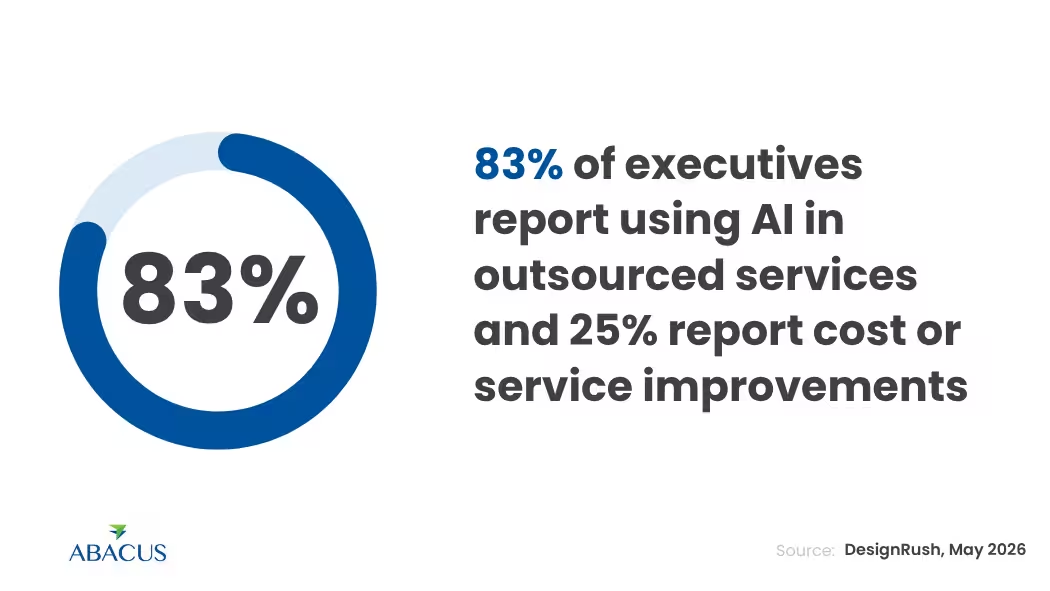
| Executives using AI in outsourced services | 83% | DesignRush, May 2026 |
What This Means for How BPO Contracts Are Being Renegotiated
Generative AI is changing the economics of BPO delivery in ways that make traditional seat-based pricing increasingly disconnected from the value actually delivered. When AI handles 60 to 80% of volume, a client paying for 20 agent seats to deliver outcomes that 6 agents with AI assist can now produce is paying for a cost model that no longer reflects the operational reality.
The BPO business model is pivoting away from seat-based outsourcing toward outcome-based pricing, a shift already underway as AI changes the cost-per-resolution equation for providers (Portage Invest, March 2026). BPO providers that embed AI platforms into client workflows and price by outcome rather than by seat are taking the contracts from providers still competing on labor cost arbitrage.
For BPO buyers, the negotiating question is shifting from "what is your agent cost per hour?" to "what is your cost per resolved interaction, and what is your resolution rate across interaction types?"
How to Evaluate Whether a BPO Partner Is Actually Using Generative AI Effectively
Generative AI appears in the marketing materials of almost every BPO provider in 2026. Evaluating whether the capability is real and deployed at production scale rather than described in a presentation requires specific questions.
Ask for the specific generative AI tools deployed in active client programs and the interaction types they handle. Ask what the AI resolution rate is for those interaction types in production, not in demos. Ask how AI quality output is monitored and what the escalation trigger logic is. Ask whether the AI assists human agents in real time or only handles fully automated interactions. Ask what the governance framework is for detecting and correcting AI errors before they reach customers.
The gap between those two numbers reflects the difference between providers that have deployed AI in a pilot and those that have integrated it at the operational level where it actually changes outcomes.
How Abacus BPO Integrates Generative AI in Client Programs
At Abacus BPO, generative AI is applied at the specific points in the support workflow where it produces the most reliable improvement in measurable outcomes: agent assist for response generation, automated QA scoring for 100% interaction coverage, post-interaction summarization to reduce after-call work time, and knowledge base maintenance to keep agent reference material accurate and current.
Each deployment is configured against the client's product context and quality standards before going live. AI outputs in agent assist workflows are reviewed by agents before being sent, maintaining human accountability for the quality of every customer-facing response. Escalation paths from AI to human agents are defined and tested for the specific interaction types in each program. Governance includes weekly review of AI quality metrics alongside human agent metrics, with the two layers reported together rather than separately.
Frequently Asked Questions
What is generative AI doing in customer support that standard chatbots could not?
Standard chatbots matched keywords to scripted responses and failed outside predefined flows. Generative AI interprets natural language contextually, generates novel responses, produces personalized communication, summarizes interactions accurately, and handles requests it has never encountered before by reasoning from context. The capability difference is structural, not incremental.
Is generative AI replacing BPO workers?
Not at the scale or speed that early projections suggested. 95% of CX leaders plan to retain human agents, and 50% of organizations that planned headcount cuts due to AI will reverse those plans by 2027 according to Gartner. Human roles are shifting toward oversight, exception handling, and complex case management rather than disappearing.
What are the risks of generative AI in customer support outsourcing?
The primary risks are hallucination (AI generating incorrect information confidently), governance gaps where AI outputs are not monitored at scale, and poor escalation design where AI attempts to resolve interactions it should have transferred to a human. All three are manageable with proper deployment architecture and ongoing monitoring.
How should a BPO buyer evaluate a provider's generative AI capability?
Ask for production resolution rates, not demo rates. Ask which specific tools are deployed in active client programs. Ask how AI quality is monitored across 100% of interactions. Ask for the escalation trigger logic for each interaction type. Ask what the governance process is for identifying and correcting AI errors.
What is the ROI timeline for generative AI investment in BPO?
Varies significantly by deployment scope. Post-interaction summarization and agent assist typically show positive ROI within 3 to 6 months because they reduce handle time immediately. Full agentic AI deployment at scale has a longer timeline that depends on integration complexity and the share of eligible interaction types in the contact mix.