On this page
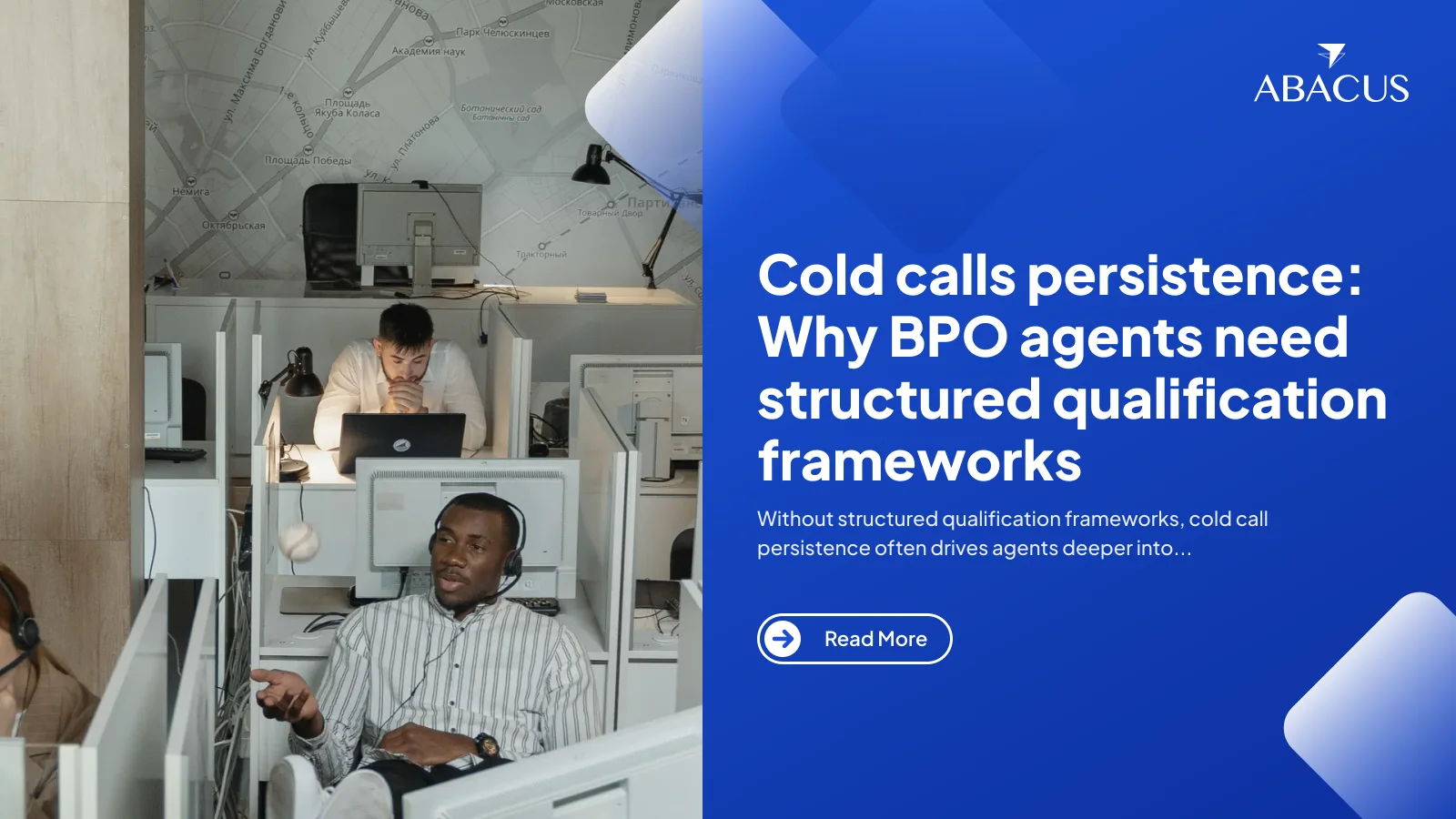
Persistence is treated as a virtue in outbound sales, almost a personality trait that separates closers from order-takers. But persistence pointed at the wrong prospect is not a strength. It is a queue management failure dressed up as hustle. The contact centre industry has spent years refining inbound routing logic, shrinkage calculations and occupancy targets, yet the equivalent rigour is rarely applied to the question of when to stop dialling acold call prospect. That gap is where most outbound programmes bleed agent capacity.
Why persistence fails without qualification frameworks
Cold calls, by definition, go to prospects who have had no prior interaction with a brand and have not expressed interest in its products or services. Starting from zero on every dial is expensive in time, and it gets more expensive the longer an agent works a prospect who was never viable. Without a framework, agents have no principled way to distinguish a prospect who is slow to commit from one who will never commit, so they default to persistence across the board.
The cost of undifferentiated effort
The practical damage shows up in handle time and pipeline velocity. An agent cycling through a list of 200 contacts without qualification criteria will spend roughly the same number of dials on a prospect outside the target segment as on a decision-maker whose role and organisation match the ideal profile precisely. That is not a motivation problem. It is a design problem.
According to Instantly.ai's B2B cold call research checklist, strategic cold calling with data-driven targeting and personalised scripts can push success rates to 10 percent or higher, compared to a baseline of 2 to 3 percent for undifferentiated dialling. The difference is not agent skill alone. It is the systematic work done before a dial is placed.
Quota pressure makes this worse, not better. When a team leader is watching conversion numbers at the end of a shift, agents redial familiar names because familiarity feels like progress. A framework removes that temptation by making disqualification an action with its own value, not an admission of failure.

Cold calls that close: Matching persistence patterns to prospect signals
Not every non-response means the same thing. A prospect who answers, asks two clarifying questions and then says they need to check with a colleague is behaving very differently from one who has gone to voicemail across five attempts spread over ten business days. Treating both the same way, either persisting with both or dropping both, destroys the discrimination that a qualification framework exists to create.
Signals that justify continued outreach
- Answered at least one call and acknowledged the product category matters to them
- Requested a callback at a specific time, even if that callback went unanswered
- Opened a follow-up email or clicked a resource link sent after an initial call
- Asked about implementation timelines or team-size requirements
Signals that trigger disqualification
- Explicit statement that a competitor contract is active and not up for review within a defined window
- Five or more voicemails with no response of any kind across two separate weeks
- Role change or departure confirmed through a social or receptionist check
- Budget cycle explicitly misaligned by more than two quarters
The distinction matters operationally because it shapes how a team leader reads a pipeline report. A prospect sitting in a ten-day follow-up cadence with positive engagement signals is a different asset from one sitting there through inertia. JB Sales notes that the cold call itself only gets the meeting. Once a qualified prospect is in discovery, a completely different skill set takes over. The framework is what earns the right to reach that stage.
Voicemail persistence beyond five attempts without a single engagement signal is not relationship-building. It is noise generation, and prospects who eventually do engage will have already formed a negative impression.

Building qualification criteria your team actually uses
A qualification framework that lives in a training deck but not in the dialler workflow is decoration. The operational requirement is that criteria are embedded in the tools agents use every minute of their shift: the CRM disposition codes, the call guide prompts and the supervisor dashboard. Anything that requires an agent to open a separate document during a live call will be skipped under pressure.
What effective implementation looks like in practice
A 300-agent outbound operation serving a property insurer ran first-notice-of-loss calls across three time zones. Before a workflow redesign, agents used a single disposition code for every unreached prospect, regardless of attempt count or prior engagement. Three weeks after the team introduced tiered dispositions tied to explicit qualification criteria, supervisors could see, in the queue view, which unreached prospects had prior positive engagement flags and which had none. Callbacks were prioritised automatically for the former group. Average attempts per disqualified contact dropped from 7.2 to 4.1 without a measurable change in the connect rate for qualified prospects, because agents were not burning dial time on contacts that the new criteria had already flagged as unviable.
Criteria that hold under quota pressure
- Binary at each decision point: yes or no, not a score that agents can game
- Tied to observable facts in the CRM, not subjective impressions of the conversation
- Reviewed in weekly calibration sessions so edge cases surface quickly
- Short enough to complete during wrap time, not after the shift ends
The distinction between hot and cold call handling also matters for criteria design. A prospect who has been re-engaged after a disqualification period needs different disposition logic than a first-touch contact, and conflating them inflates the apparent size of the active pipeline.
Abacus BPO, which has operated contact centre and back-office programmes since 2008 and holds ISO 18295-1 certification for customer contact centres, builds qualification criteria review into programme governance cycles rather than treating it as a one-time training event.
Measuring persistence ROI by qualification tier
The argument for longer sales cycles on qualified prospects only holds if the data can demonstrate it. Without tier-level reporting, a team leader cannot know whether the time invested in a prospect flagged as high-fit actually produces better outcomes than the time spent cycling through a larger pool of unqualified contacts at lower attempt counts.
Operational indicators for evaluating persistence by qualification tier
| Metric | Unqualified tier | Qualified tier | Source |
|---|---|---|---|
| Average attempts to connect | High, diminishing returns after attempt 3 | Moderate, engagement signals extend viability | Leads at Scale, 2026 |
| Success rate baseline | 2 to 3 percent without targeting | Up to 10 percent with data-driven targeting | Instantly.ai |
| Disposition accuracy | Low when single code used for all non-contacts | High when tiered codes tied to criteria | Operational best practice |
| Pipeline velocity | Inflated by stale contacts | Accurate when disqualification is active | Operational best practice |
| Agent handle time per qualified meeting | Difficult to isolate | Trackable by tier when CRM coded correctly | JB Sales |
Sources: Leads at Scale 2026; Instantly.ai; JB Sales.
The reporting structure that makes tiers visible
Tier-level reporting requires that qualification status is a field in the CRM, not a mental note in an agent's head. When status is explicit, supervisors can pull conversion rates by tier, calculate average dials per outcome for each group, and present a defensible case to programme leadership for increasing attempt limits on the qualified tier and reducing them on the unqualified one.
The goal is not to prove that cold calls work in the abstract. It is to show precisely which contacts, at which stage, with which engagement history, deserve more agent time. That is a solvable measurement problem once the tiers exist. For further context on how BPO providers approach lead qualification across different verticals, the structural principles transfer across industries even when the qualification criteria differ.
Frequently Asked Questions
What are cold calls and why do they require qualification frameworks?
Cold calls are outreach attempts to prospects who have had no prior interaction with a brand and have not expressed interest in its products. Without a qualification framework, agents have no principled basis for deciding when to persist and when to disqualify, so they spend equal effort on viable and unviable prospects. A framework converts that default behaviour into a signal-driven process.
How many cold calls should agents make before disqualifying a prospect?
The answer depends on whether the prospect has produced any engagement signal, not on a fixed number alone. An unresponsive prospect with no engagement across five attempts spread over two weeks is a different case from one who answered once and requested a callback. Frameworks typically set lower attempt caps for zero-engagement contacts and higher ones for prospects with confirmed interest signals.
What signals justify continued persistence on cold calls?
Signals that support continued outreach include answering at least one call, asking a clarifying question about the product, requesting a specific callback time, or interacting with a follow-up email. Explicit statements about an active competitor contract, confirmed role changes, or five or more unreturned voicemails with no engagement of any kind are disqualification triggers.
How does a qualification framework affect agent performance under quota pressure?
Quota pressure tends to push agents toward redial activity on familiar names because it feels productive. A framework reframes disqualification as a positive action with its own value, removing the incentive to persist without cause. When disposition codes are tied to qualification criteria in the CRM, supervisors can verify compliance in a calibration session without relying on agent self-reporting.
How should BPO operations measure whether persistence on qualified cold calls outperforms fast cycling on unqualified ones?
The measurement requires tier-level reporting in the CRM, where qualification status is an explicit field rather than an informal category. With that structure in place, supervisors can calculate dials per qualified meeting and conversion rates by tier, then compare outcomes across groups. Pipeline velocity is a useful secondary metric because it exposes stale contacts that inflate apparent funnel size without producing results.