On this page
- Why Cloud Based Call Center Technology Implementations Fail Without Formal Change Management
- The Hidden Workflow Retraining Problem Nobody Budgets For
- How BPO Vendors Exploit the Change Management Vacuum
- The Competitive Risk When Change Management Discipline Separates Winners From Stalled Deployments
- Frequently Asked Questions
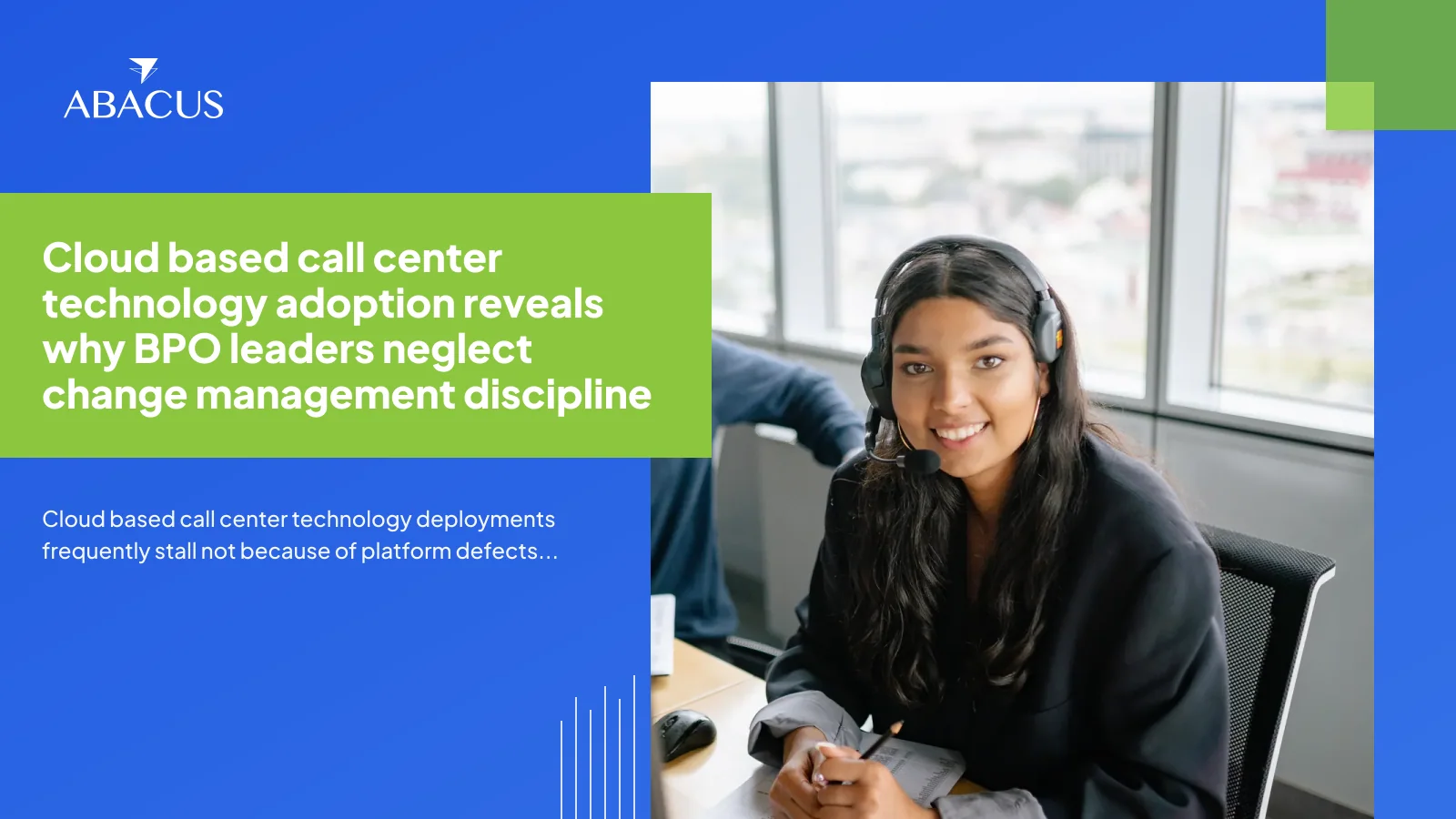
When a BPO transitions to cloud based call center technology, the sales cycle is thorough, the demos are polished, and the go-live date gets marked on every calendar. What rarely gets the same attention is the six-week stretch after go-live when queue times spike, QA scores drop, and team leaders spend more time troubleshooting login issues than coaching. That gap is not a platform problem. It is a change management problem, and the industry keeps treating it as a footnote.
Why Cloud Based Call Center Technology Implementations Fail Without Formal Change Management
The discipline gap is structural. Most BPO operations leaders are promoted for their ability to manage floor performance, not for running organizational change programmes. When a new cloud platform arrives, the natural instinct is to treat it like a hardware refresh: swap the old system, brief the team leads, and trust that agents will adapt within a few shifts. That instinct is wrong for cloud, and it is wrong in a specific way.
Why cloud transitions are categorically different
On-premise upgrades typically change one component, a new IVR module or a refreshed ACD routing table, while leaving the agent desktop and workflow patterns largely intact. A full cloud migration, by contrast, changes the authentication layer, the supervisor dashboard, the reporting cadence, the quality monitoring interface, and often the omnichannel queue logic all at once. Agents are not adapting to a new tool. They are adapting to a new operating model.
The absence of a named change owner is the most common structural failure. No single person holds accountability for readiness milestones, adoption metrics, or the feedback loop between floor observations and configuration adjustments. Without that role, problems surface in CSAT scores weeks after they could have been caught in a calibration session.
Cloud deployments that lack a designated change owner tend to discover adoption failures through customer complaints rather than through internal leading indicators, by which point the cost in handle time and quality scores is already embedded in the reporting cycle.

The Hidden Workflow Retraining Problem Nobody Budgets For
Retraining for a cloud contact centre migration is not the same as the product training that vendors provide. Vendor training covers feature navigation: how to find the wrap-up code screen, how to transfer a call in the new interface. Workflow retraining covers everything the agent does between those moments, and it is entirely the client's responsibility to design and deliver it.
How the gap shows up in practice
Consider a 12-person back-office pod handling a fintech app's chat and email queue. On a Monday morning three weeks after their cloud go-live, the workforce planner pulls up the intraday view at 9 a.m. The 8:30 interval already shows email backlog at 140 percent of target, not because volume is unusual but because average handle time has crept up by roughly four minutes per interaction. By the 10:00 interval, two agents are flagged as unavailable for periods the system is coding as auxiliary time, but the team leader suspects they are actually navigating unfamiliar queue-transfer steps that used to be a single keystroke. By noon, two tickets have been misrouted because the new platform's channel-blend logic defaults differently from the legacy system. The workforce planner cannot fix any of this in the interval view. The problem was baked in three weeks earlier when the retraining plan allocated 90 minutes to platform orientation and nothing to revised workflow procedures.
The retraining gap is almost always a budget casualty. Project plans account for the vendor's onboarding sessions but rarely for the internal labour required to map old procedures to new ones, run parallel-environment drills, or rebuild the reference guides that agents rely on during escalations. Ramp periods for cloud transitions, when no structured workflow retraining exists, run considerably longer than when a formal programme is in place, with meaningful impact on first-contact resolution and adherence rates during the first 60 days.
Operational impact indicators: structured vs. unstructured cloud transition retraining
| Indicator | Structured retraining programme | No formal retraining | Primary risk |
|---|---|---|---|
| Agent ramp period | Defined milestones, typically 2 to 3 weeks | Ad hoc, often 6 to 10 weeks | Prolonged AHT and queue build |
| Workflow procedure alignment | Old-to-new mapping completed pre-launch | Agents self-discover during live interactions | Misrouting and repeat contacts |
| QA calibration | Updated scorecards aligned to new platform behaviours | Legacy scorecards applied to new workflows | Inaccurate coaching and false compliance signals |
| Supervisor readiness | Supervisors trained ahead of agent cohorts | Supervisors learn alongside agents | No floor support during peak adoption stress |
| FCR during ramp | Protected through controlled rollout | Drops sharply in first 30 days | CSAT erosion before metrics recover |
Source: Operational criteria drawn from contact centre change management practices; no external financial data cited. For a detailed look at platform capabilities that affect retraining scope, see cloud based call center software features.

How BPO Vendors Exploit the Change Management Vacuum
Cloud platform vendors are not obligated to ensure adoption. Their contracts define go-live as the successful provisioning of the platform environment, not as the moment agents are productively using it. That distinction matters enormously, and most procurement teams miss it until a dispute arises.
Contract clauses that shift accountability to the buyer
Standard CCaaS agreements define service-level obligations around uptime, latency, and support response time. They say nothing about agent utilisation rates, adherence to configured routing logic, or the accuracy of wrap-up coding. When an operation's AHT climbs post-migration because agents are not using the new disposition workflow correctly, the vendor's SLA dashboard shows green. The platform is performing. The adoption failure is invisible to the contract.
Vendors also define training deliverables narrowly: a fixed number of administrator sessions, a self-paced e-learning library, and a hypercare period of 30 to 60 days during which escalated support is available. Once hypercare ends, any remaining adoption friction is reclassified as a client operations issue. BPO leaders who have not built internal change governance by that point find themselves without a contractual lever and without an internal programme to fall back on. Reviewing what a complete cloud based call center solution should include before signing helps clarify where vendor accountability ends and client governance must begin.
The Competitive Risk When Change Management Discipline Separates Winners From Stalled Deployments
Cloud based call center technology now underpins most competitive BPO propositions. The market for cloud contact centre platforms continues to expand rapidly, as tracked by IMARC Group's 2024 market analysis of the cloud-based contact center market, which projects sustained growth through 2034 driven by enterprise migration and AI-integrated routing. As the technology itself becomes a commodity, the differentiator is no longer which platform a BPO runs. It is how quickly and completely that BPO's workforce adopts it.
What formal change governance actually looks like
BPOs that treat change management as a parallel workstream, running alongside technical deployment rather than after it, typically define adoption readiness criteria before go-live rather than measuring damage afterwards. That means named change owners, pre-launch workflow mapping, supervisor-first training sequencing, updated QA scorecards aligned to new platform behaviours, and a 30-day post-launch feedback loop with authority to pause or adjust rollout pace.
The performance gap between these operations and those that treat adoption as self-executing shows up in three places: FCR in the first 90 days, adherence rates during the ramp window, and attrition among agents who experience early-deployment frustration as a signal about operational culture. Abacus BPO, which has operated contact centre and back-office programmes since 2008 and holds ISO 18295-1 certification for customer contact centres, treats change governance as a named delivery phase in every cloud migration, not an optional add-on. For operations leaders evaluating their own readiness, the starting point is understanding how call center technology intersects with workforce and process design before the first configuration decision is made.
The stalled deployment pattern
Operations that skip formal change governance tend to follow a recognisable trajectory: a go-live that feels smooth because volume is controlled, a gradual metric deterioration over weeks two through five, an escalation that gets framed as a platform defect, and a vendor investigation that finds no technical fault. By the time leadership accepts that the problem is adoption, the ramp period has consumed the buffer built into the project plan and the operation is managing a live-environment remediation with no structured programme in place. That is an avoidable outcome, and it is the most common one.
Frequently Asked Questions
What is cloud based call center technology and why does it require different change management than on-premise systems?
Cloud based call center technology is a customer contact platform hosted off-site and accessed via the internet, managing voice, chat, email and other channels through a unified interface. Unlike on-premise upgrades that typically change one component, a cloud migration replaces authentication, routing logic, supervisor dashboards and reporting simultaneously. That scope requires structured organisational change management, not just vendor onboarding sessions.
Why do BPO leaders consistently underestimate the change management requirements of cloud migrations?
Most BPO operations leaders are promoted for floor performance management rather than organisational change expertise, so they default to treating cloud migrations like hardware refreshes. The absence of a named change owner and the conflation of vendor product training with workflow retraining are the two most common structural failures. Both are discipline gaps, not technology gaps.
What contract clauses allow CCaaS vendors to avoid accountability for adoption failures?
Standard CCaaS agreements define go-live as successful platform provisioning, not as productive agent adoption. SLA obligations cover uptime, latency and support response time, with no reference to agent utilisation, routing accuracy or wrap-up coding compliance. Once the vendor's hypercare period ends, typically 30 to 60 days post-launch, all remaining adoption friction is reclassified as a client operations issue.
How long does the agent ramp period typically extend when no structured retraining programme exists?
Without formal workflow retraining, agent ramp periods for cloud contact centre migrations frequently run six to ten weeks, compared to two to three weeks when a structured programme with defined milestones is in place. The difference is not platform complexity but the absence of old-to-new procedure mapping and supervisor-first training sequencing. FCR and adherence metrics reflect this gap acutely in the first 30 days.
What does formal change governance for a cloud based call center technology deployment include?
Formal change governance runs as a parallel workstream alongside technical deployment, not after it. It includes a named change owner, pre-launch workflow mapping, supervisor-first training, updated QA scorecards aligned to new platform behaviours, and a 30-day post-launch feedback loop with authority to adjust rollout pace. Operations that build these elements before go-live consistently protect FCR and adherence metrics through the ramp window.