On this page
- Essential elements of a call center onboarding checklist by agent role
- Knowledge transfer sequencing that prevents early repeat calls from new agents
- Measurement checkpoints that predict which new agents will reach full productivity by day 90
- Compliance and security sign-offs required before agent access to customer data
- Frequently Asked Questions
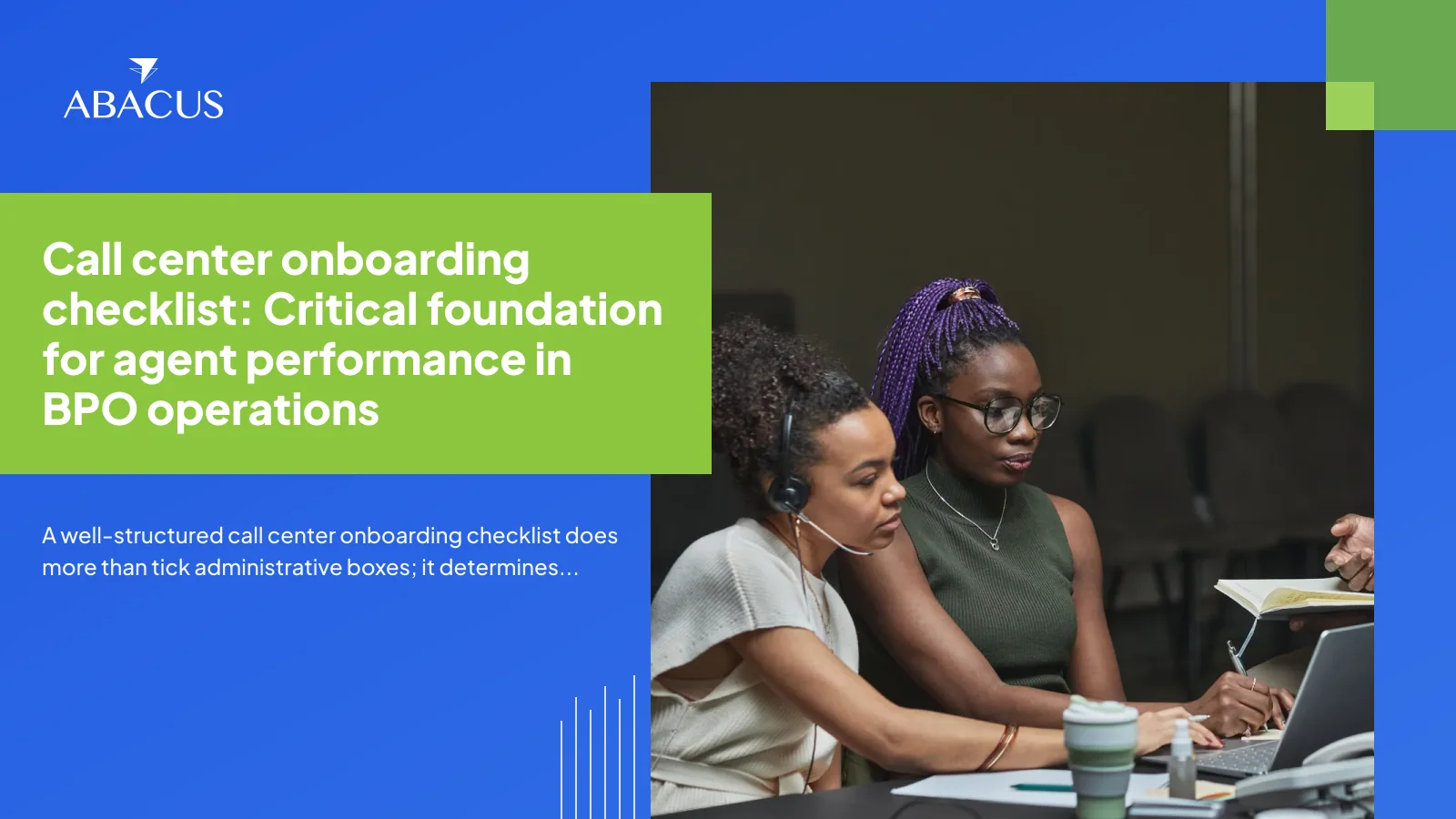
Most onboarding failures in contact centre operations are not training failures. They are sequencing failures. A new agent can sit through two weeks of classroom product training and still generate a surge of repeat contacts in week three, because the order in which information was introduced did not match the order in which decisions actually appear on a live call. The call center onboarding checklist, when built correctly, is not a documentation exercise; it is a performance architecture decision. Get the sequence right and FCR climbs from week two. Get it wrong and team leaders spend the first 90 days firefighting errors that the checklist was meant to prevent.
Essential elements of a call center onboarding checklist by agent role
Applying the same onboarding checklist to every new hire is one of the more quietly damaging practices in BPO operations. An inbound patient scheduling agent, an outbound collections agent, and a billing recovery specialist all need system access, compliance training, and product knowledge, but the weighting, depth, and gate sequence differ significantly by role. Collapsing those differences into a single generic list creates agents who are technically checked off but operationally underprepared for the calls their queue will actually generate.
Inbound support roles
Inbound agents need empathy scripting, call type taxonomy, and escalation routing before anything else. The checklist should front-load call listening hours tied to specific call categories, not generic examples. System proficiency comes second, after the agent can mentally map a call type to a resolution path.
Outbound sales roles
Outbound agents face a different cognitive sequence: they initiate the interaction, so objection handling and product positioning must be internalised before compliance disclosures are introduced. A checklist that leads with regulatory scripts before the agent understands what they are selling produces stilted calls and low contact rates.
Billing recovery roles
- FDCPA or state-specific collection regulations must be gated before first live contact, not embedded mid-checklist
- Payment system navigation requires a dedicated sandbox sign-off, separate from general CRM access
- Tone calibration, specifically how to stay compliant while maintaining rapport under payment resistance, requires dedicated role-play before go-live
According to guidance published by NICE, a structured five-point onboarding model separates technology and workspace setup, customer and product knowledge, process and compliance, skills practice, and go-live support into distinct phases rather than a single consolidated list. That separation only delivers its benefit when it is applied with role-specific content in each phase, not role-agnostic material.

Knowledge transfer sequencing that prevents early repeat calls from new agents
Repeat contact generated by new agents is one of the most reliable indicators that onboarding knowledge was transferred in the wrong order. The agent knew the right answer eventually, but could not retrieve it quickly enough in the moment, so the customer called back. Fixing that is a sequencing problem, not a content problem.
The practical sequence for a 30-day ramp follows the shape of a live call, not the shape of a training catalogue. Day one through five should cover call type identification and the top five customer intents for that queue. Days six through fifteen introduce the CRM and the specific decision trees tied to those intents, with supervised practice before unsupervised access. Product system depth, escalation logic, and edge-case handling come in weeks three and four, once the agent has a mental model of the common path and can distinguish a deviation from it.
Where the sequencing breaks
The most common failure point is introducing exception handling too early. When a new agent learns about account holds, payment disputes, and regulatory escalations in week one alongside standard scheduling or inquiry flows, those edge cases crowd out the high-frequency knowledge the agent needs for the first 200 calls they will ever take. Edge cases should appear in week three, anchored to the base knowledge already built.
Agents who can correctly identify call type within the first ten seconds of a contact handle exceptions faster by week four than agents who learned exception logic first, because the classification reflex is already automatic.
A 90-agent operation running day and overnight shifts on a healthcare provider's patient scheduling line illustrated this during a weekly ramp review. The team leader pulled up a first-week call-type accuracy report on the quality dashboard and found that overnight agents, who had received condensed training due to shift constraints, were misclassifying referral calls as general scheduling at nearly twice the rate of day-shift agents. The decision in that meeting was not to add training hours but to reorder the overnight checklist so that referral-call taxonomy came before appointment-modification flows, which were lower volume but had consumed the first training days. By week three, the classification gap had closed. The call center performance metrics team monitored the correction in real time rather than waiting for a 30-day aggregate.
Measurement checkpoints that predict which new agents will reach full productivity by day 90
Day-90 FCR and handle time targets are lag indicators. By the time an agent misses them, three months of ramp investment has already been spent. The more useful discipline is identifying leading signals in weeks one through four that forecast whether a given agent is on a trajectory toward standard performance, or whether they need a corrective intervention before the gap becomes structural.

Week one and two signals
- Call-type identification accuracy: agents who correctly classify call type at first listening above a threshold rate in week one tend to reach FCR targets by day 60
- Wrap time: excessive post-call work in week two is a CRM navigation problem, not a knowledge problem, and needs a targeted system session rather than general coaching
- Escalation rate: a new agent escalating more than twice the team average in week two is encountering call types not covered in their first-phase training
Week three and four signals
By week three, monitoring shifts from classification to resolution. Agents who handle the most common intents without supervisor intervention by day 21 consistently reach handle time targets by day 75. Those still requiring mid-call support at day 21 almost always need checklist remediation, not generic coaching. Nextiva's onboarding guidance identifies KPI goal clarity from day one as a predictor of agent engagement and performance consistency, which aligns with the operational finding that agents who understand what full productivity looks like before week one ends are easier to course-correct when early signals diverge from that standard.
Early onboarding signals and their day-90 performance associations
| Week | Signal | What it predicts | Intervention if off-track | Source |
|---|---|---|---|---|
| 1-2 | Call-type accuracy | FCR trajectory by day 60 | Reorder taxonomy training | NICE onboarding model |
| 1-2 | Wrap time | CRM navigation readiness | Targeted system session | c2perform onboarding playbook |
| 2 | Escalation rate vs team average | Call-type coverage gaps | Supplemental call listening | Nextiva onboarding guide |
| 3 | Unsupervised resolution rate | Handle time by day 75 | Checklist remediation review | NICE onboarding model |
| 4 | Quality score on monitored calls | CSAT stabilisation by day 90 | Calibration session with QA lead | Nextiva onboarding guide |
Source: NICE call center onboarding checklist; Nextiva agent onboarding guide; c2perform onboarding playbook.
Understanding how call center quality assurance integrates with ramp-period measurement determines whether these early signals are acted on in time or only surfaced in retrospective reporting.
Compliance and security sign-offs required before agent access to customer data
Compliance gates are the one part of the call center onboarding checklist where sequencing is not negotiable. An agent who begins handling live calls before completing data handling and security attestations creates documented regulatory exposure, regardless of how well they perform on quality monitoring. The gate must close before the access is granted, in that order, every time.
Required sign-offs before PII access
- Data handling policy acknowledgement tied to the specific regulation governing that queue: HIPAA for healthcare, PCI DSS for payment-taking lines, TCPA acknowledgement for outbound dialling
- Screen-capture and call-recording consent training, with confirmation the agent understands when disclosure is required to the customer
- Password and access credential policy sign-off, documented in the HR or workforce management system, not held only on paper
- Phishing and social engineering awareness completion, confirmed with a scored assessment, not just attendance
Documentation that must exist before go-live
Every sign-off must be timestamped and stored in a retrievable format that can be produced in the event of a regulatory inquiry. Verbal confirmation or a supervisor initialism on a paper sheet does not satisfy the documentation standard for most regulated environments. The compliance record and the system access provisioning log should be cross-referenced so that any agent whose access was granted before the sign-off date can be identified immediately.
Abacus BPO, which has operated contact centre and back-office programmes since 2008 and holds ISO 27001, ISO 27701, and ISO 18295-1 certifications, treats compliance gate completion as a hard dependency in its provisioning workflow rather than a parallel track, precisely because parallel tracks allow access to outpace documentation. That dependency structure is replicable in any operation that manages provisioning through a ticketing or workforce system with field-level sequencing.
Frequently Asked Questions
What should a call center onboarding checklist include for a new inbound agent?
A role-specific call center onboarding checklist for inbound agents should cover call-type taxonomy, system access and CRM navigation, escalation routing, compliance attestations, and supervised call practice before go-live. The order matters: call-type identification and product knowledge should precede system training, which should precede edge-case handling. Generic checklists that treat all inbound roles identically tend to produce agents who are administratively complete but operationally underprepared.
How long should call center agent onboarding take before an agent handles live calls?
Most structured BPO programmes use a 10- to 15-day pre-live period for standard inbound roles, longer for regulated queues involving HIPAA or PCI DSS compliance requirements. The more important measure is checklist completion quality, not calendar duration: an agent who has completed all compliance gates, demonstrated call-type identification accuracy, and passed a CRM navigation assessment is ready regardless of day count.
Which early metrics predict whether a new agent will reach full productivity by day 90?
Call-type identification accuracy in weeks one and two, wrap time as a proxy for CRM navigation confidence, and escalation rate relative to the team average are the three most reliable leading indicators. Agents who resolve the most common call intents without supervisor support by day 21 consistently reach handle-time and FCR targets by day 75 to 90. These signals allow team leaders to intervene with targeted remediation before the ramp period closes.
What compliance sign-offs are required before a new call center agent can access customer data?
Before accessing any personally identifiable information, agents must complete and document data handling policy acknowledgement, relevant regulatory training for that queue such as HIPAA or PCI DSS, screen-capture and call-recording disclosure training, and a scored phishing awareness assessment. All sign-offs must be timestamped and cross-referenced against system access provisioning logs to confirm that access was not granted before documentation was complete.
How does a call center onboarding checklist differ between outbound sales and billing recovery roles?
Outbound sales checklists should sequence objection handling and product positioning before compliance disclosures, since the agent initiates the interaction and must understand what they are selling before regulatory scripts are meaningful. Billing recovery checklists must gate collection-law compliance training, specifically FDCPA or applicable state regulations, before any live contact, and require a separate sandbox sign-off for payment system navigation in addition to general CRM access.