On this page
- What AI Customer Service Agents Can Do in 2026
- Where AI Agents Consistently Outperform Human Agents
- Where Human Agents Still Win in 2026
- AI vs Human Agents: Side-by-Side Comparison
- The Hybrid Model: What the Data Says
- How Abacus BPO Structures AI and Human Agent Operations
- Frequently Asked Questions
The debate around AI customer service agents versus human agents has largely been resolved by the data. The answer is neither one alone.
79% of Americans still strongly prefer interacting with a human over an AI agent for customer service overall, according to a SurveyMonkey study of 2,017 US adults (SurveyMonkey, February 2026). Yet Gartner's March 2025 research predicts agentic AI will resolve 80% of common customer service issues without a human by 2029, with a corresponding 30% reduction in operating costs (Chatbase, June 2026).
Those two facts are not in conflict. They describe different parts of the same contact mix. The business challenge is not choosing between AI and human agents. It is designing the architecture that puts each one in front of the interaction types where it actually performs better.
This guide breaks down exactly what the 2026 data shows about where AI wins, where humans win, and how to build the model that combines both.
What AI Customer Service Agents Can Do in 2026
The capability of AI in customer service has changed significantly in the past two years. The current generation of AI agents is not limited to FAQ deflection. Agentic AI systems now carry context across sessions, connect to backend systems to take real actions, and handle multi-step resolution flows without escalation.
The performance data reflects this evolution. AI agents resolve 70% of routine customer inquiries without human involvement, according to WifiTalents' verified benchmark data (WifiTalents, July 2026). Average handle time drops by 45% with AI chatbots in comparable interaction types. Voice AI now handles 19% of inbound contact center volume in 2026, up from 6% in 2024, with banking and telecoms leading adoption (DigitalApplied, April 2026).
The cost differential is stark. AI resolutions average $0.62 per interaction versus $7.40 for human agents across the McKinsey AI in Customer Service 2026 sample, with chat interactions averaging $0.41 and voice AI averaging $1.18 (DigitalApplied, April 2026).
CSAT for AI-handled tickets is now at 4.10 out of 5.0 on average for structured intents like password resets (4.41) and refund status (4.32), according to Intercom's Customer Service Trends 2026 data (DigitalApplied, April 2026). For these interaction types, the human-versus-AI quality gap has effectively closed.
Where AI Agents Consistently Outperform Human Agents
AI outperforms human agents across a specific and well-defined category of interactions: those that are structured, predictable, high-volume, and do not require contextual emotional judgment.
The strongest use cases for AI in 2026 are:
- Tier 0 and Tier 1 query resolution: Password resets, account lookups, order status, balance inquiries, and appointment confirmations all follow deterministic resolution paths that AI handles faster and more consistently than a human agent
- 24/7 availability without staffing cost: AI operates continuously without fatigue, shift premiums, or coverage gaps. 51% of consumers say they prefer bots over humans when they want immediate service (Zendesk CX Trends 2026, via Zendesk.com)
- High-volume triage and routing: AI handles initial intent detection, collects context, and routes interactions to the right tier or agent before a human is ever involved, reducing misrouted contacts and handle time for the agents who do get involved
- After-call and post-interaction work: Automated call summarization, CRM updates, and follow-up task creation free human agents from administrative overhead that adds no customer value
- Real-time agent assist: AI surfaces knowledge base articles, suggested responses, and relevant account context during live human interactions, improving first-contact resolution without replacing the human in the conversation
Where Human Agents Still Win in 2026
Despite the capability advances, 84% of consumers believe human agents are more accurate than AI, and 89% believe companies should always offer the option to speak with a human (SurveyMonkey, February 2026). The reason is not nostalgia. It is a recognition that certain interaction types genuinely require human capabilities that AI has not matched.
CSAT for AI-handled interactions drops significantly in emotionally sensitive categories: complaint handling scores 3.34 out of 5.0 and billing disputes score 3.61 under pure AI handling, compared to 4.10 for structured intents (DigitalApplied, April 2026). Customer satisfaction scores are 23% higher with human agents for complex issues (Central Tact, July 2026).
Human agents remain the better option for:
- Complex, multi-system troubleshooting: Issues that do not follow a single documented resolution path require improvisation and judgment that current AI cannot reliably replicate
- Emotionally charged interactions: Customers reporting safety incidents, major financial disputes, or experiences that have caused genuine distress need to feel heard before they will accept any resolution. Empathy cannot be simulated to the standard that retention-critical interactions require
- High-stakes account and relationship conversations: Retention calls, escalated complaints, enterprise account management, and situations where the outcome determines whether a customer stays or churns benefit from the relationship intelligence that human agents develop over time
- Regulatory and compliance-sensitive interactions: In healthcare, financial services, insurance, and legal contexts, the liability of an AI agent providing inaccurate information is significantly higher than the cost of routing to a human specialist
- Novel or ambiguous issues: AI performs well on known interaction types with documented resolution paths. Truly novel problems, those that have not appeared in the training data or the knowledge base in their current form, require human problem-solving
AI vs Human Agents: Side-by-Side Comparison
| Dimension | AI Customer Service Agents | Human Customer Service Agents |
|---|---|---|
| Availability | 24/7, no coverage gaps or shift premiums | Limited to staffed hours; 24/7 requires shift management |
| Response speed | Sub-3 seconds for most interactions | 2 to 8 minutes average first response for live chat |
| Cost per interaction | $0.41 to $1.18 (AI-handled) | $5.20 to $15.00 depending on channel and complexity |
| CSAT for structured interactions | 4.10 to 4.41 out of 5.0 | Comparable when available and knowledgeable |
| CSAT for complex/emotional interactions | 3.34 to 3.61 out of 5.0 | Significantly higher; 23% above AI for complex issues |
| Scalability | Scales instantly with volume | Scales with hiring and training cycles |
| Consistency | Identical quality on every interaction | Varies with agent experience, fatigue, and mood |
| Complex problem-solving | Limited to known resolution paths | Strong; adapts to novel and ambiguous situations |
| Empathy and emotional intelligence | Improving but not yet reliable for high-stakes interactions | Essential strength; directly affects retention |
| Compliance and regulated interaction handling | High risk without guardrails; hallucination rate ~0.34% | Appropriate with proper training and oversight |
| Best interaction type | Structured, high-volume, repeatable Tier 0 to Tier 1 | Complex, emotional, high-value, compliance-sensitive |
Sources: DigitalApplied 2026, SurveyMonkey 2026, WifiTalents 2026, Central Tact 2026
The Hybrid Model: What the Data Says
The evidence in 2026 consistently favors hybrid models over either pure-AI or pure-human setups. NPS impact from pure-AI handling runs at minus 3 points against the all-human baseline, while hybrid models produce plus 1 point above that baseline (Bain and Company, via DigitalApplied 2026). Companies implementing hybrid models report 85% success in combining both approaches (Atidiv, May 2026).
50% of organizations that planned to cut support teams due to AI will reverse those plans by 2027, according to the same research.
The architecture that consistently outperforms both extremes works like this:
- AI handles first contact across structured, high-volume Tier 0 and Tier 1 interactions. Volume deflection ranges from 41% with standard chatbots to 70 to 85% with agentic platforms that connect to backend systems (Helply, June 2026)
- AI escalates with context when it detects complexity, frustration, or interaction types outside its resolution capability. The quality of this handoff determines whether the hybrid model succeeds or fails
- Human agents handle escalations with full interaction context already loaded, so the customer never has to repeat their situation
- AI assists human agents in real time by surfacing knowledge base content, account history, and suggested responses during live interactions, improving resolution accuracy without replacing the human
This structure has produced an 18% improvement in first-contact resolution attributed specifically to AI knowledge management and agent assistance in 2024 industry benchmarks (Gitnux, June 2026).
How Abacus BPO Structures AI and Human Agent Operations
At Abacus BPO, every client program is designed around the specific contact mix the client's customers actually generate, not a generic AI-first or human-first default.
In practice, this means mapping the client's inbound contact reasons by volume, complexity, and emotional sensitivity before any technology or staffing decision is made. Structured, high-volume interaction types with documented resolution paths are configured for AI handling. Interaction types involving financial disputes, service failures, compliance-sensitive language, or high-value account relationships are staffed for human agents with AI assist tools active during the interaction.
Every escalation path is defined and tested before the program launches. AI tools are deployed with specific confidence thresholds below which human escalation is triggered automatically. Agent coaching is structured around the interaction types where humans are expected to add the most value, not the ones AI could handle but has not been configured to.
Frequently Asked Questions
Will AI replace human customer service agents?
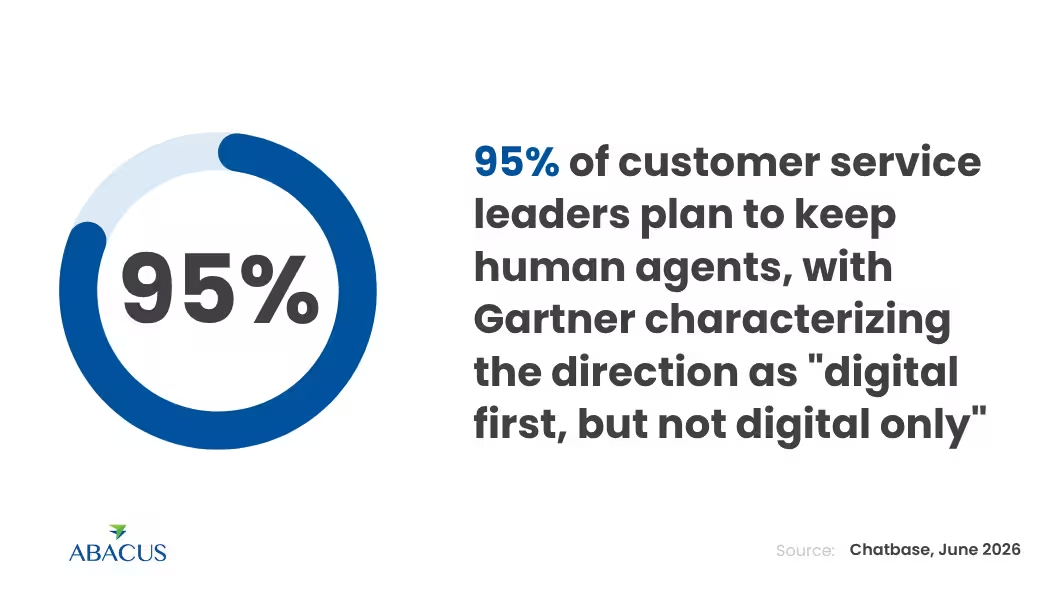
Not in any complete sense, and not on any near-term timeline supported by current research. 95% of customer service leaders plan to retain human agents according to Gartner's 2026 data. The trajectory is toward AI handling a growing share of structured, routine interactions while human agents take on a higher-value, more complex portfolio of work.
What types of interactions should be routed to AI?
Structured, high-volume, repeatable interactions with documented resolution paths: password resets, order status, balance inquiries, appointment scheduling, and basic troubleshooting are where AI performs at or above human quality levels at a fraction of the cost.
What types of interactions should always go to a human agent?
Complex multi-system issues, emotionally charged complaints, safety incidents, compliance-sensitive conversations, high-value account retention discussions, and any interaction type where an incorrect AI response creates significant legal or financial risk.
What is the cost difference between AI and human agent interactions?
AI resolutions average $0.62 per interaction compared to $7.40 for human-handled interactions, across the McKinsey 2026 sample. Even at conservative deflection rates, the cost difference at scale is substantial. The ROI case for AI investment becomes more complicated when oversight costs, implementation, and model maintenance are included in the total cost calculation.
How do customers actually feel about AI in customer service?
The data is nuanced. 51% prefer bots when they want immediate service. 79% prefer humans overall. 89% want the option to reach a human always available. Customers reward AI when it resolves their issue quickly and resent it when it prevents them from reaching a human for an issue that needs one.