On this page
- What Are Advanced Analytics Services?
- Advanced Analytics vs. Traditional Business Intelligence
- The Four Types of Advanced Analytics Services
- The Core Techniques Inside Advanced Analytics Services
- Business Applications of Advanced Analytics Services in 2026
- What to Look for When Evaluating Advanced Analytics Service Providers
- How Abacus BPO Applies Advanced Analytics in Client Programs
- The Bottom Line
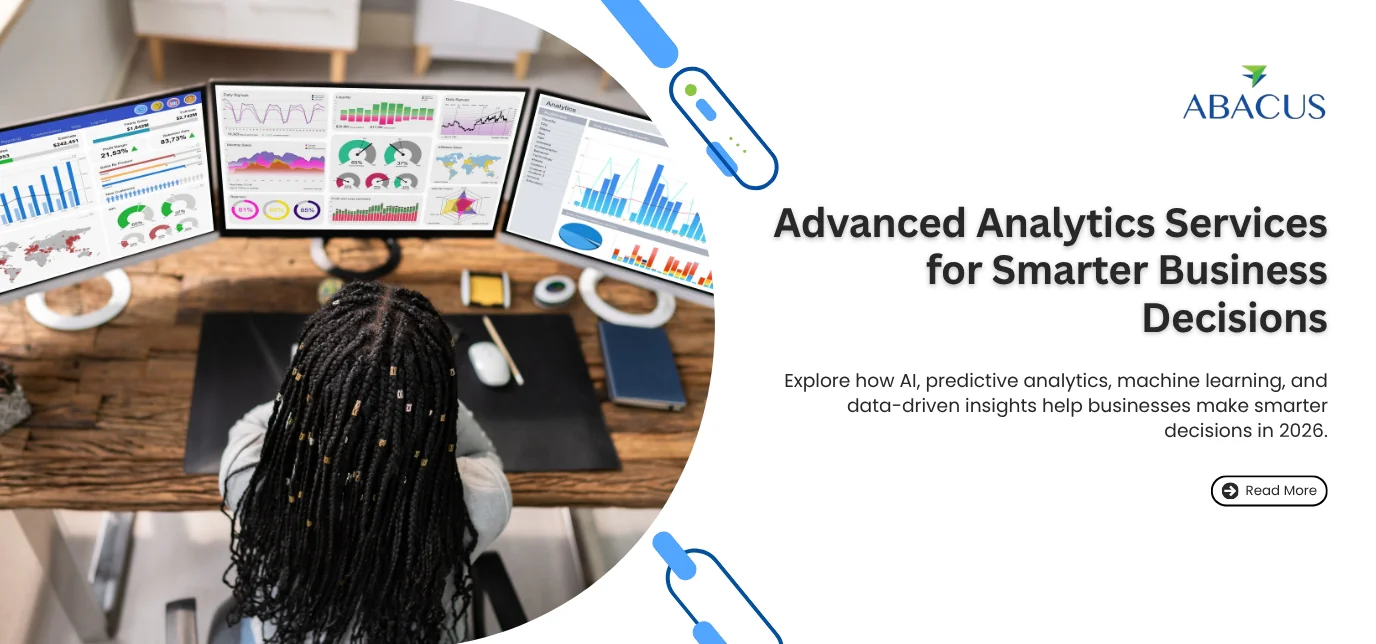
Traditional business reporting tells you what happened. Advanced analytics tells you what is likely to happen next, why it happened in the first place, and what action is most likely to change the outcome. That is a meaningful difference, and in 2026, it is becoming the primary distinction between organizations that use data well and those that simply produce more of it.
The high-performance data analytics market is expected to grow from $48.28 billion in 2020 to $187.57 billion in 2026, registering a compound annual growth rate of 25.4%. This growth reflects a market-wide recognition that competitive advantage is no longer about having the most data. It is about having the most capable analysis applied to it.
At Abacus BPO, advanced analytics sits inside the operational intelligence layer of every client program: from contact center performance modeling and agent productivity analysis to customer satisfaction forecasting and campaign outcome prediction. This guide covers what advanced analytics services actually include, how they differ from traditional business intelligence, the types that matter most in business contexts, and what to look for when evaluating a provider.
What Are Advanced Analytics Services?
Advanced analytics is the process of using complex machine learning and visualization techniques to derive data insights beyond traditional business intelligence. Modern organizations collect vast volumes of data and analyze it to discover hidden patterns and trends. They use the information to improve business process efficiency and customer satisfaction. With advanced analytics, you can take this one step further and use data for future and real-time decision-making.
Advanced analytics is an umbrella term referring to a range of data analysis techniques used primarily for predictive purposes, such as machine learning, predictive modeling, neural networks, and artificial intelligence. Businesses employ advanced analytics to forecast future outcomes and guide their decision-making, not just to gain business insights. Organizations use advanced analytics for a wide range of purposes, including to identify emerging market trends, reduce bias in decision-making, and anticipate complex market dynamics.
Advanced analytics services, as a category of outsourced or consulting-delivered capability, provide businesses with the tools, models, and analytical expertise to move beyond historical reporting toward forward-looking insight. They typically include model development, data pipeline architecture, visualization, interpretation, and ongoing analysis support.

Advanced Analytics vs. Traditional Business Intelligence
The distinction between advanced analytics and traditional business intelligence is one of the most commonly confused in the data industry, and it has direct implications for what a business actually needs to buy.
Traditional business intelligence focuses on historical data and uses common analytics techniques such as data visualization, data mining, statistical analysis, and reporting to create actionable insights based on current and historical data. Advanced analytics aims to forecast future events and behaviors, encompassing predictive analytics, machine learning, data mining, and big data analytics to uncover patterns and predict outcomes.
| Dimension | Traditional Business Intelligence | Advanced Analytics |
|---|---|---|
| Primary question answered | What happened? | What will happen? What should we do? |
| Data orientation | Historical, descriptive | Predictive and prescriptive |
| Core techniques | Dashboards, reports, SQL queries, visualization | Machine learning, statistical modeling, NLP, neural networks |
| Output type | Summaries, trends, comparisons | Probability scores, forecasts, recommended actions |
| Analyst skill required | Data analyst, BI developer | Data scientist, ML engineer, statistician |
| Decision type supported | Review and monitoring | Strategic planning, real-time intervention |
| Example in BPO context | Call volume report by hour | Predicting call volume three weeks ahead based on campaign, seasonality, and historical patterns |
| Time orientation | Backward-looking | Forward-looking |
| Suitable for | Operational monitoring, performance reporting | Risk modeling, demand forecasting, customer churn prediction |
The most mature data operations in 2026 use both. Business intelligence provides the operational reporting layer. Advanced analytics builds the predictive and prescriptive models on top of it.
The Four Types of Advanced Analytics Services
Advanced analytics is not a single technique. It covers a family of analytical approaches, each suited to a different level of complexity and a different type of business question.
Descriptive Analytics
Descriptive analytics summarizes historical data to answer "what happened." It is the foundation of business intelligence dashboards, performance reports, and KPI monitoring. While often considered basic relative to the other types, descriptive analytics is the data quality and accuracy layer that determines whether advanced models produce trustworthy results. Models built on poorly structured descriptive data fail in predictable ways.
Diagnostic Analytics
Diagnostic analytics investigates why something happened by drilling into the data behind a trend or anomaly. Root cause analysis, cohort comparisons, and drill-down reporting fall into this category. In a contact center context, diagnostic analytics might identify why first-contact resolution dropped by 8% in a specific channel during a specific period.
Predictive Analytics
Predictive analytics uses historical data to predict future outcomes. Techniques include statistical modeling, machine learning algorithms, and regression analysis.
Predictive analytics capabilities can help an organization be more efficient and increase its accuracy in decision-making. Using advanced analytics can confirm or refute prediction and forecast models with better accuracy than traditional BI tools.
Predictive analytics is the type most commonly associated with advanced analytics services. Applications include customer churn prediction, demand forecasting, lead scoring, risk modeling, and staffing optimization.
Prescriptive Analytics
Prescriptive analytics goes further than prediction to recommend specific actions based on predicted outcomes. It answers not just "what will happen?" but "what should we do about it, and what are the expected outcomes of each option?"
Prescriptive analytics suggests actions based on predictive analytics findings.
In practice, prescriptive analytics powers recommendation engines, automated decision workflows, and dynamic pricing models. In BPO operations, it drives automated routing decisions, real-time staffing adjustments, and proactive retention outreach triggered by predictive churn scores.
The Core Techniques Inside Advanced Analytics Services
Understanding what tools advanced analytics services actually deploy helps businesses evaluate whether a provider's capabilities match their specific needs.
- Machine learning (ML): Machine learning is a form of artificial intelligence concerned with building analytic models capable of autonomous learning. To create machine learning models, algorithms are trained using large data sets that incrementally alter the algorithm with each iteration. ML underpins most modern predictive and prescriptive analytics applications.
- Natural language processing (NLP): ccording to Statista, the global NLP market, valued at $3 billion in 2017, is projected to reach $43 billion by 2025, reflecting its exponential growth across industries such as customer service, healthcare, and business analytics. NLP processes text and voice data: customer feedback, chat transcripts, call recordings, and social media content, converting unstructured language into structured analytical inputs.
Predictive modeling and regression analysis. Statistical models that quantify the relationship between variables and use those relationships to forecast future values. Call volume forecasting, sales pipeline modeling, and customer lifetime value prediction all rely on these techniques.
Cluster analysis and segmentation. Techniques that group data points by similarity without predefined categories. Used for customer segmentation, market mapping, and anomaly detection.
Time series analysis. Specialized modeling for data that varies over time, such as call volumes, transaction counts, and demand patterns. Crucial for accurate staffing and resource planning in contact center environments.
Neural networks and deep learning. Advanced ML architectures used for complex pattern recognition in large datasets. Most applicable in voice analytics, image recognition, and highly non-linear prediction problems.
Business Applications of Advanced Analytics Services in 2026
The range of business functions where advanced analytics delivers measurable value has expanded considerably. Here is how it maps to the most common operational challenges:
Contact center and BPO operations. Predictive call volume modeling enables accurate staffing weeks in advance rather than relying on recent trend extrapolation. Agent performance modeling identifies the drivers of first-contact resolution and CSAT, allowing targeted coaching rather than generic training. Customer churn prediction flags at-risk accounts before they cancel.
Sales and revenue operations. Lead scoring models trained on historical conversion data prioritize outreach toward the prospects most likely to convert. Opportunity scoring within the sales pipeline identifies which deals are at risk of stalling and where the highest-probability revenue sits. Sales forecasting models reduce the end-of-quarter variance between predicted and actual revenue.
Marketing analytics. Attribution modeling identifies which channels and touchpoints are actually driving revenue rather than just clicks. Audience segmentation models identify high-value customer profiles for lookalike targeting. Campaign performance prediction supports budget allocation decisions before campaigns launch.
Risk and compliance. Anomaly detection models identify unusual patterns in transactional or interaction data that signal fraud, compliance violations, or data quality issues. In regulated industries, predictive risk models support proactive compliance management rather than reactive response.
Workforce management. Attrition prediction models identify employees at risk of leaving before they resign, enabling proactive retention conversations. Performance prediction models forecast likely outcomes for new hires based on historical cohort data.
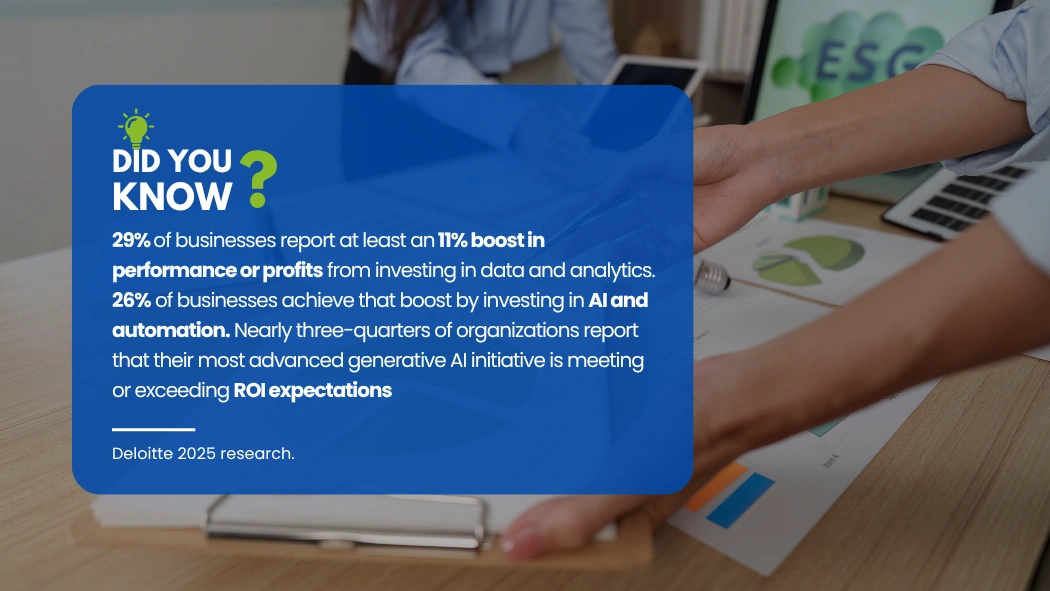
29% of businesses report at least an 11% boost in performance or profits from investing in data and analytics. 26% of businesses achieve that boost by investing in AI and automation. Nearly three-quarters of organizations report that their most advanced generative AI initiative is meeting or exceeding ROI expectations, according to Deloitte 2025 research.
What to Look for When Evaluating Advanced Analytics Service Providers
Advanced analytics is a broad category, and provider capabilities vary considerably. Before engaging a provider, these are the questions that separate genuine analytical depth from a dashboard reskin.
- What analytical methods do they actually use? A provider who describes their work primarily in terms of visualization and reporting tools is delivering business intelligence, not advanced analytics. Advanced analytics providers should be able to describe specific modeling approaches and explain why each is appropriate for the problem at hand.
- How do they validate model accuracy? Every predictive model should have a defined accuracy metric and a testing methodology. Providers who cannot explain how their models are tested against held-out data are producing models of unknown reliability.
- How is data quality managed before modeling? 68% of augmented analytics implementations fail for companies under 500 employees without proper data quality baselines. A 45% failure rate for self-service analytics exists when governance frameworks are not established first. The most common reason advanced analytics programs underperform is not the model. It is the data going into it.
- What does the output actually look like? Advanced analytics should produce insights that are specific, actionable, and connected to business outcomes. Generic trend reports with no decision implications are not advanced analytics output. They are reporting dressed in a more expensive platform.
- Can they show results from comparable programs? Industry-specific case studies with measurable outcomes are the most reliable signal that a provider has applied their methods in a context similar to yours.
How Abacus BPO Applies Advanced Analytics in Client Programs
Advanced analytics is built into the operational intelligence layer of every Abacus BPO client program. In practice, this means:
- Predictive call volume modeling using time series analysis on historical interaction data, allowing staffing to be calibrated to expected demand rather than recent actuals
- Agent performance models that identify the specific variables, call type, experience level, training recency, shift timing, most strongly associated with CSAT and first-contact resolution outcomes
- Customer churn prediction models built on interaction history, satisfaction trends, and engagement signals, supporting proactive retention outreach for clients running recurring-revenue programs
- Lead scoring and pipeline health models for clients running B2B outbound programs, prioritizing outreach toward the highest-fit, highest-intent prospects in the contact base
- Campaign outcome prediction that supports pre-launch strategy decisions rather than requiring full campaign execution before knowing which approaches are likely to perform
The Bottom Line
Advanced analytics services have moved from a competitive differentiator to a baseline expectation for any organization serious about operational performance. The question is no longer whether to use predictive and prescriptive analytics. It is whether the models being built are reliable, the data going in is clean, and the outputs are connected to decisions that change outcomes.
Advanced analytics can confirm or refute prediction and forecast models with better accuracy than traditional BI tools. Faster decision-making follows directly because improving the accuracy of predictions allows executives to act more quickly with confidence that their decisions will achieve the desired results.
For any organization evaluating analytics services, the right starting point is not the technology platform. It is the operational problem. Start with the decision that needs to be made better, work backward to the data required to support it, and then determine what analytical method is most appropriate. That sequence produces useful analytics. The reverse sequence produces expensive dashboards.