On this page
- The Problem AI Is Actually Solving
- 1: Conversational AI and Intelligent Self-Service
- 2: Real-Time Agent Assist - AI Working Alongside Humans
- 3: Predictive Analytics - Moving From Reactive to Proactive
- 4: AI-Powered Quality Management
- 5: Agentic AI - The Next Phase US Businesses Are Preparing For
- What Separates Successful AI Deployments From Expensive Failures
- How Outsourcing Accelerates AI Adoption for US Businesses
- The Bottom Line
A customer contacts support at 11pm on a Sunday, explains a billing issue once, gets a precise answer in under two minutes, and never speaks to a human. They hang up - or rather, close the chat window - completely satisfied.
Five years ago, that experience was a product demo. In 2026, it is a Tuesday night for thousands of US businesses that have embedded artificial intelligence into their contact center operations.
But here is what most articles about AI and contact centers get wrong: they frame it as a story about replacing people. The real story - the one playing out in operations centers across the country - is about something more nuanced. It is about using AI to make every customer interaction faster, more accurate, and more human, not less.
This is how US businesses are making that happen.
The Problem AI Is Actually Solving
Before discussing the technology, it helps to understand the pressure US contact centers were under before AI entered the picture.
Average handle time was climbing. Agent burnout and turnover were at historic highs - the average US contact center loses between 30% and 45% of its agent workforce every year. Customer expectations, shaped by experiences with Amazon, Apple, and Uber, had reset the baseline for what "good service" means. And the volume of contacts was not decreasing - it was growing across more channels simultaneously.
The math stopped working. Hiring more agents to handle more volume at higher wages was not a sustainable model. Something structural had to change.
AI did not arrive as a magic fix. It arrived as a set of very specific tools that, when deployed correctly, address very specific friction points in the contact center workflow. Understanding which tools solve which problems is where most US businesses are now focused.
1: Conversational AI and Intelligent Self-Service
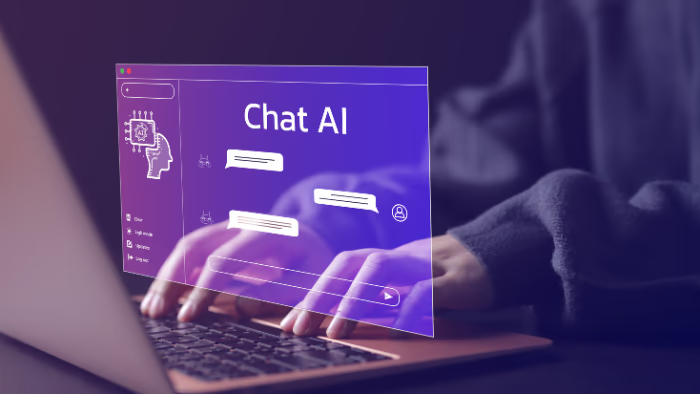
The most visible application of AI in US contact centers today is conversational AI - the technology powering virtual agents, smart IVR systems, and chat assistants that can hold genuine back-and-forth conversations rather than following rigid decision trees.
Unlike the frustrating phone bots of the previous decade, modern conversational AI is built on natural language processing (NLP) that understands intent, not just keywords. A customer who says "I was charged twice last month and I'm pretty annoyed about it" and a customer who says "billing error on my account" are expressing the same need. A modern AI system handles both correctly.
For US businesses, this matters most in three scenarios. First, after-hours coverage - AI handles contacts at 2am without staffing a night shift. Second, peak volume absorption - during high-demand periods like holiday retail seasons or open enrollment windows in healthcare, AI deflects routine contacts so human agents focus on complex ones. Third, multilingual support - NLP-powered systems can serve Spanish, Mandarin, and French-speaking US customers without specialized agent hiring.
The benchmark that matters here is containment rate - the percentage of contacts fully resolved by AI without escalation. High-performing US deployments are hitting 60–70% containment on routine inquiry types, which translates directly into significant cost savings and faster resolution for the majority of customers.
2: Real-Time Agent Assist - AI Working Alongside Humans
Not every contact can or should be handled without a human agent. Complex complaints, emotional conversations, high-value account issues - these require judgment, empathy, and relationship awareness that AI cannot replicate end-to-end.
What AI can do is make human agents dramatically more effective in real time.
Real-time agent assist tools listen to live conversations - voice or text - and surface relevant information exactly when the agent needs it. When a customer mentions a specific product issue, the system instantly pulls the relevant troubleshooting steps. When a conversation begins escalating in tone, sentiment analysis flags it for the agent or supervisor before the situation deteriorates. When a call ends, AI generates the post-call summary automatically, eliminating the after-call work (ACW) that typically consumes 3–5 minutes per interaction.
The cumulative effect on performance metrics is substantial. US contact centers using agent assist tools consistently report reductions in average handle time of 15–25%, improvements in first call resolution (FCR) rates, and meaningful decreases in the time new agents need to reach full productivity.
That last point is particularly valuable for US businesses dealing with high turnover. When a new agent has AI surfacing the right answer in real time, the gap between a six-month veteran and a six-week newcomer narrows considerably.
3: Predictive Analytics - Moving From Reactive to Proactive
The traditional contact center model is fundamentally reactive. A customer has a problem, they reach out, the contact center responds. Every step in that chain has a cost attached.
Predictive analytics flips that model.
By analyzing historical interaction data, purchase behavior, service patterns, and real-time signals, AI can identify customers who are likely to have an issue before they call. A US e-commerce company, for example, might use predictive models to flag orders showing shipping delay indicators and proactively notify those customers - eliminating the inbound contact entirely.
Similarly, AI-driven workforce management forecasting uses historical volume patterns and external variables like weather, promotions, and seasonal demand to predict contact volumes at 15–30 minute intervals. This enables precise scheduling that eliminates the twin cost problems of overstaffing during quiet periods and understaffing during peaks.
For US businesses managing contact center services across multiple channels and time zones, this kind of predictive capability is no longer a competitive advantage - it is a baseline requirement for cost-efficient operations.
4: AI-Powered Quality Management

Traditionally, contact center quality assurance meant supervisors manually reviewing a small sample of recorded calls - typically 2–5% of total volume - and scoring them against a rubric. The problem is obvious: 95% of interactions went unreviewed, and feedback loops were slow.
AI changes this completely.
Automated quality management tools can analyze 100% of interactions - every call, every chat, every email - and score them against quality criteria in real time. Compliance violations are flagged immediately rather than discovered weeks later. Coaching opportunities are identified systematically rather than randomly. Patterns across thousands of interactions reveal systemic issues that no human reviewer could detect from a sample.
For US businesses operating in regulated industries - healthcare, financial services, fintech - this capability carries particular weight. Compliance is not optional, and AI-powered QA creates the audit trail and oversight consistency that manual processes simply cannot provide at scale.
5: Agentic AI - The Next Phase US Businesses Are Preparing For
While most of the AI applications above are already operational in leading US contact centers, the next wave is beginning to take shape: agentic AI.
Agentic AI systems do not just respond to customer requests - they take autonomous action to resolve them. An agentic system handling a billing dispute does not just acknowledge the issue and flag it for human review. It checks the account, verifies the discrepancy, initiates the refund, updates the CRM record, and sends the customer a confirmation - all within a single interaction.
Gartner projects that by 2029, agentic AI will autonomously resolve 80% of common customer service issues without human intervention. US businesses that are building their contact center infrastructure on cloud-native, API-connected platforms today are the ones who will be positioned to deploy agentic capabilities as they mature.
The critical lesson from early US deployments is that agentic AI works best when it operates within clearly defined boundaries with transparent escalation paths. Customers tolerate AI that acknowledges its limits and hands off gracefully far better than AI that confidently gives wrong answers.
What Separates Successful AI Deployments From Expensive Failures
With all the momentum behind AI in contact centers, it is worth being direct about something: most early AI deployments underdeliver.
Research from Qualtrics found that nearly one in five US consumers who interacted with AI-powered customer service saw no benefit from the experience. A separate analysis found that 95% of AI pilots fail to scale beyond proof of concept.
The pattern behind successful US deployments is consistent. They start with a specific, measurable problem rather than a broad mandate to "implement AI." They define success in concrete terms - reduce AHT by 20%, improve FCR by 10 percentage points, achieve 60% self-service containment - and measure against those targets from day one. And critically, they invest as much in agent training and change management as they do in the technology itself.
AI does not transform a contact center. Deliberate implementation of AI, within a broader operational strategy, does.Therefore AI with strategy is what is important now!
How Outsourcing Accelerates AI Adoption for US Businesses
One of the most practical paths for US mid-sized businesses to access AI-powered contact center capabilities without the capital investment and implementation risk is through a specialized outsourcing partner.
Modern contact center services providers have already built AI infrastructure into their operations - the conversational AI platforms, the agent assist tools, the automated QA systems - and they deploy that infrastructure on behalf of their clients from day one.
For a US business that would otherwise spend 12–18 months evaluating vendors, integrating systems, and training staff, outsourcing compresses that timeline to days. The AI is already working. The agents are already trained. The performance metrics are already being tracked.
This is why an increasing number of US businesses in healthcare, e-commerce, and fintech are choosing to partner with specialized BPO providers rather than build AI contact center capabilities internally - particularly when their core business is not customer service operations.
The Bottom Line
AI is not coming to US contact centers. It is already there, and the gap between businesses using it effectively and those still running on traditional models is widening every quarter.
The question for US business leaders is not whether to incorporate AI into customer support operations. It is how to do it in a way that genuinely improves the customer experience rather than just cutting costs at the customer's expense.
The businesses getting it right share a common philosophy: AI handles volume, speed, and consistency. Humans handle complexity, emotion, and judgment. Together, they deliver something neither can achieve alone.
If you are evaluating how AI-powered contact center operations could work for your US business, reach out to Abacus BPO for a free consultation. Our teams are already delivering these outcomes for clients across healthcare, e-commerce, and financial services - and we can show you exactly what that looks like in practice.